
Cephus cinctus
Norton
Wheat Stem Sawfly, Western Wheat-stem Sawfly
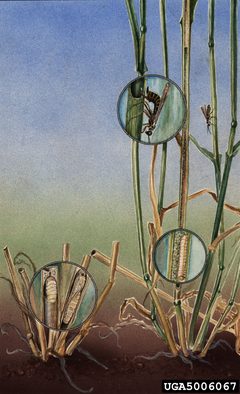
Cephus cinctus, the wheat stem sawfly, is a destructive pest of cereal crops in North America. are slow-flying with yellow and black coloration. Females lay in wheat and other grass stems, where larvae bore through pith tissue, eventually cutting stems at ground level and causing lodging. The has an obligatory larval and typically produces one per year, though some individuals may complete a two-year cycle under certain conditions.
Pronunciation
How to pronounce Cephus cinctus: //ˈsɛfəs ˈsɪŋktəs//
These audio files are automatically generated. While they are not always 100% accurate, they are a good starting point.
Identification
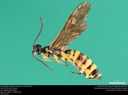
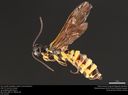
Distinguished from other Cephus by geographic distribution and associations. Larvae can be distinguished from caterpillars by having six or more pairs of (caterpillars have five or fewer) and lacking (hooked structures on prolegs that caterpillars possess). are recognized by the combination of black body with yellow abdominal bands, smoke-colored wings, and yellow legs.
Images
Appearance
are small , 7–12 mm in length, with males smaller than females. Body is black with yellow bands on the . Wings are smoke-colored. Legs are yellow. The ovipositor is saw-like, with teeth resembling a saw blade. Larvae are legless, creamy-white adapted to boring within plant stems.
Habitat
Agricultural fields and grassland dominated by large-stemmed grasses. Found in wheat, barley, rye, and native grassland . Larvae develop entirely within plant stems.
Distribution
Native to northeastern Asia; introduced and now established in western and northern North America. Chronic pest in the Northern Great Plains of the United States (Montana, North Dakota, South Dakota, Nebraska, Colorado) and the Canadian Prairies (Alberta, Saskatchewan, Manitoba). Also present in British Columbia and Ontario.
Seasonality
emerge in late spring to early summer (May–June) to mate and oviposit. Larvae feed through summer, migrate to stem bases in mid-to-late July, and cut stems in late summer. Larvae overwinter in within stubble. Some individuals may extend diapause to two years.
Diet
Larvae feed on parenchyma tissue within stems of large-stemmed grasses. do not feed significantly.
Host Associations
- Triticum aestivum - primary common wheat
- Triticum durum - durum wheat
- Hordeum vulgare - barley
- Secale cereale - rye
- Agropyron spp. - wheatgrass
- Phleum spp. - timothy
- Elymus spp. -
- Bromus tectorum - cheatgrass
Life Cycle
Complete . Females deposit singly into stems using a saw-like ovipositor. Unfertilized eggs develop into males (); fertilized eggs develop into females. Larvae progress through instars while boring through stem parenchyma. Mature larvae migrate to stem bases, cut a notch around the inner circumference, plug the exposed end, and form a cocoon. Obligatory as mature larvae; diapause termination requires specific temperature regimes involving two factors (x and y factors). occurs in spring; emerge to restart the cycle. Normally , but some individuals may require two years.
Behavior
are slow fliers with limited capacity; they concentrate at field margins when densities are high. Larvae exhibit negative and positive geotaxis when migrating to stem bases. Cutting is triggered by light transmission changes through ripening stems and moisture loss. Larvae prefer drier sites for cutting and cocoon formation. When disturbed, larvae may exhibit defensive postures.
Ecological Role
Major agricultural pest causing significant yield losses in wheat production. are regulated by , (only one larva can mature per stem), by braconid wasps (Bracon cephi), hyperparasitism, and environmental mortality. No significant positive ecological role documented.
Human Relevance
Destructive economic pest of wheat, barley, and rye. Reduces yields through stem lodging, reduced weight, diminished grain quality, lower protein content, and seed shriveling. Management is complicated by the concealed within stems, rendering largely ineffective. Control relies on cultural practices (tillage of infested stubble), ( ), and (solid-stemmed wheat varieties). methods are being developed to estimate field- .
Similar Taxa
- Cephus pygmaeusEuropean wheat stem sawfly; distinguished by geographic distribution (Palearctic vs. Nearctic)
- Cephus tabidusAnother North American Cephus ; distinguished by subtle morphological differences and preferences
- Lepidopteran caterpillarsLarvae resemble caterpillars but have six or more pairs of and lack ; C. cinctus larvae develop within stems rather than externally on foliage
More Details
Diapause physiology
involves two elimination factors: the x factor (requires subdevelopmental temperatures, positive temperature coefficient up to developmental threshold) and the y factor (eliminated at low or moderate temperatures, positive coefficient up to ~30°C). When x factor elimination is complete but y factor persists, larvae can re-enter diapause under high temperatures or moisture stress, resulting in occasional two-year .
Host plant resistance mechanism
Solid-stemmed wheat varieties resist because pith-filled lower internodes cause high larval mortality. Hollow-stemmed varieties allow survival. The amount and distribution of pith determines resistance level; shading can reduce stem solidness and compromise resistance.
Reproductive biology
Haplodiploid sex determination: unfertilized produce males, fertilized eggs produce females. Females carry an average of 32.7 eggs. is influenced by larval plant conditions.
Sources and further reading
- BugGuide
- Wikipedia
- GBIF taxonomy match
- iNaturalist taxon
- NCBI Taxonomy
- A Good Morning for a Bee | Bug Squad
- Rosie defoliators: Roseslug sawfly, Endelomyia aethiops, Curled rose sawfly, Allantus cinctus, and Bristley rose sawfly, Cladius pectinicornis — Bug of the Week
- Rosie defoliators - Roseslug sawfly, Endelomyia aethiops, Curled rose sawfly, Allantus cinctus, and Cladius pectinicornis — Bug of the Week
- Sawflies - Curled rose sawfly, Allantus cinctus, and dusky birch sawfly, Croesus latitarsus — Bug of the Week
- Archive — Bug of the Week
- Cephus cinctus . [Distribution map].
- Wheat stem sawfly (Cephus cinctus Norton)
- THELYTOKOUS PARTHENOGENESIS IN CEPHUS CINCTUS NORT.: A CRITICISM
- Resistance to the Wheat Stem Sawfly, Cephus cinctus Nort.
- The development of Western wheat stem sawfly (Cephus cinctus Nort) in various host plants as an index of resistance
- Changing distribution of wheat stem sawfly (Cephus cinctus Norton) in eastern Colorado winter wheat
- POPULATION DYNAMICS OF THE WHEAT STEM SAWFLY, CEPHUS CINCTUS (HYMENOPTERA: CEPHIDAE), IN WHEAT
- Moisture and Diapause in the Wheat Stem Sawfly,Cephus cinctusNort. (Hymenoptera: Cephidae)
- Observations on Hyperparasitism of the Wheat Stem Sawfly Cephus cinctus Nort. (Hymenoptera: Cephidae)
- Note on a Method of Artificially Sustaining Larvae of the Wheat Stem Sawfly, Cephus cinctus Nort. (Hymenoptera: Cephidae)
- EFFECTS OF MOISTURE, GRAVITY, AND LIGHT ON THE BEHAVIOR OF LARVAE OF THE WHEAT STEM SAWFLY, CEPHUS CINCTUS (HYMENOPTERA: CEPHIDAE)
- Mapping Wheat Stem Sawfly (Cephus cinctus Norton) Infestations in Spring and Winter Wheat Fields via Multiway Modelling of Multitemporal Sentinel 2 Images
- SOME EFFECTS OF TEMPERATURE ON THE PRODUCTION AND ELIMINATION OF DIAPAUSE IN THE WHEAT STEM SAWFLY, CEPHUS CINCTUS NORT.
- Resistance of Spring Wheats to the Wheat Stem Sawfly, Cephus cinctus Nort. (Hymenoptera: Cephidae): I. Resistance to the Egg
- Spatial distributions of Cephus cinctus Norton (Hymenoptera: Cephidae) and its braconid parasitoids in Montana wheat fields