
Trachelus tabidus
(Fabricius, 1775)
Black Wheat Stem-sawfly
is a stem- in the Cephidae, commonly known as the Black Wheat Stem-sawfly. It is an agricultural pest of cereal crops, particularly wheat. The larvae bore inside stems, causing lodging and yield loss. It has been documented in North America and Europe, including the Azores.
Pronunciation
How to pronounce Trachelus tabidus: //ˈtræk.ə.ləs ˈtæb.i.dəs//
These audio files are automatically generated. While they are not always 100% accurate, they are a good starting point.
Identification
Distinguished from other Cephidae by its predominantly black coloration and association with wheat. Cephus cinctus (Wheat Stem Sawfly), a related pest, has a black body with yellow legs and more extensive yellow markings; T. tabidus is generally darker with less prominent pale patterning. can be separated from other Hymenoptera by the broad connection between and (no petiole), characteristic of . Larvae are identified by their within cereal stems and the presence of a horn on the terminal abdominal segment, typical of cephid larvae.
Images
Appearance
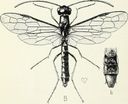
are slender, -like with black bodies and yellowish or pale markings on the legs. The body is cylindrical and elongated, lacking the narrow waist characteristic of many other Hymenoptera. are long and thread-like. Wings are membranous with reduced venation. Larvae are legless, creamy-white with a brown capsule, adapted for boring in plant stems.
Habitat
Agricultural landscapes dominated by cereal . Found in wheat fields and adjacent grasslands. Larvae develop inside stems of plants. are active in field margins and crop interiors during periods.
Distribution
Documented from Canada (Nova Scotia), Norway, and Portugal (Terceira Island, Azores). The has a transatlantic distribution, occurring in both European and North American localities. The Azorean represents an insular occurrence, possibly introduced.
Seasonality
are active during the growing season of crops. In temperate regions, likely coincides with wheat anthesis and early grain development. Specific varies by region; Canadian records suggest summer activity.
Diet
Larvae feed internally on pith and vascular tissues of wheat stems (Triticum spp.) and possibly other cereals. do not feed; they rely on larval reserves.
Host Associations
- Triticum aestivum - larval common wheat; primary economic
- Triticum - larval wheat
Life Cycle
Females insert into wheat stems using a saw-like ovipositor. Larvae bore downward through the stem pith, consuming internal tissues. Mature larvae girdle the stem base, causing lodging. occurs within the stem or in soil. There is typically one per year; larvae may in stems through winter.
Behavior
Larvae are endophytic, feeding concealed within plant stems. The terminal girdling weakens stems and causes plants to fall. are weak fliers, typically moving short distances between plants. Mating occurs on plants.
Ecological Role
Primary consumer of cereal stems. As a pest, it reduces agricultural productivity. Provides food for and vertebrate that exploit stem-boring insects. Contributes to nutrient cycling through plant tissue consumption, though this is outweighed by economic impact in agricultural systems.
Human Relevance
Agricultural pest of wheat, causing lodging and yield reduction through larval stem boring. Economic impact is regionally variable; less studied than the related Cephus cinctus. Management involves wheat varieties with solid stems, which impede larval development.
Similar Taxa
- Cephus cinctusAlso a wheat stem sawfly; distinguished by more extensive yellow leg markings and different geographic distribution (primarily North American Great Plains)
- Trachelus oenophilusCongeneric with similar ; may overlap in distribution and use
More Details
Taxonomic history
Originally described as Cephustabidus by Fabricius in 1775. Transferred to Trachelus, which currently contains approximately 20 worldwide.
Agricultural significance
Less economically important than Cephus cinctus, but represents a secondary pest of wheat in parts of its range. The Azorean on Terceira Island is notable as an isolated occurrence, possibly resulting from human-mediated introduction.