
Trachelus
Jurine, 1807
stem sawflies
Species Guides
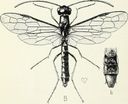
1- Trachelus tabidus(Black Wheat Stem-sawfly)
Trachelus is a of stem sawflies in the Cephidae. are internal feeders in grass stems, with several species recognized as significant agricultural pests of wheat and barley. The genus occurs across the Palearctic region, with documented species in Europe, the Middle East, and Central Asia. Larval development occurs entirely within plant stems, causing characteristic damage often called 'whiteheads' in cereal crops.
Pronunciation
How to pronounce Trachelus: /ˈtrækiːləs/
These audio files are automatically generated. While they are not always 100% accurate, they are a good starting point.
Identification
Identification to level requires examination of male genitalia, specifically the structure of the preapical sterna and the hypopygium. Females can be distinguished by ovipositor , including the size of denticles and the length of valvula 3 of the ovipositor . Genetic analysis of mitochondrial (COI, cyt b) and nuclear (EF-1α) markers supports species boundaries where morphology is ambiguous.
Images
Habitat
Grassland and agricultural environments; larvae develop internally within stems of grasses (Poaceae). Documented in arid cereal-growing regions including the Negev Desert and Mediterranean climates.
Distribution
Palearctic region. Documented from: southern Israel (Negev); southeastern and central Anatolia, Türkiye; Europe. GBIF records indicate presence in Norway and Sweden.
Seasonality
in late winter to early spring (February–March in Israel, timing varies by latitude). Larval development in spring, with in cut stem stubs during dry summer conditions. occurs in late winter prior to adult emergence. One per year.
Diet
Larval feeding on internal parenchyma of grass stems. No feeding documented.
Host Associations
- Triticum aestivum - larval wheat; major agricultural pest
- Hordeum vulgare - larval barley; major agricultural pest
- Avena sp. - larval wild oat
- Stipa holosericea - larval feather grass; first record of Stipa as
Life Cycle
deposited in young developing grass stems. Larvae feed internally, completing development within the stem. Mature larvae cut the stem internally, causing the upper portion to die (whitehead ). Larvae enter in cut stem stubs. occurs within stubs. emerge following winter rains or spring warming.
Behavior
are active for a brief period following winter rains or spring warming. Males emerge 4–6 days before females and are less numerous. Adults do not feed. Larvae are solitary stem borers.
Ecological Role
Primary consumer of grasses. Agricultural pest causing yield losses up to 55% in wheat and 50% in barley in conditions. Subject to by including Collyria coxator, Collyria calcitrator, Ceratobracon stschegolevi, and Tetrastichus sp., with rates reaching 22% in some regions.
Human Relevance
Significant pest of wheat and barley production in Mediterranean and Middle Eastern agriculture. cause direct yield loss through stem cutting. Management relies on and avoidance of broad-spectrum that harm .
Similar Taxa
- Cephuscongeneric Cephidae; also stem-boring of cereals. Distinguished by genitalic and ovipositor structure.
- Cephus pygmaeussympatric in same regions; is more abundant in Israeli and Turkish studies, with C. pygmaeus representing <5% of specimens in some .
More Details
Taxonomic notes
Catalogue of Life erroneously places Trachelus in Coleoptera (Curculionidae); this is a database error. The is correctly placed in Hymenoptera: Cephidae per all primary sources.
Species diversity
At least four recognized: T. flavicornis, T. libanensis, T. tabidus, and T. stipa (described 2016 from Central Anatolia). T. troglodyta mentioned as morphologically similar to T. stipa.
Sources and further reading
- BugGuide
- Wikipedia
- GBIF taxonomy match
- iNaturalist taxon
- NCBI Taxonomy
- Catalogue of Life
- Biology of the stem sawflies Trachelus tabidus and Cephus pygmaeus in the Negev of southern Israel
- Parasitism rates of wheat stem sawflies [Cephus pygmeus and Trachelus tabidus (Hymenoptera: Cephidae)] in Southeastern Türkiye
- Trachelus stipa (Hymenoptera: Cephidae), a new stem sawfly from Central Anatolia associated with feather grass (Stipa holosericea, Poaceae)