
Trioza magnoliae
(Ashmead, 1881)
Red Bay Psyllid
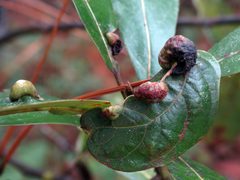
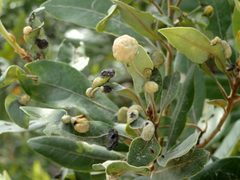
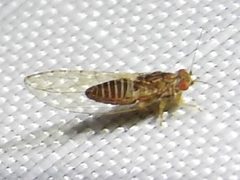
Trioza magnoliae, commonly known as the Red Bay , is a gall-forming psyllid native to eastern North America. This induces characteristic galls on the leaves of native Persea bay trees, particularly red bay (Persea borbonia) and related species. The insect has a wide distribution across the eastern and central United States. While primarily an ecological curiosity due to its gall-forming habit, it has gained attention in relation to the decline of red bay caused by the laurel wilt , as the psyllid's trees significant mortality.
Pronunciation
How to pronounce Trioza magnoliae: /ˈtrɪ.oʊ.zə mæɡˈnoʊ.li.i/
These audio files are automatically generated. While they are not always 100% accurate, they are a good starting point.
Identification
Identification relies primarily on plant association and gall . The induces characteristic galls on leaves of native Persea , particularly red bay (Persea borbonia). Galls appear as raised, often discolored structures on leaf surfaces. Definitive identification of the insect itself requires examination by a in Psylloidea , as morphological differentiation from related Trioza species is subtle. The combination of gall form and geographic location within the eastern United States provides strong circumstantial evidence for identification.
Images
Habitat
Occurs in supporting native Persea bay trees, including maritime forests, swamp forests, and mixed hardwood forests of the southeastern United States. The is tightly associated with its plants and is found wherever suitable Persea species occur, from coastal maritime forests to inland wetland areas.
Distribution
Widely distributed across eastern and central North America. Documented from Alabama, Arkansas, Florida, Georgia, Illinois, Indiana, Iowa, Kansas, Kentucky, Louisiana, Maine, Massachusetts, Michigan, Minnesota, Mississippi, Missouri, Montana, Nebraska, Nevada, New Hampshire, New Jersey, New Mexico, New York, North Carolina, North Dakota, Ohio, Oklahoma, Oregon, Pennsylvania, Rhode Island, South Carolina, South Dakota, Tennessee, and Texas. The distribution corresponds closely with that of its native plants.
Diet
Phloem-feeding on native Persea . Nymphs and extract plant sap from vascular tissues of leaves, with feeding activity concentrated within and around gall tissues.
Host Associations
- Persea borbonia - primary Red bay, primary native
- Persea spp. - Other native bay tree in the Persea
Life Cycle
with , nymph, and stages. Multiple nymphal instars develop within the protection of leaf galls. The gall provides shelter and feeding site for developing nymphs. Specific details of egg placement, number of per year, and stage are not well documented in available sources.
Behavior
Induces gall formation on plant leaves through feeding activity. The gall serves as a protected microhabitat for nymphal development. possess strong jumping ability using enlarged hind legs, a characteristic escape response of psyllids when disturbed. The is sedentary and tightly associated with host plants, with limited capacity.
Ecological Role
Functions as a gall-forming herbivore on native Persea trees. The galls represent a form of plant manipulation that creates novel structure on leaves. The may serve as a food source for and , though specific natural enemy records are not well documented. The ecological role has become complicated by the laurel wilt (caused by Raffaelea lauricola and vectored by Xyleborus glabratus), which is causing widespread mortality of red bay and potentially threatening the long-term persistence of this native .
Human Relevance
Primarily of ecological and scientific interest rather than economic importance. The is not considered a significant pest of cultivated plants. It has gained attention from researchers studying the of native Persea species and the impacts of laurel wilt on southeastern forest . The serves as an for native red bay and contributes to understanding the biodiversity supported by these threatened tree species. No active management is directed at this species.
Similar Taxa
- Trioza brevigenaeAnother gall-forming Trioza , but occurs on Ficus microcarpa rather than Persea, and is in California rather than native to eastern North America
- Other Trioza speciesMany Trioza are morphologically similar and require identification; plant association is the primary distinguishing feature for T. magnoliae
More Details
Conservation context
The Red Bay an indirect conservation threat from laurel wilt , which is causing extensive mortality of red bay (Persea borbonia) throughout the southeastern United States. As the primary tree declines, of this native psyllid may be at risk.
Sources and further reading
- BugGuide
- GBIF taxonomy match
- iNaturalist taxon
- NCBI Taxonomy
- Catalogue of Life
- Encyrtid Holdings | Entomology Research Museum
- Publications | Entomology Research Museum
- Trioza acuminatissima Archives - Entomology Today
- trioza-acuminatissima - Entomology Today
- Trioza brevigenae Archives - Entomology Today
- A New Psyllid Pest on Ornamental Trees in California
- Red Bay Psyllid, Trioza magnoliae (Ashmead) (Insecta: Hemiptera: Sternorrhyncha: Psyllidae)