
Pachypsylla pallida
Patch, 1912
Hairy Bud Gall Psyllid
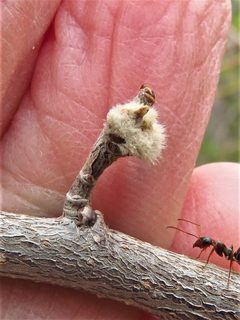
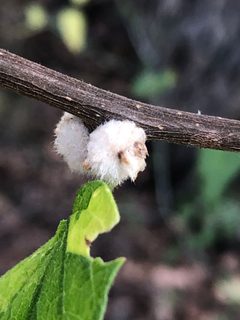
Pachypsylla pallida is a hackberry in the Aphalaridae, known for inducing distinctive galls on hackberry trees (Celtis spp.). It is one of at least seven species in the Pachypsylla that specialize on hackberry . The species produces hairy bud galls, distinguishing it from that create nipple galls or other gall morphologies. Like other psyllids, it has and undergoes with five nymphal instars developing within the protective gall structure.
Pronunciation
How to pronounce Pachypsylla pallida: //ˌpækɪˈsɪlə ˈpælɪdə//
These audio files are automatically generated. While they are not always 100% accurate, they are a good starting point.
Identification
Identified by the hairy bud gall it induces on hackberry, in contrast to the smooth nipple galls of P. celtidismama. are tiny (approximately 3-4 mm), resembling miniature cicadas with membranous wings held roof-like over the body. Specific adult morphological characters distinguishing P. pallida from other Pachypsylla are not documented in available sources.
Images
Habitat
Associated with hackberry trees (Celtis spp.), occurring in both natural stands and ornamental plantings. The requires developing hackberry buds for gall formation.
Distribution
North America; distribution records indicate presence in Arizona (ARIOO) and New Mexico/Northwest Mexico (NWMOO). Range corresponds with native and ornamental hackberry distribution.
Diet
Nymphs feed on plant tissue within the gall structure. feed on hackberry sap using .
Host Associations
- Celtis spp. - obligate planthackberry trees; induces hairy bud galls on buds
Life Cycle
Females deposit on hackberry buds. Nymphs hatch and feed, inducing gall formation as a plant response. Five nymphal instars develop within the gall, with the final instar possessing wing pads. emerge by cutting an exit through the gall wall. not explicitly documented for this , though related Pachypsylla species overwinter as adults in sheltered locations.
Ecological Role
Gall formation creates microhabitat structure on hackberry trees. Nymphs serve as for parasitic including Psyllaephagus spp. (Encyrtidae) and Torymus spp. (Torymidae).
Human Relevance
Minor nuisance pest when aggregate on building exteriors seeking shelter, as occurs with related hackberry . No significant economic or health impact.
Similar Taxa
- Pachypsylla celtidismamaAlso occurs on hackberry, but produces smooth nipple galls on leaf undersides rather than hairy bud galls
- Other Pachypsylla speciesSix additional occur on hackberry, distinguished primarily by gall (size, shape, location, and texture)
More Details
Gall morphology
The hairy bud gall is diagnostic for this among hackberry psyllids. Gall texture and location (buds vs. leaves) provide the most reliable identification method.
Taxonomic note
placement has varied; some sources list Psyllidae rather than Aphalaridae. The Pachypsylla is restricted to hackberry in North America.
Sources and further reading
- BugGuide
- GBIF taxonomy match
- iNaturalist taxon
- NCBI Taxonomy
- Catalogue of Life
- Those Incredible Digger Bees and Their Nest Parasites | Bug Squad
- Bees, Parasites and Maybe the End? | Bug Squad
- The Amazing Bee-Parasite Research of Leslie Saul-Gershenz | Bug Squad
- A Silver Digger Bee in Flight at Bodega Head | Bug Squad
- Encyrtid Holdings | Entomology Research Museum
- Bug Eric: Hackberry Psyllids: A Fixture of Fall