
Pachypsylla celtidisasterisca
Riley, 1890
Hackberry Star Gall Psyllid
Pachypsylla celtidisasterisca is a of hackberry native to North America, known for inducing distinctive star-shaped galls on hackberry leaves. emerge in fall and seek shelter to overwinter, becoming a nuisance when they aggregate on building exteriors. The species is one of approximately seven Pachypsylla species associated with hackberry, each producing characteristic gall morphologies that serve as the primary identification cue.
Pronunciation
How to pronounce Pachypsylla celtidisasterisca: //ˌpækɪˈsɪlə ˌsɛltɪdɪsæsˈtɛrɪska//
These audio files are automatically generated. While they are not always 100% accurate, they are a good starting point.
Identification
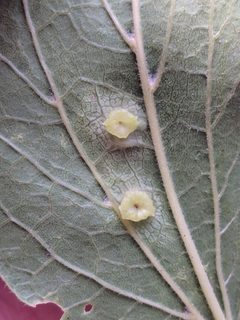
Distinguished from other hackberry psyllids by the star-shaped (asterisca) gall it induces on the upper surface of hackberry leaves, contrasting with the nipple galls of P. celtidismama on leaf undersides. are 3.5–4.5 mm long, resembling tiny cicadas with beak-like . Wing pads are visible in the fifth instar nymph.
Images
Habitat
Associated with hackberry trees (Celtis spp.), both in natural stands and ornamental plantings. Galls form on leaf surfaces where nymphs develop.
Distribution
Ranges throughout North America wherever hackberry (Celtis) occurs naturally or as an ornamental.
Seasonality
emerge in fall (September–October), seek shelter, and reappear in spring when hackberry leaves begin unfolding from buds. Females deposit at this precise phenological window.
Diet
Nymphs feed on plant sap within the gall; feed on hackberry sap using .
Host Associations
- Celtis - obligateinduces star-shaped galls on leaves; precise timing of oviposition required for successful development
Life Cycle
Females deposit on unfolding hackberry leaves in spring. Nymphs hatch and induce gall formation through feeding activity, progressing through five instars within the gall. The fifth instar has visible wing pads and spike-like projections used to cut an exit hole. emerge from galls in fall, seek sites, and resume activity the following spring.
Behavior
aggregate in large numbers on building exteriors, window screens, and door frames during fall in search of shelter. Nymphs are sedentary within galls.
Ecological Role
Gall formation creates microhabitats that support ; nymphs serve as for parasitic including Psyllaephagus spp. (Encyrtidae) and Torymus spp. (Torymidae).
Human Relevance
Considered a nuisance pest when fall-emerging congregate on homes and buildings; poses no structural damage or health threat. Management by hosing with water is sufficient.
Similar Taxa
- Pachypsylla celtidismamaproduces nipple galls on leaf undersides rather than star galls on upper surfaces; similarly sized and overlaps
- Pachypsylla spp.six additional hackberry produce distinct gall morphologies (blister, petiole, etc.) on different plant tissues; identification requires gall examination
More Details
Parasitoid associations
Nymphs are parasitized by chalcidoid wasps including Psyllaephagus pachypsyllae (Encyrtidae), which has been reared from galls.
Gall characteristics
Star galls are typically 3–5 mm in diameter with radiating points; may occur singly or in small clusters on leaf upper surface.