
Ceroplastes sinensis
Del Guercio, 1900
Chinese Wax Scale
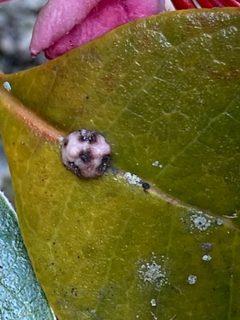
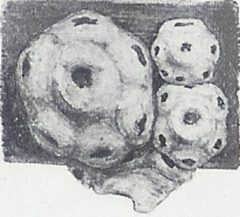
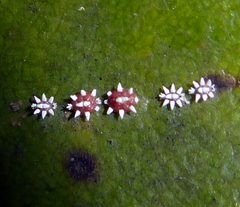
Ceroplastes sinensis is a insect pest of commercial citrus and other woody plants. Native to Central or South America based on cladistic analysis, it has established across temperate regions including Australia, New Zealand, Mediterranean Europe, North America, and parts of Asia. The produces a distinctive waxy covering and completes a single in temperate climates. It has become a significant agricultural pest, particularly in citrus groves, prompting development of sampling protocols and efforts.
Pronunciation
How to pronounce Ceroplastes sinensis: //ˌsɛroʊˈplæstiːz sɪˈnɛnsɪs//
These audio files are automatically generated. While they are not always 100% accurate, they are a good starting point.
Images
Habitat
Found in commercial citrus groves and on other woody plants in temperate climates. In Mediterranean regions, occurs in cultivated citrus orchards. In Australia, recorded from Acacia baileyana in urban and agricultural settings. Climatically more restricted than previously believed, with distribution mainly in temperate zones.
Distribution
Native range predicted to be Central or South America based on cladistic analysis; confirmed by discovery of heavily parasitized in Argentina. Established populations: Australia (New South Wales, Victoria, Queensland, South Australia, Western Australia, Australian Capital Territory, Northern Territory), New Zealand, Mediterranean Europe (Spain, France, Italy, Portugal, Greece, Turkey, Balearic Islands, Corsica, Sardinia, Sicily), North Africa (Algeria, Morocco, Tunisia, Libya, Madeira, Canary Islands), North America (USA: California, North Carolina, Virginia; Mexico), Central and South America (Argentina, Brazil, Chile, Ecuador, Uruguay, Trinidad), Asia (China, Iran, Lebanon, Philippines, Syria), and Pacific Islands (Solomon Islands, Norfolk Island).
Seasonality
Completes a single in temperate regions. oviposition begins in May and continues until mid-July. Egg hatching begins mid-June, with maximum percentage of hatched eggs reached in first quarter of August.
Diet
Phloem-feeding on plant sap.
Host Associations
- Citrus - primary major commercial crop pest
- Ficus - figs
- Vitis - grape
- Pyrus - pear
- Acacia baileyana - Australian record
Life Cycle
Completes a single in temperate climates. Females produce that are retained under the waxy covering. Males occur but comprise only about 3% of the ; males have 6 instars including a true third instar. Overwinters as eggs or stages under the protective waxy covering.
Behavior
Sedentary as and most stages; feeding on plant stems and leaves. Males are mobile in some instars.
Ecological Role
Herbivore and agricultural pest. Serves as for multiple including Coccophagus ceroplastae, Metaphycus helvolus, Scutellista caerulea (or S. cyanea), and Aprostocetus ceroplastae. In its native range, high rates suggest natural enemy regulation; in invaded ranges, parasitoid abundance often too low to suppress effectively.
Human Relevance
Significant pest of commercial citrus production causing economic damage. Subject to programs with developed sampling plans targeting 12-20% invaded twigs or 0.2-0.5 females per twig. Recommended : 90-160 twigs per grove for enumerative plans, 160-245 twigs for binomial plans. introductions attempted but hampered by uncertainty of native origin until resolved by cladistic analysis.
Similar Taxa
- Ceroplastes destructorcongeneric pest of citrus in New Zealand and other regions; distinguished by morphological features of waxy covering and preferences
- Ceroplastes ceriferuscongeneric with similar ; cladistic analysis suggests Neotropical origin for C. ceriferus versus Central/South American origin for C. sinensis
- Ceroplastes rubenscongeneric ; cladistic analysis suggests Afrotropical origin for C. rubens versus Central/South American origin for C. sinensis
Sources and further reading
- BugGuide
- GBIF taxonomy match
- iNaturalist taxon
- NCBI Taxonomy
- Catalogue of Life
- Decorations on the Christmas tree: Egg cases of the European mantis, Mantis religiosa, Chinese mantis, Tenodera sinensis, and Carolina mantis, Stagmomantis carolina — Bug of the Week
- Surviving winter, Part III: Egg cases of the Praying mantis, Mantis religiosa, Chinese mantis, Tenodera sinensis, and Carolina mantis, Stagmomantis carolina — Bug of the Week
- Decorations on the Christmas tree: Egg cases of the European mantis, Mantis religiosa, Chinese mantis, Tenodera sinensis, and Carolina mantis, Stagmomantis carolina — Bug of the Week
- Death of a stink bug, Part 1: A curious reunion between the Brown Marmorated Stink Bug, Haylomorpha halys, and the Chinese Praying Mantis, Tenodera sinensis — Bug of the Week
- From the Bug of the Week Mailbag: Non-native mantids, the European mantis, Mantis religiosa, and Chinese mantis, Tenodera sinensis, enjoying North American cuisine — Bug of the Week
- To eat a stink bug, part 1 - A curious reunion, Brown marmorated stink bug, Halyomorpha halys , and Chinese praying mantis, Tenodera sinensis
- Ceroplastes sinensis . [Distribution map].
- Ceroplastes sinensis . [Distribution map].
- CEROPLASTES SINENSIS DEL GUERCIO (HOMOPTERA: COCCIDAE), A WAX SCALE NEW TO AUSTRALIA
- The current distribution and geographical origin of the scale insect pestCeroplastes sinensis(Hemiptera: Coccidae)
- Seasonal trends, sampling plans and parasitoid complex of the Chinese wax scale, Ceroplastes sinensis Del Guercio (Hemiptera: Coccidae), in Mediterranean citrus groves
- The Role of Parasitoids and Entomopathogenic Fungi in Mortality of Third-instar and Adult Ceroplastes destructor and C. sinensis (Hemiptera: Coccidae: Ceroplastinae) on Citrus in New Zealand