
Ceroplastes rubens
Maskell, 1893
red wax scale, pink wax scale, ruby wax scale
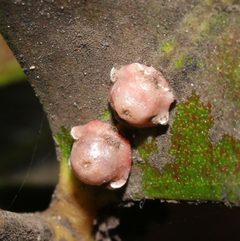
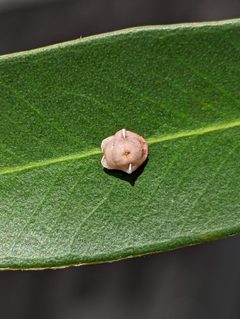
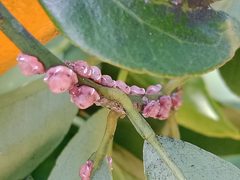
Ceroplastes rubens is a soft insect in the Coccidae, commonly known as the red or pink wax scale. Native to Africa, it has become widely distributed across tropical and subtropical regions including Australia, Asia, and the Pacific Islands. The is highly , feeding on sap from over 193 plant in 84 families, with significant economic impact on citrus, mango, avocado, and ornamental plants. females are covered in a distinctive hard, pink to pale red wax covering approximately 3-4 mm in diameter. is primarily parthenogenetic, with 1-2 per year depending on climate.
Pronunciation
How to pronounce Ceroplastes rubens: /ˌsɛroˈplæstiːz ˈruːbɛnz/
These audio files are automatically generated. While they are not always 100% accurate, they are a good starting point.
Identification
Distinguished from similar Ceroplastes by the pink to pale red coloration of the female wax covering (C. ceriferus has white wax, C. floridensis has darker red wax). The globular shape with depression and paired lateral lobes is characteristic. The presence of two types of stigmatic setae (bullet-like and hemispherical) aids microscopic identification. First instar can be separated from C. ceriferus by settling : C. rubens prefers 0-year-old twigs while C. ceriferus prefers 1-2-year-old twigs. accumulation on plants often indicates presence.
Images
Appearance
females are covered by a hard, globular, smooth wax coating colored pink to pale red, approximately 3-4 mm in diameter. The wax covering features a depression on top and two lateral lobes on each side. Beneath the wax, the actual insect body is reddish-pink. Stigmatic setae occur in two distinct forms: bullet-like and hemispherical. Two pairs of setae are present between the . are brick red in color. First instar nymphs () possess three pairs of legs, two spots, and a pair of antennae. Later nymphal instars develop white wax coverings initially, which become pinker with age.
Habitat
Tropical and subtropical environments; occurs in agricultural orchards, ornamental plantings, and natural vegetation. In temperate regions, limited to protected environments such as glasshouses. Shows preference for roadside and exposed tree positions where establishment success is higher. plant availability is the primary determinant.
Distribution
Native to Africa (origin). Established in Australia (Queensland, New South Wales, Northern Territory), China, Japan, South Korea, Southeast Asia (Indonesia, Malaysia, Philippines, Thailand, Vietnam), Pacific Islands (Fiji, Hawaii, New Caledonia, Solomon Islands, Vanuatu, Western Samoa, and others), Caribbean (Jamaica, Puerto Rico, Trinidad), and United States (limited, southern regions). In Europe, present only in a single tropical glasshouse in Germany since 2010.
Seasonality
Activity patterns vary by region: in China, Japan, and southern New South Wales (Australia); in South Africa, northern New South Wales, and Queensland (Australia). Summer lasts 4-6 months; winter generation 6-8 months. In temperate regions, overwinters as females. Oviposition occurs in spring to early summer (e.g., early to mid-July in Japan). emerge 2-3 days after oviposition begins.
Diet
Phytophagous; feeds on plant sap extracted from shoots, leaves, and fruit stalks using a piercing-sucking . Highly , attacking plants from over 193 in 84 . Preferred include Citrus spp., Mangifera indica (mango), Persea americana (avocado), Ficus spp., Camellia spp., Cinnamomum spp., Ilex cornuta, Magnolia spp., and various Pinus . Also feeds on Malus sylvestris, Prunus spp., Pyrus spp., and numerous ornamental plants.
Host Associations
- Citrus spp. - primary considered important pest of citrus
- Mangifera indica - mango
- Persea americana - avocado
- Ficus spp. -
- Camellia spp. -
- Cinnamomum spp. -
- Ilex cornuta -
- Magnolia spp. -
- Pinus spp. -
- Malus sylvestris -
- Prunus spp. -
- Pyrus spp. -
- Schefflera actinophylla - umbrella tree; common in Queensland
- Acer palmatum -
- Cedrus deodara -
Life Cycle
Holometabolous-like development with three stages: , nymph, and . Female develops through four nymphal instars; male through five nymphal instars. Eggs are deposited in a cavity beneath the mother's body and hatch into mobile first instar within 2-3 days of oviposition. Crawlers disperse and settle on young twigs (preferentially 0-year-old twigs) within 6 hours, then become . Wax shell formation begins at end of first instar, increasing in size and thickness with subsequent . Adult females are sessile and covered in prominent wax coating; males are rare, winged, and short-lived. time varies: 4-6 months for summer generation, 6-8 months for winter generation in .
Behavior
First instar are the only mobile stage, dispersing to find settlement sites on young plant tissue. After settlement, all subsequent stages remain , permanently attached to plant by piercing mouthparts. Crawlers show spacing-out distribution at high densities, indicating avoidance. Settlement site selection is non-ideal: frequent settling on less profitable sites early in season, insufficient use of most profitable twigs, and high mortality on overcrowded twigs despite available unoccupied sites. All life stages excrete honeydew, a sugary waste product that accumulates on plant surfaces.
Ecological Role
Herbivore that reduces plant vigor through sap extraction; heavy can cause branch dieback. Honeydew producer that supports fungal growth, reducing photosynthetic capacity of plants. Ants are attracted to honeydew for foraging, forming facultative mutualisms that may protect from natural enemies. Serves as host for including Anicetus beneficus (introduced agent) and Coccidoctonus dubius (native hyperparasitoid).
Human Relevance
Significant agricultural and ornamental pest. Damage described as 'minor and frequent' but can become severe during . Economic impact through direct feeding damage, honeydew/ of fruit, and reduced aesthetic value of ornamental plants. Major pest of citrus in multiple regions; also affects mango, avocado, tea, coffee, and numerous ornamental crops. Subject to phytosanitary regulations in Europe due to establishment risk. programs using Anicetus beneficus have been implemented in several countries.
Similar Taxa
- Ceroplastes ceriferusSimilar globular wax covering, but white in color rather than pink/red; prefers 1-2-year-old twigs for settlement versus 0-year-old twigs for C. rubens
- Ceroplastes floridensisSimilar but wax covering is darker red; primarily distributed in southeastern United States
- Ceroplastes destructorWhite with similar ; important agricultural pest in southern hemisphere
More Details
Parthenogenesis
is primarily parthenogenetic; males are rarely observed in most (never recorded in Australia, rarely in Japan, more common in Shanghai where occurs). This reproductive strategy allows single females to establish new populations.
Survival capacity
females can survive 40-46 days of starvation; newly hatched nymphs survive only 4-5 days without food, indicating critical importance of rapid settlement and feeding initiation.
Climate change implications
Observed range expansion into temperate regions (e.g., Maryland, Germany) associated with warming winters; previously restricted to subtropical/tropical climates.
Sources and further reading
- BugGuide
- Wikipedia
- GBIF taxonomy match
- iNaturalist taxon
- NCBI Taxonomy
- Catalogue of Life
- Grasshopper Collections and Survey
- Who are you? Carolina mantids (Stagmomantis carolina), wax scales (Ceroplastes), and katydids — Bug of the Week
- Northern hospitality for the Florida predatory stink bug, Euthyrhynchus floridanus, and wax scales, Ceroplastes spp. — Bug of the Week
- Study Finds Very Few Wild Bee Species Pollinate Major Crops
- Plionoma suturalis in Oklahoma—a new state record! | Beetles In The Bush
- Archive — Bug of the Week
- Pest categorisation of Ceroplastes rubens
- Ceroplastes rubens . [Distribution map].
- Ceroplastes rubens . [Distribution map].
- The Life Cycle and Seasonal History of Ceroplastes Rubens
- Settling‐site selection and survival of two scale insects, Ceroplastes rubens and C. ceriferus, on citrus trees
- Spatial Distribution of Pink Wax Scale, Ceroplastes Rubens Maskell (Hemiptera: Coccidae), on Umbrella Trees in South-Eastern Queensland: the Pattern of Outbreaks
- Natural Enemies of Pink Wax Scale, Ceroplastes rubens Maskell (Hemiptera: Coccidae), on Umbrella Trees in Southeastern Queensland
- Host Selection Behavior of Anicetus beneficus ISHII et YASUMATSU(Hymenoptera : Encytidae) : II. Bioassay of Oviposition Stimulants in Ceroplastes rubens MASKELL(Hemiptera : Coccidae)
- Outbreaks of pink wax scale, Ceroplastes rubens Maskell (Hemiptera: Coccidae), on umbrella trees in south‐eastern Queensland: Patterns of parasitisation