
Ceroplastes rusci
(Linnaeus, 1758)
Fig Wax Scale
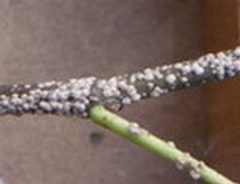
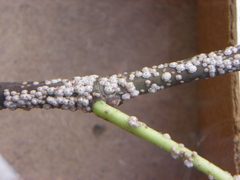
Ceroplastes rusci, commonly known as the fig , is a soft insect ( Coccidae) native to the Mediterranean region. First discovered in Florida in 1994-1995, it has since spread to numerous countries across six continents and is recognized as a significant agricultural and forestry pest. The feeds on more than 94 from 52 plant families, with notable impacts on figs, citrus, grapes, and ornamental plants. Climate change modeling predicts expanding suitable ranges through 2100, increasing its potential in temperate regions.
Pronunciation
How to pronounce Ceroplastes rusci: /se.roʊˈplæs.tiːz ˈrʌs.kiː/
These audio files are automatically generated. While they are not always 100% accurate, they are a good starting point.
Images
Habitat
Found in agricultural and horticultural settings, particularly in fruit orchards, nurseries, and landscapes with plants. Established occur in tropical, subtropical, and warm temperate climates. populations have been documented in greenhouses and outdoor plantings in regions with mild winters.
Distribution
Native to the Mediterranean region (Europe, North Africa, Middle East). Introduced and established in the Americas (United States: Florida; Brazil; Argentina; Uruguay; Caribbean), Africa (sub-Saharan regions), Asia (India, Southeast Asia), and Oceania. First detected in Florida, USA in 1994-1995. Predicted to expand range under future climate scenarios.
Diet
Phloem-feeding herbivore that extracts sap from plants using . Excess sap is excreted as honeydew.
Host Associations
- Ficus carica - primary : fig; major cultivated
- Citrus spp. - Various citrus
- Vitis vinifera - Grapevine; of grapevine leafroll viruses
- Ixora spp. - Ornamental shrub; early detection in Florida
- Camellia spp. - Ornamental
- Olea europaea - Olive
- Pistacia vera - Pistachio
- Annona muricata - Soursop; heavy recorded in Vietnam
- Ochna integerrima - Hoa Mai flower; culturally important in Vietnam
- multiple other genera - More than 94 from 52 documented as
Life Cycle
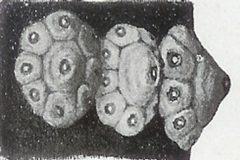
Reproduces parthenogenetically; males have not been observed in wild . Females lay up to approximately 1,000 beneath the waxy covering in late spring. Eggs hatch into mobile first-instar nymphs called "" that disperse to find feeding sites on branches. After settling, nymphs insert stylets into bark and produce waxy secretions. stages are called "cameos" due to their resemblance to Victorian jewelry. One per year in temperate regions; multiple generations possible in tropical climates.
Behavior
Sedentary as ; nymphs produce conspicuous white waxy coverings for protection. First-instar nymphs are the only mobile stage, dispersing to establish new feeding sites. Heavy feeding produces copious honeydew that supports growth.
Ecological Role
Agricultural and forestry pest causing direct damage through sap extraction and indirect damage via honeydew production and . Documented of Grapevine leafroll associated virus-3 (GLRaV-3) and GLRaV-5, with transmission efficiencies of 3.3% and 1.7% respectively. Serves as prey for natural enemies including the predatory Eublemma amabilis.
Human Relevance
Significant economic pest of fruit crops (figs, citrus, grapes) and ornamental plants. Management includes physical removal of , using like Eublemma amabilis, and . Climate warming facilitates northward range expansion into previously unsuitable temperate regions. Subject to and interception efforts by agricultural inspection services.
Similar Taxa
- Ceroplastes floridensisAnother Ceroplastes with waxy covering; distinguished by morphological differences in wax structure and preferences
- Ceroplastes sinensisRelated ; intercepted at U.S. ports indicating similar potential
- Parthenolecanium quercifexOak lecanium scale; similar as soft but differs in waxy covering structure and specificity
More Details
Climate change impacts
Maximum Entropy modeling indicates that temperature range and mean temperature of warmest quarter are key variables determining distribution. Suitable area is predicted to increase through 2100 under multiple climate scenarios, with expansion into currently uninfested temperate regions.
Virus transmission
First soft insect documented to transmit grapevine leafroll-associated viruses, though with lower than mealybug Planococcus ficus.
Biological control
The noctuid Eublemma amabilis has been investigated as a biocontrol agent in Vietnam, showing efficient but exhibiting hyperactive in early instars that reduces survival in laboratory rearing.
Sources and further reading
- BugGuide
- GBIF taxonomy match
- iNaturalist taxon
- NCBI Taxonomy
- Catalogue of Life
- Who are you? Carolina mantids (Stagmomantis carolina), wax scales (Ceroplastes), and katydids — Bug of the Week
- Northern hospitality for the Florida predatory stink bug, Euthyrhynchus floridanus, and wax scales, Ceroplastes spp. — Bug of the Week
- Wax on, wax off: Wax scale, Ceroplastes sp. — Bug of the Week
- The holly and the wax scale - Ceroplastes sp. — Bug of the Week
- Ceroplastes sinensis Archives - Entomology Today
- Archive — Bug of the Week
- Ceroplastes rusci . [Distribution map].
- Ceroplastes rusci . [Distribution map].
- Fig Wax Scale, Ceroplastes rusci (L.) (Insecta: Hemiptera: Coccoidea: Coccidae)
- Description of the immature female instars of Ceroplastes rusci (Linnaeus) (Hemiptera: Coccidae)
- New host plant records of Fig Wax Scale Ceroplastes rusci (Linnaeus, 1758) (Hemiptera: Coccomorpha: Coccidae) from India
- Transmission of Grapevine Leafroll Viruses byPlanococcus ficus(Hemiptera: Pseudococcidae) andCeroplastes rusci(Hemiptera: Coccidae)
- A report on occurrence, morphology, population ecology and infestation of Ceroplastes rusci (Linnaeus: 1758) in Muzaffarnagar, Uttar Pradesh, India. Coccidae: Coccoidea: Hemiptera: Insecta
- Current and future potential distribution of the invasive scale Ceroplastes rusci (L., 1758) (Hemiptera: Coccidae) under climate niche
- The fig wax scale Ceroplastes rusci (Linnaeus) (Homoptera: Coccidae) in south‐east Vietnam: Pest status, life history and biocontrol trials with Eublemma amabilis Moore (Lepidoptera: Noctuidae)