
Eulachnus rileyi
(Williams, 1911)
pine needle aphid
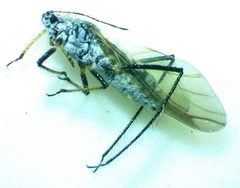
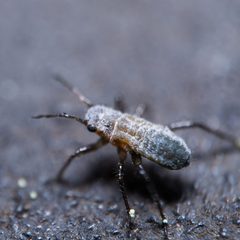
Eulachnus rileyi is a pine needle native to North America that has become established in pine plantations across Africa, South America, and Europe. It feeds on phloem sap of pine needles, showing preference for 3-4 year old foliage. exhibit bimodal peaks in spring and autumn, with crashes during heavy rainfall periods. The reproduces parthenogenetically, producing both winged forms and wingless forms. It is considered a significant pest in commercial pine plantations, where dense can cause needle yellowing, reduced growth, and tree stress.
Pronunciation
How to pronounce Eulachnus rileyi: /juːˈlæknəs ˈraɪli.aɪ/
These audio files are automatically generated. While they are not always 100% accurate, they are a good starting point.
Identification
Distinguished from other Eulachnus by morphological characters detailed in taxonomic revisions; European were formerly confused with E. tauricus, now synonymized. and females, as well as sexual morphs, have been redescribed and figured. Fundatrix morph described. Specific diagnostic characters require microscopic examination and reference to taxonomic keys.
Images
Habitat
Pine plantations and natural stands of Pinus . Within trees, shows distinct vertical distribution: highest abundance in the middle crown, lower abundance in upper and lower crown. Preference for 3-4 year old needles over current-year foliage.
Distribution
Native to North America; introduced and established in Africa (Tanzania, Zimbabwe), South America (Brazil, Chile), and Europe. GBIF records document presence in Brazil (Distrito Federal, Paraná, Rio Grande do Sul, São Paulo), Chile (multiple regions), Denmark, and São Miguel (Azores, Portugal). European distribution includes Czech Republic and Croatia based on recent records.
Seasonality
Bimodal peaks in October-November and February-March in Zimbabwe; rapid decline in January due to heavy rainfall. Activity suppressed by temperatures above 30°C.
Diet
Phloem sap of pine needles (Pinus ).
Host Associations
- Pinus patula - Significant pest in plantations; higher abundance than on P. elliottii in some studies
- Pinus elliottii - Higher abundance documented compared to P. patula in Tanzania study
- Pinus cembra - for related Eulachnus ; may extend to E. rileyi
- Pinus species - General
Life Cycle
Parthenogenetic typical of aphids, with alternating or simultaneous production of winged () and wingless () females. Sexual morphs ( females and males) produced seasonally. Fundatrix morph present. , nymphs, and occur simultaneously; nymphs typically most abundant life stage, eggs least abundant.
Behavior
Exhibits temperature-sensitive with negative response to sustained high temperatures above 30°C. Shows strong rainfall-induced crashes. Vertical stratification within trees: concentrates in middle crown. Preference for older needle age classes (3-4 years) may reflect nutritional optimization or avoidance.
Ecological Role
Herbivore and pest of pine plantations. Serves as prey for diverse natural enemy complex including coccinellid beetles, syrphid flies, lacewings, spiders, stink bugs (Pentatomidae), and (Aphidius sp.). Weak positive correlation observed between abundance and natural enemy numbers. May influence nutrient cycling in plantation through honeydew production and subsequent growth.
Human Relevance
Significant economic pest in commercial pine plantations, particularly in Africa and South America where introduced. Causes needle discoloration, reduced , and growth loss. Management recommendations include tending operations (thinning, weeding, pruning), regular monitoring, and agent introduction (e.g., Tetraphleps raoi suggested for Tanzania). Chemical control generally not emphasized; cultural practices preferred.
Similar Taxa
- Eulachnus tauricusFormerly considered distinct , now synonymized with E. rileyi based on molecular and morphological revision
- Eulachnus brevipilosusCongeneric pine needle with similar ; distinguished by morphological characters and associations
- Eulachnus agilisEuropean with similar ; part of same requiring careful morphological examination
Sources and further reading
- BugGuide
- GBIF taxonomy match
- iNaturalist taxon
- NCBI Taxonomy
- Catalogue of Life
- Soybean Insects: Mid-to-Late Season Pests (V8 to Maturity) - AgriLife Extension Entomology
- It’s a Mayfly…It’s a Moth…It’s Thyridopteryx | Beetles In The Bush
- Bug Eric: Wasp Wednesday: Neorileya
- Recent literature – The Coleopterists Bulletin | Beetles In The Bush
- Curious Scientific Names Can Make Insects Famous
- moths | Beetles In The Bush | Page 4
- Biology and Population Dynamics of the Pine Needle Aphid, Eulachnus rileyi (Williams) in Zimbabwe
- Distribution and Abundance of Pine Needle Aphids (Eulachnus rileyi Williams) and Their Potential Natural Enemies on Pine Tree Species (Pinus patula and Pinus elliottii) at Sao Hill Forest Plantation, Tanzania
- European species of the aphid genus Eulachnus Del Guercio, 1909 (Hemiptera: Aphididae: Lachninae): revision and molecular phylogeny