
Periphyllus
van der Hoeven, 1863
Periphyllus Aphids, maple aphids
Species Guides
4- Periphyllus californiensis(California maple aphid)
- Periphyllus lyropictus(Norway Maple Aphid)
- Periphyllus negundinis(Box Elder Aphid)
- Periphyllus testudinaceus(Common Maple Aphid)
Periphyllus is a of aphids in the Aphididae, Chaitophorinae, containing more than 40 described . Species in this genus are primarily associated with maple trees (Acer spp.), though some feed on related plants such as Koelreuteria. Many species exhibit complex with polymorphic forms including females, aestivating dimorphs, and sexual morphs. Several species are pests outside their native ranges, spreading with ornamental host plants.
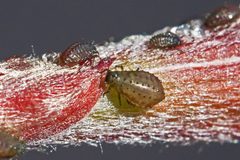
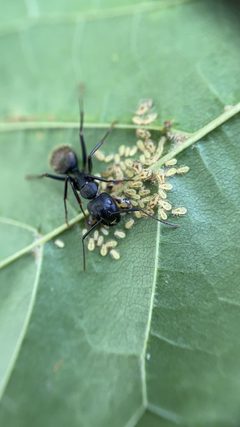
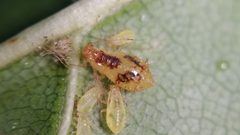
Pronunciation
How to pronounce Periphyllus: //pɛrɪˈfɪləs//
These audio files are automatically generated. While they are not always 100% accurate, they are a good starting point.
Identification
-level identification requires examination of morphological details such as siphunculi shape and pigmentation, cauda structure, and antennal segment ratios. Within Periphyllus, P. californiensis is distinguished from P. testudinaceus by uniformly black hind tibiae in females. P. acerihabitans differs from P. viridis and P. californiensis in specific morphological features detailed in available keys.
Images
Habitat
Associated with deciduous trees, primarily maple (Acer). Found on leaves, shoots, buds, and inflorescences. Some species occupy specific microhabitats: aestivating dimorphs occur on fully expanded leaves or key-fruits during summer dormancy.
Distribution
Widespread in temperate regions of the Northern Hemisphere. Native ranges include East Asia (China, Japan, Korea, Russian Far East, Taiwan, India) and Europe. Several introduced to North America, Australia, New Zealand, and parts of Europe. P. californiensis recorded as in Poland (2009), Netherlands, Italy, Denmark, Croatia, Germany, Switzerland, and England.
Seasonality
Activity patterns closely tied to tree . Spring develop on new growth and inflorescences. Summer spent as inactive aestivating dimorphs. Autumn populations resume activity in October, utilizing key-fruits, then leaves, then twigs through December. Winged occurs in November. hatching synchronized with bud burst in spring.
Diet
Phloem-feeding on plant sap. Oligophagous: most restricted to Acer spp. (maples). P. koelreuteriae feeds exclusively on Koelreuteria species.
Host Associations
- Acer palmatum - primary for P. californiensis
- Acer japonicum - for P. californiensis
- Acer buergerianum - for P. acerihabitans
- Acer platanoides - Norway maple, for P. lyropictus
- Koelreuteria bipinnata - for P. koelreuteriae
- Koelreuteria paniculata - for P. koelreuteriae
Life Cycle
Holocyclic (with sexual phase) or observed. Produces multiple morphs: females, viviparous females, aestivating dimorphs (foliate nymphs with marginal hairs), females, and males. Viviparous predominates during growing season; sexual morphs produced in autumn. Some produce offspring in response to risk.
Behavior
Forms colonies on leaf undersides and new growth. Produces aestivating dimorphs that remain inactive on leaves or fruits during summer, with >99.9% mortality during this period due primarily to . Winged females disperse in autumn to exploit feeding sites across trees. Shows stage-dependent responses to cues: nymphs respond to odor but not visual cues; respond to both. Predation risk induces increased production of offspring and altered development timing.
Ecological Role
Herbivore and phloem feeder on woody plants. Prey for lady beetles (Harmonia axyridis), (Trioxys spp.), and other natural enemies. Some are significant pests of ornamental and native trees in invaded ranges.
Human Relevance
Several are pests damaging ornamental maple plantings and native Acer . P. californiensis and P. koelreuteriae of particular concern in horticulture. Spread facilitated by international trade in ornamental plants. Subject to efforts using predatory lady beetles.
Similar Taxa
- P. testudinaceusSimilar to P. californiensis; distinguished by hind tibiae coloration in females
- P. viridisSimilar to P. acerihabitans; occurs on related Acer ; morphological keys available for separation
- P. californiensisSimilar to P. acerihabitans; both associated with Acer buergerianum or related maples; distinguished by specific morphological features
Sources and further reading
- BugGuide
- Wikipedia
- GBIF taxonomy match
- iNaturalist taxon
- NCBI Taxonomy
- Catalogue of Life
- Description of sexuales of Periphyllus singeri (Börner) (Hemiptera, Aphidoidea: Chaitophorinae)
- Periphyllus californiensis Shinji, 1917 (Hemiptera: Aphidoidea) - an invasive aphid species new to Poland
- Description of the previously unknown morphs of Periphyllus koelreuteriae (Takahashi) (Hemiptera, Aphididae: Chaitophorinae)
- Predation Risk Effects of Harmonia axyridis on the Development and Fecundity of Periphyllus koelreuteriae
- Reproduction of maple aphid (Periphyllus californiensis) in spring in relation to phenology of host tree.
- Descriptions of little-known and unknown morphs of Periphyllus acerihabitans Zhang (Hemiptera: Aphididae: Chaitophorinae)
- EGG HATCHING OF PERIPHYLLUS CALIFORNIENSIS (HEMIPTERA: APHIDIDAE) IN TWO MICROHABITATS WITH DIFFERENT BUDBURST PHENOLOGIES
- Spatial distribution and mortality of aestivating dimorphs of the maple aphid, Periphyllus californiensis Shinji (Homoptera, Aphididae)
- Host preference and population dynamics in an autumnal population of the maple aphid, Periphyllus californiensis Shinji (Homoptera, Aphididae)
- THE NORWAY MAPLE APHID - PERIPHYLLUS LYROPICTUS (KESSLER) (HEMIPTERA: APHIDIDAE) REDISCOVERED IN BĂNEASA- BUCUREȘTI AREA (SOUTH ROMANIA)
- Amounts of favourable feeding materials in spring for the maple aphid, Periphyllus californiensis Shinji, estimated from the phenological relations between the aphid and host trees
- Predation Risk Effects of Lady Beetle <em>Harmonia axyridis</em> (Pallas) on the Development and Fecundity of <em>Periphyllus koelreuteriae</em> Takahashi
- The effect of budding and flowering of maple trees on the development of the maple aphid, Periphyllus californiensis Shinji (Homoptera, Aphididae) population
- The Di-Symbiotic Systems in the Aphids Sipha maydis and Periphyllus lyropictus Provide a Contrasting Picture of Recent Co-Obligate Nutritional Endosymbiosis in Aphids
- Differentiation in the eastern AsianPeriphyllus koelreuteriae(Hemiptera: Aphididae) species complex driven by climate and host plant
- Nonconsumptive Harmonia axyridis (Coleoptera: Coccinellidae) induces stage-dependent dispersal, development, and diapause investment in Periphyllus koelreuteriae (Hemiptera: Chaitophoridae).