
Banasa
Stål, 1858
Banasa stink bugs
Species Guides
12- Banasa calva
- Banasa dimidiata(green burgundy stink bug)
- Banasa euchlora(juniper stink bug)
- Banasa flavosa
- Banasa grisea
- Banasa herbacea
- Banasa lenticularis
- Banasa packardii
- Banasa rolstoni
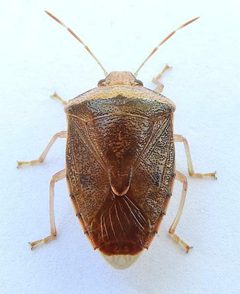
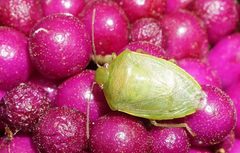
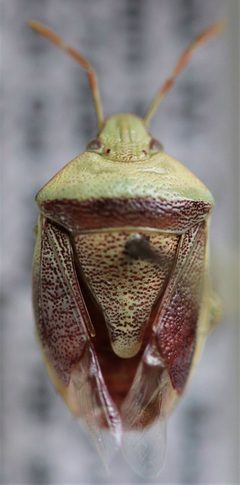
Banasa is a of phytophagous stink bugs in the Pentatomidae, tribe Pentatomini. These plant-feeding true bugs are primarily associated with woody plants, particularly conifers and broadleaf trees. The genus contains at least eleven in North America, with additional species described from South America including the recently described B. maculata from the Brazilian Atlantic Forest. Species identification typically requires microscopic examination of morphological characters.
Pronunciation
How to pronounce Banasa: /bəˈnɑːsə/
These audio files are automatically generated. While they are not always 100% accurate, they are a good starting point.
Identification
-level identification within Banasa requires microscopic examination of characters such as male genitalia (pygophore shape, gonocoxites, proctiger form) and pronotal markings. Banasa maculata belongs to the 'cuspidata group' characterized by an projection on each posterolateral angle of the pygophore. stages show distinguishing abdominal color patterns, with light and dark morphs observed in later instars of some species. Several North American species are visually similar and cannot be reliably separated without dissection.
Images
Habitat
Associated with forested and wooded . Banasa maculata occurs in the Brazilian Atlantic Forest. Banasa tumidifrons is associated with Rocky Mountain Juniper in the western United States. Banasa sordida occurs in coastal California on cypress .
Distribution
North America (at least eleven ), South America (Brazilian Atlantic Forest), western United States, coastal California.
Seasonality
overwinter and become active on warm winter days. Activity observed in January in Kansas, USA during unseasonably warm conditions.
Diet
Phytophagous; feeds on plant sap. Specific associations include: fruits of Miconia sellowiana (Melastomataceae) for B. maculata; Rocky Mountain Juniper (Juniperus scopulorum) for B. tumidifrons; Monterey Cypress and Gowen Cypress (Cupressus macrocarpa, C. goveniana) for B. sordida.
Host Associations
- Miconia sellowiana - food plantFruits; laboratory rearing of B. maculata
- Juniperus scopulorum - food plantRocky Mountain Juniper; B. tumidifrons
- Cupressus macrocarpa - food plantMonterey Cypress; B. sordida
- Cupressus goveniana - food plantGowen Cypress; B. sordida
Life Cycle
For B. maculata: to in 37.6 ± 13.24 days; five nymphal instars; most frequent clutch size 12 eggs; highest mortality in fifth instar (45.9%). Eggs have reticulate with deep and irregular rims. -width measurements overlap only between fourth and fifth instars.
Behavior
Overwinters as , becoming active on warm winter days. Some exhibit color in nymphal stages (light and dark morphs in third-fifth instars of B. maculata).
Ecological Role
Phytophagous component of forest and woodland . Prey for predatory including Astata unicolor, which has been documented capturing Banasa dimidiata.
Human Relevance
Generally not considered an economic pest, though some feed on commercially important conifers. Banasa calva is noted as rarely if ever being a pest despite feeding on tree and shrub sap. Serves as prey for native agents targeting stink bugs.
Similar Taxa
- Other Pentatomidae generaSimilar shield bug ; requires genitalia examination for definitive identification to
- Banasa calvaVisually similar to other Banasa ; requires microscopic characters for separation
Sources and further reading
- BugGuide
- Wikipedia
- GBIF taxonomy match
- iNaturalist taxon
- NCBI Taxonomy
- Catalogue of Life
- Bug Eric: New Year’s Insects and Spiders
- Oregon Researchers Find a Native Wasp With a Taste for Stink Bugs
- Bug Eric: 2026
- Banasa préromaine. Un état de la question
- A new South American species of Banasa Stål (Hemiptera: Heteroptera: Pentatomidae: Pentatominae): from egg to adult
- Rocky Mountain Juniper (Juniperus scopulorum; Cupressaceae) as a Host Plant of Banasa tumidifrons Thomas and Yonke (Hemiptera: Pentatomidae) in the Western United States
- Banasa sordida(Uhler) (Hemiptera: Pentatomidae): Monterey Cypress and Gowen Cypress (Cupressus macrocarpa, C. goveniana; Cupressaceae) as Host Plants in Coastal California