
Banasa dimidiata
green burgundy stink bug
Banasa dimidiata is a North American in the Pentatomidae, commonly known as the green burgundy stink bug. range 8.5–11.0 mm and display a distinctive color pattern of vibrant green anteriorly and burgundy-brown posteriorly. The is a plant feeder associated with trees, shrubs, and berries, particularly blueberries. It occurs transcontinentally across Canada and the United States, with peak activity from June through July.
Pronunciation
How to pronounce Banasa dimidiata: /bəˈnɑːsə dɪˌmɪdiˈɑːtə/
These audio files are automatically generated. While they are not always 100% accurate, they are a good starting point.
Identification
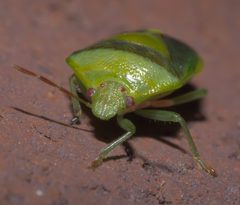
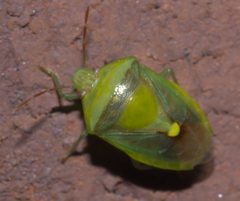
Distinguished from other green stink bugs by the smooth green-to-burgundy color transition on the surface; many similar lack the pronounced burgundy or show different color patterns. The combination of green legs, long with reddish-brown tips, and specific body proportions aid separation from and other Pentatomidae.
Images
Appearance
Shield-shaped body typical of Pentatomidae, measuring 8.5–11.0 mm in length. Primary coloration is vibrant green on the portion, transitioning to burgundy-brown on the wings and rear of body; transition may appear slightly iridescent. Legs are green. are long with reddish-brown tips. are small, round, dark, and positioned laterally on the . is smooth with a slight sheen.
Habitat
Found on a wide variety of trees and shrubs, with particular association with berry-producing plants including blueberries.
Distribution
Transcontinental in North America: Canada from British Columbia to Nova Scotia; United States from California to Texas to Florida; extends into Mexico.
Seasonality
Mostly observed from April to October, with peak abundance during June and July.
Diet
Plant feeder; feeds on trees, shrubs, and berries, with documented association with blueberries.
Host Associations
- blueberries - food plantfrequently observed on berry crops
- trees and shrubs - /foodwide variety of woody plants
Ecological Role
Documented as prey for the predatory Astata unicolor, which paralyzes and provisions stink bugs for its offspring. This represents a known -prey relationship in Pacific Northwest .
Human Relevance
Associated with berry crops, particularly blueberries, suggesting potential agricultural relevance. Serves as native prey for agents targeting stink bugs.
Similar Taxa
- Chinavia hilaris (green stink bug)Similar green coloration but lacks burgundy ; B. dimidiata distinguished by color transition pattern
- Halyomorpha halys (brown marmorated stink bug)Both are prey for Astata unicolor, but H. halys is brown with white banding, not green
More Details
Predation by native wasps
Banasa dimidiata has been documented as prey for the soil-nesting predatory Astata unicolor in Oregon. This wasp paralyzes stink bugs and provisions them for its larvae. While A. unicolor shows strong preference for the Halyomorpha halys, B. dimidiata represents a native alternative prey item, indicating potential ecological interactions between native and invasive through shared .