
Chinavia hilaris
(Say, 1832)
Green Stink Bug, Green Soldier Bug
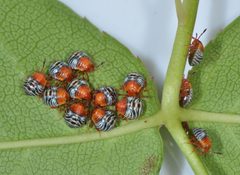
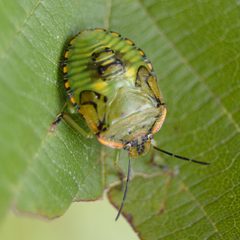
Chinavia hilaris, commonly known as the green , is a native North American pentatomid pest primarily affecting cotton, soybean, and pistachio crops. are bright green with distinctive black bands on the and a pointed spine projecting between the hind legs. The exhibits a unique seasonal , colonizing woody noncrop such as black cherry and elderberry in spring before dispersing to agricultural crops in mid-to-late season. Unlike the southern green stink bug (Nezara viridula), C. hilaris rarely completes development in peanut and shows strong fidelity to cotton. It is susceptible to the microsporidian Nosema maddoxi and is cross-attracted to of other stink bug species.
Pronunciation
How to pronounce Chinavia hilaris: /tʃɪˈneɪviə hɪˈlærɪs/
These audio files are automatically generated. While they are not always 100% accurate, they are a good starting point.
Identification
Distinguished from the southern green stink bug (Nezara viridula) by the pointed spine between the hind legs (N. viridula has a short, rounded spine) and black antennal bands (N. viridula has reddish bands). Larger than N. viridula (5/8 inch vs. 1/2 inch). Distinguished from the redbanded stink bug (Piezodorus guildinii) by larger size, lack of reddish band across the - junction, and presence of the pointed spine. Distinguished from brown stink bugs (Euschistus spp.) by bright green coloration.
Images
Habitat
Agricultural farmscapes in the southeastern and midwestern United States, particularly cotton, soybean, and corn fields. Noncrop include field borders and woodlands with woody shrubs and trees, especially black cherry (Prunus serotina), elderberry (Sambucus nigra subsp. canadensis), mimosa (Albizia julibrissin), and pecan (Carya illinoinensis). Aggregated distributions occur in cotton, particularly at field edges and crop interfaces.
Distribution
Native to North America; distributed throughout the United States. Documented in the southeastern coastal plain (Georgia, South Carolina, Alabama), midwestern states, Texas, California (pistachio orchards), and Vermont. Historical specimens from Illinois (1970-1972) confirm long-established presence in the Midwest.
Seasonality
present on black cherry from April until early July; large nymphs on black cherry from late May through mid-July. Adults colonize elderberry in mid-May and remain through July; large nymphs present mid-June through July. Adults and nymphs on mimosa from mid-July to early September. In cotton, nymphs observed in late September with peak abundance just after the autumnal equinox, followed by peak of nonreproductive adults within 2 weeks.
Diet
Piercing-sucking herbivore; feeds on plant sap. Causes internal injury to cotton bolls (warts and stained lint). Feeds on developing soybean pods, reducing yield and seed quality. Feeds on pistachio nuts in California. Feeds on noncrop woody including black cherry, elderberry, mimosa, and pecan nuts before shell hardening.
Host Associations
- Gossypium hirsutum - Economic ; mid-to-late seasonPrimary crop ; causes boll damage with internal warts and stained lint
- Glycine max - Economic and nymphs present; feeding reduces yield and seed quality
- Pistacia vera - Economic Documented pest of pistachios in California orchards
- Prunus serotina - Early season noncrop Source for of cotton; feed April-July
- Sambucus nigra subsp. canadensis - Early-to-mid-season noncrop Source for cotton ; colonize mid-May through July
- Albizia julibrissin - Mid-to-late season noncrop and nymphs present mid-July to early September
- Carya illinoinensis - Noncrop Feeding on nuts before shell hardening; can penetrate hardened shell after mid-August
- Sesbania punicea - plantFirst recorded in Florida
Life Cycle
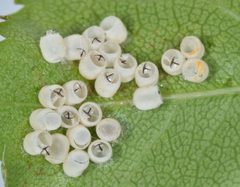
to development occurs through five nymphal instars. Developmental rates estimated at 27°C based on cited literature. Egg masses detected in cotton and corn. Nymphs rarely detected in peanut, indicating incomplete development in this crop. In cotton, all instars and adults of both sexes present simultaneously during late season. Adults overwinter in sheltered locations.
Behavior
Exhibits aggregated spatial distribution in cotton with clustering at field edges, particularly near noncrop . Cross-attracted to Plautia stali and captured in Euschistus spp. pheromone-baited traps. disperse from noncrop host in field borders into crops, primarily cotton. Does not establish breeding in peanut. Shows strong fidelity to cotton compared to other .
Ecological Role
Economic pest of cotton, soybean, and pistachio crops. Acts as a disperser from noncrop woody into agricultural crops. Part of in southeastern farmscapes alongside Nezara viridula and Euschistus servus. Host to including Hexacladia spp. and microsporidian Nosema maddoxi.
Human Relevance
Significant agricultural pest causing yield loss and quality reduction in cotton, soybean, and pistachio production. Damage to cotton bolls results in internal warts and stained lint; damage to soybean pods reduces germination rates and causes delayed maturity. Management involves scouting with sweep nets, for treatment (36 and older nymphs per 100 sweeps), and applications. Cross-attraction to enables monitoring. Rarely breeds indoors; occasional nuisance invader to buildings in autumn but does not establish indoor .
Similar Taxa
- Nezara viridulaBoth are green stink bugs of similar size and general appearance; distinguished by spine shape and antennal band color
- Piezodorus guildiniiBoth are green-appearing stink bugs in soybean fields; distinguished by size, presence of reddish band, and spine
- Halyomorpha halysBoth are pests of multiple crops; distinguished by coloration (mottled brown vs. bright green) and size
- Euschistus servusBoth are pests in southeastern farmscapes; distinguished by coloration (brown vs. green)
Sources and further reading
- BugGuide
- GBIF taxonomy match
- iNaturalist taxon
- Soybean Insects: Late-Season Pests (R1 to R7) - AgriLife Extension Entomology
- Stink Bugs: New IPM Guide for Midwestern Corn, Soybean Growers
- Believe It or Nut: Bugs Like Almonds, Too
- Texas Entomologists Find Redbanded Stink Bug to Be Dominant Species on Soybean
- Redbanded Stink Bugs: Variety of Methods Available to Manage Impact on Soybean Crops
- Stinky exodus underway: Brown Marmorated Stink Bug, Halyomorpha halys — Bug of the Week
- Spatiotemporal Distribution of Chinavia hilaris (Hemiptera: Pentatomidae) in Corn Farmscapes
- Spatiotemporal Distribution ofChinavia hilaris(Hemiptera: Pentatomidae) in Peanut-Cotton Farmscapes
- First record of Hexacladia hilaris Burks (Hymenoptera: Encyrtidae) in Brazil and association with Chinavia erythrocnemis (Berg) (Heteroptera: Pentatomidae)
- First record ofSesbania punicea(Fabales: Fabaceae) as a Host Plant forChinavia hilaris(Hemiptera: Pentatomidae)
- Life History Parameters of <I>Chinavia hilaris</I> (Hemiptera: Pentatomidae), a Stink Bug Injurious to Pistachios in California
- Seasonal Abundance and Population Structure of Chinavia hilaris and Nezara viridula (Hemiptera: Pentatomidae) in Georgia Farmscapes Containing Corn, Cotton, Peanut, and Soybean
- Nosema maddoxi sp. nov. (Microsporidia, Nosematidae), a Widespread Pathogen of the Green Stink Bug Chinavia hilaris (Say) and the Brown Marmorated Stink Bug Halyomorpha halys (Stål)