
Hexacladia
Ashmead, 1891
Species Guides
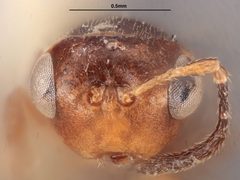
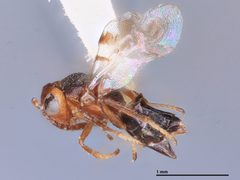
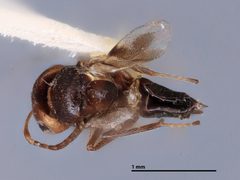
1Hexacladia is a of gregarious endoparasitoid in the Encyrtidae, Encyrtinae. develop as endoparasitoids within heteropteran , primarily in the family Pentatomidae (stink bugs), with some records from Coreidae and Scutelleridae. Multiple individuals typically emerge from a single . The genus has been documented as a agent of agricultural pest stink bugs in South America, including species that attack soybean and rice crops. Seven species are recorded from South America, with H. smithii being the most widely reported.
Pronunciation
How to pronounce Hexacladia: /hɛk.səˈkleɪ.di.ə/
These audio files are automatically generated. While they are not always 100% accurate, they are a good starting point.
Identification
Small chalcidoid wasps with typical encyrtid . Specific diagnostic features for -level identification require examination of morphological characters not detailed in available sources. -level identification relies on microscopic examination of antennal structure, wing venation, and other standard chalcidoid characters.
Images
Habitat
Agricultural , particularly soybean fields and rice plantations. Collections have been made from soybean stubble fields, rice fields intercropped with cassava and corn, and areas bordered by secondary vegetation.
Distribution
South America is the primary documented region, with records from Brazil (Paraná, Rio Grande do Sul, Mato Grosso, Maranhão states), Argentina (Santa Fe province), and Rica, Puerto Rico, and the United States for some .
Host Associations
- Arvelius albopunctatus - endoparasitoidgregarious of , up to 17 per
- Dichelops furcatus - endoparasitoidgregarious of in soybean fields
- Edessa meditabunda - endoparasitoidpreviously recorded
- Euschistus heros - endoparasitoidnew record from Mato Grosso State, Brazil; rates 1.5-14% in surveyed fields
- Tibraca limbativentris - endoparasitoid of H. lemosae, and occasionally nymphs parasitized
- Chinavia erythrocnemis - endoparasitoid of H. hilaris, first South American record
- Coreidae - endoparasitoid-level record from literature
- Scutelleridae - endoparasitoid-level record from literature
Life Cycle
Gregarious endoparasitoid development within , occasionally in nymphs. Larval and pupal stages occur entirely within the living host. Adults emerge by cutting a round hole through the abdominal wall of the host. Multiple individuals (2-39 recorded) emerge from a single host. Host typically dies following , though H. lemosae has been observed emerging while host remains alive.
Behavior
Endoparasitoid of heteropteran . Gregarious development with multiple per is characteristic. involves cutting through host ; in most the host dies after emergence, though some observations indicate hosts may survive emergence in certain species or circumstances.
Ecological Role
agent of stink bugs and other heteropteran pests in agricultural , particularly in soybean and rice agroecosystems. Contributes to natural suppression of pest including , Dichelops furcatus, and Tibraca limbativentris.
Human Relevance
Potential biocontrol agent for management of pests in soybean and rice . Documented of economically important pests including the redbanded stink bug (Piezodorus guildinii) in Argentina, though specific efficacy data not detailed.
Similar Taxa
- Other Encyrtidae generaMany encyrtid are endoparasitoids of Hemiptera; microscopic examination of morphological characters required for differentiation
- Tachinidae (Diptera)Also of stink bugs but dipteran flies with different and larval development mode
Sources and further reading
- BugGuide
- GBIF taxonomy match
- iNaturalist taxon
- NCBI Taxonomy
- Catalogue of Life
- Encyrtid Holdings | Entomology Research Museum
- Redbanded Stink Bugs: Variety of Methods Available to Manage Impact on Soybean Crops
- A new species of Hexacladia Ashmead (Hymenoptera, Encyrtidae) and new record of Hexacladia smithii Ashmead as parasitoids of Dichelops furcatus (Fabricius) (Hemiptera, Pentatomidae) in Argentina
- New records of pentatomids as hosts of Hexacladia smithii ashmead (Hymenoptera: Encyrtidae) in southern Brazil
- New species of Hexacladia Ashmead (Hymenoptera: Encyrtidae), a parasitoid of Tibraca limbativentris Stål (Hemiptera: Pentatomidae)
- First record of Hexacladia hilaris Burks (Hymenoptera: Encyrtidae) in Brazil and association with Chinavia erythrocnemis (Berg) (Heteroptera: Pentatomidae)
- Natural parasitism of Hexacladia smithii Ashmead (Hymenoptera: Encyrtidae) on Euschistus heros (F.) (Hemiptera: Pentatomidae): new record from Mato Grosso State, Brazil
- Aportaciones sobre la Biología de Hexacladia smithii Ashmead1, Parasitoide de Edessa conspersa Stål2 en Cerro Frío, Puente de Ixtla, Morelos, México
- Figures 11-16 from: Torréns J, Fidalgo P, Fernández C, Punschke E (2017) A new species of Hexacladia Ashmead (Hymenoptera, Encyrtidae) and new record of Hexacladia smithii Ashmead as parasitoids of Dichelops furcatus (Fabricius) (Hemiptera, Pentatomidae) in Argentina. Journal of Hymenoptera Research 61: 85-93. https://doi.org/10.3897/jhr.61.20742
- Figures 1-10 from: Torréns J, Fidalgo P, Fernández C, Punschke E (2017) A new species of Hexacladia Ashmead (Hymenoptera, Encyrtidae) and new record of Hexacladia smithii Ashmead as parasitoids of Dichelops furcatus (Fabricius) (Hemiptera, Pentatomidae) in Argentina. Journal of Hymenoptera Research 61: 85-93. https://doi.org/10.3897/jhr.61.20742