
Ochteridae
Kirkaldy, 1906
Velvety Shore Bugs
Genus Guides
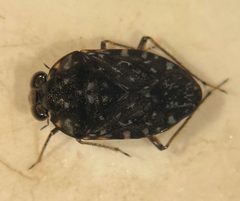
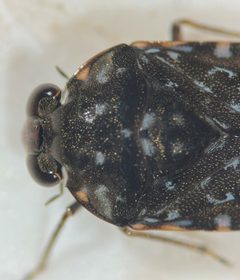
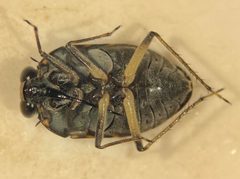
1is a small of true bugs (Hemiptera: Heteroptera: Nepomorpha) comprising approximately 80–90 described in eight . Commonly known as velvety shore bugs, they are semi-aquatic insects inhabiting the margins of freshwater bodies worldwide, with highest diversity in tropical regions. The family is characterized by a velvety body texture, small size (4.5–9 mm), and distinctive antennal and leg adapted to riparian . Recent taxonomic revisions have significantly expanded the known , particularly in Australia, Mesoamerica, and the Andes.
Pronunciation
How to pronounce Ochteridae: /ɒkˈθɛrɪˌdeɪ/
These audio files are automatically generated. While they are not always 100% accurate, they are a good starting point.
Identification
can be distinguished from the superficially similar Saldidae (shore bugs) by their velvety body texture (Saldidae typically have a more shiny or polished appearance), shorter relative to body length, and preference for moist soil at water margins rather than exposed rocks or vegetation. They differ from Gelastocoridae (toad bugs) by their more elongate body form, less enlarged fore , and lack of the characteristic toad-like posture. The antennal of Ochteridae include two types (plate-like and placodea multilobated) not documented in other Nepomorpha, though this requires microscopic examination. The is distinguished from other Nepomorpha by the combination of: riparian rather than fully aquatic habit, velvety , and particular arrangement of leg sensilla with greatest variability in mechanoreceptive structures.
Images
Habitat
Margins of freshwater bodies including streams, rivers, ponds, and lakes. Occupies moist, often sandy or muddy substrates at the water's edge rather than open water surfaces. Some occur in semi-terrestrial adjacent to water. The microhabitat typically includes damp soil with sparse vegetation or algal cover.
Distribution
Worldwide distribution with greatest in tropical regions, particularly the Australian region (Australia and New Guinea), Oriental region, and Neotropics. Present in the Nearctic region including the United States and Mesoamerica. Documented from all major biogeographic regions except Antarctica. Specific records include: Socotra Island, Tanzania, Colombia, Ecuador, Panama, Rica, Mexico, Australia, New Guinea, China, Thailand, Laos, Myanmar, India, Oman, Sudan, Mozambique, and Central African Republic.
Diet
Predatory on small , particularly larvae of flies (Diptera) and other small aquatic or semi-aquatic arthropods.
Life Cycle
Hemimetabolous development with and five nymphal instars. Nymphs of some camouflage themselves by gluing sand grains and debris to their surface; this is also known in a few species.
Behavior
Active and agile, capable of quick running, leaping, and . Tends to avoid direct sunlight, remaining under cover or in shade during bright conditions. When disturbed, individuals may fly short distances or seek in cracks and vegetation. Cryptic enhanced by camouflage through debris-carrying in some .
Ecological Role
in riparian , likely contributing to regulation of small in shoreline . Their specialized sensory structures (antennal and leg ) indicate important roles in detecting prey and environmental conditions in the boundary zone between aquatic and terrestrial .
Human Relevance
No documented economic importance. Occasionally encountered by entomologists and naturalists at freshwater margins. Not known as pests or . Of interest in studies of insect sensory evolution and to semi-aquatic .
Similar Taxa
- SaldidaeSimilar shore-dwelling habit and general body form, but distinguished by shiny (not velvety) , relatively longer , and preference for exposed rocky or vegetated shorelines rather than moist soil margins.
- GelastocoridaeRelated nepomorphan with riparian habit, but distinguished by enlarged, forelegs, toad-like body posture and shape, and more fully terrestrial .
- CorixidaeAquatic nepomorphan that share proximity, but distinguished by fully aquatic habit, swimming-adapted hind legs with fringed setae, and lack of velvety texture.
Misconceptions
The "velvety shore bugs" is somewhat misleading as not all occur near the sea; the is primarily associated with freshwater . The historical classification of fossil has been unstable, with Propreocorinae formerly included in but now recognized as a separate family Propreocoridae.
More Details
Sensory Biology
possess a complex array of antennal including nine main types: sensilla trichodea, chaetica, club-like, campaniformia, basiconica, coeloconica, plate-like, ampullacea, and sensilla placodea multilobated. The latter two types were first documented in Nepomorpha through study of this . Leg sensilla show the greatest variability in mechanoreceptive structures among studied nepomorphan , reflecting adaptations to the riparian interface.
Camouflage Behavior
Debris-carrying for camouflage is well-developed in nymphs of some and in of a few species. Individuals actively apply sand grains, soil particles, and other environmental debris to their surface using specialized structures, rendering them nearly invisible against their substrate.
Taxonomic History
The has undergone significant recent revision. The 2020 world catalogue recognized three extant (Megochterus, Ochterus, Ocyochterus) with 84 and 4 , though eight genera total are recognized when fossil are included. The Australian region shows unexpectedly high compared to the Oriental region, suggesting complex biogeographic history.
Sources and further reading
- BugGuide
- Wikipedia
- GBIF taxonomy match
- iNaturalist taxon
- NCBI Taxonomy
- Catalogue of Life
- Two new species of Ocyochterus (Heteroptera: Ochteridae) from Ecuador and Panama
- Ocyochterus irmae, a beautiful new species of Ochteridae (Heteroptera) from the Northern Andes
- Revision of the genus Ochterus Latreille in the Australian region (Heteroptera: Ochteridae)
- Revision of the genus Ochterus (Hemiptera: Heteroptera: Ochteridae) in Mesoamerica and the United States
- Insect evolution toward aquatic habitats; reassessment of antennal sensilla in the water bug families Ochteridae, Gelastocoridae and Aphelocheiridae (Hemiptera: Heteroptera: Nepomorpha)
- The Leg Sensilla of Insects from Different Habitats—Comparison of Strictly Aquatic and Riparian Bugs (Corixidae, Ochteridae, Gelastocoridae: Nepomorpha: Insecta: Heteroptera)
- Taxonomic catalogue of the family Ochteridae with description of Ochterus papaceki sp. nov. from Socotra Island and Tanzania (Hemiptera: Heteroptera)