
Nabis americoferus
Carayon, 1961
Common Damsel Bug
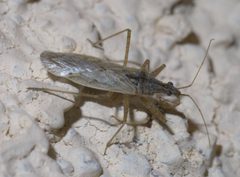
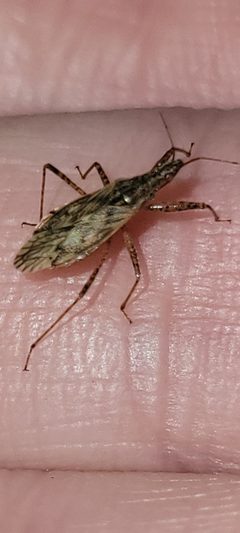
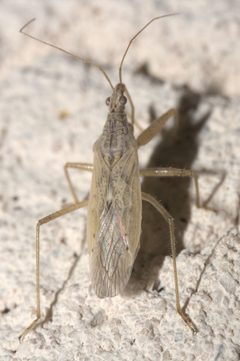
Nabis americoferus, the common damsel bug, is a small predatory true in the Nabidae. It occurs across North America and Central America, with well-documented in eastern Ontario and agroecosystems of the United States. The produces two per year in temperate regions, overwinters as in field margins, and colonizes crop fields in late spring. It is an economically important agent, feeding on agricultural pests including aphids, leafminers, and mirid bugs.
Pronunciation
How to pronounce Nabis americoferus: //ˈneɪ.bɪs əˌmɛrɪˈkoʊ.fɛrəs//
These audio files are automatically generated. While they are not always 100% accurate, they are a good starting point.
Identification
Distinguished from plant bugs (Miridae) by the absence of a —a pronounced notch or wrinkle in the forewing margin where the leathery meets the membranous tip. Separated from assassin bugs (Reduviidae) by smaller size and more slender build; most reduviids exceed 12 mm. Lacks the fossa spongiosa (specialized tibial hair pad) found in the Pagasa. Closely resembles other Nabis ; definitive identification requires examination of genitalia or expert verification.
Images
Appearance
Small, slender predatory ; typically under 12 mm in length. Body elongated with long . Coloration varies, generally brownish or grayish. Front muscular and swollen, armed with rows of small teeth on the underside for securing prey. Rostrum (beak) short and stout compared to plant-feeding bugs. Wings may be fully developed or reduced; some individuals have abbreviated non-functional wings.
Habitat
Agricultural fields, particularly alfalfa, soybean, and strawberry crops. Overwinters in field margins and non-crop vegetation. Found in diverse open including meadows, prairies, and early successional areas. are deposited in plant stems, predominantly where stem diameter measures 0.8–1.9 mm.
Distribution
North America and Central America. Documented from eastern Ontario through the United States to Central America. Present in the Nearctic region including Beringia and California.
Seasonality
Two per year in temperate regions. overwinter and resume activity in late March. First generation immatures: mid-April to mid-July. First-generation adults appear mid-July. Second generation immatures: mid-July to early September. Second-generation adults appear late August. Adults active from early spring through late fall.
Diet
. Documented prey includes pea aphid (Acyrthosiphon pisum), alfalfa blotch leafminer larvae (Agromyza frontella), and tarnished plant bug (Lygus lineolaris). Development rate varies by prey type; nymphs develop faster when fed leafminer larvae than when fed aphids.
Host Associations
- Acyrthosiphon pisum - preypea aphid
- Agromyza frontella - preyalfalfa blotch leafminer larvae
- Lygus lineolaris - preytarnished plant bug
- Leucostoma simplex - tachinid fly
- Mermithidae -
Life Cycle
Hemimetabolous development with , five nymphal instars, and stages. Females lay eggs singly in plant stems and immediate vicinity; at 23°C, mean of 157 eggs over a 3-week oviposition period. Development temperature-dependent: theoretical threshold 11.1°C for eggs, 10.6°C for nymphs; requirements 123.5 for eggs, 370.4 for nymphal stage. Second- females enter reproductive in early autumn; both sexes continue feeding until hard frosts.
Behavior
Primarily . Capable of subduing prey larger than itself. disperse from sites in field margins to colonize crops in late May to early June. Attracted to artificial lights at night, possibly to exploit other insects drawn there. Non-consumptive effects on prey: presence of N. americoferus can alter plant selection and oviposition of prey .
Ecological Role
in agroecosystems and natural . agent of agricultural pests including aphids, leafminers, and mirid bugs. Contributes to top-down regulation of herbivore . Serves as for including tachinid flies and mermithid , supporting higher .
Human Relevance
Economically important as a natural enemy in . Evaluated for biocontrol of tarnished plant bug in strawberry production, both in open fields and greenhouses. Used in combination with and other agents including phytoseiid mites and fungi. Abundance and monitored to optimize strategies.
Similar Taxa
- Nabis roseipennisCongeneric damsel bug with overlapping distribution and ; requires genitalia examination for definitive separation
- Nabis rufusculusCongeneric damsel bug co-occurring in alfalfa and soybean; similar size and general appearance
- Pagasa spp.Ground-dwelling damsel bugs with -like appearance; distinguished by fossa spongiosa on front tibia and often reduced wings
- Miridae (plant bugs)Similar body form but possess on forewing margin and lack front legs
- Reduviidae (assassin bugs)Share predatory habit and short rostrum but generally larger and more robust
More Details
Developmental plasticity
Nymph development rate varies significantly with prey type, with faster development on leafminer larvae (Agromyza frontella) than on pea aphids (Acyrthosiphon pisum) at equivalent temperatures.
Non-consumptive effects
Presence of N. americoferus alters tarnished plant bug , increasing their presence on strawberry plants when are present on preferred , demonstrating context-dependent predator effects in agroecosystems.
Parasitism pressure
by tachinid flies and mermithid generally occurs at rates below 10%, suggesting limited top-down regulation of damsel bug by these natural enemies.
Sources and further reading
- BugGuide
- Wikipedia
- GBIF taxonomy match
- iNaturalist taxon
- NCBI Taxonomy
- A Big Cheer for a Crab Spider | Bug Squad
- Bug Eric: Damsels That Cause Distress
- Bug Eric: My Kind of Fourth of July
- Bug Eric: Blacklighting Already?
- Bug Eric: July 2019
- Phenology and Abundance of Nabis americoferus, N. roseipennis, and N. rufusculus (Hemiptera: Nabidae) and Their Parasitoids in Alfalfa and Soybean
- BIONOMICS OF THE DAMSEL BUG, NABIS AMERICOFERUS CARAYON (HEMIPTERA: NABIDAE), A PREDATOR OF THE ALFALFA BLOTCH LEAFMINER (DIPTERA: AGROMYZIDAE)
- Evaluation of Trap Crops and the Presence of the Predator Nabis americoferus for the Management of the Tarnished Plant Bug in Strawberries
- Integration of the Generalist Predator Nabis americoferus (Hemiptera: Nabidae) in a Greenhouse Strawberry Biocontrol Program with Phytoseiid Predatory Mites and the Entomopathogenic Fungus Beauveria bassiana.
- The Potential of Nabis americoferus and Orius insidiosus as Biological Control Agents of Lygus lineolaris in Strawberry Fields.