
Agromyza frontella
(Rondani, 1874)
alfalfa blotch leafminer
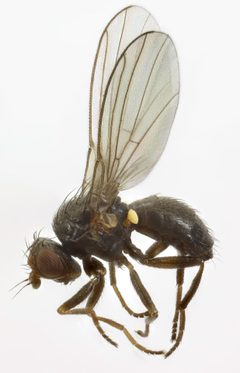
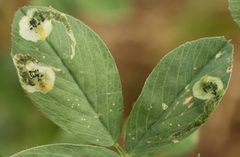
Agromyza frontella, the alfalfa blotch leafminer, is a small dipteran leafminer in the Agromyzidae. Native to Europe, it has become an established agricultural pest of alfalfa (Medicago sativa) in North America, particularly in Canada and the northern United States. Larvae feed between leaf surfaces, creating distinctive blotch-shaped mines. The exhibits in daily activity patterns, with males most active during cooler morning and evening periods while females feed and oviposit throughout the day. It has been subject to using the introduced Dacnusa dryas.
Pronunciation
How to pronounce Agromyza frontella: //əˌɡroʊˈmaɪzə frɒnˈtɛlə//
These audio files are automatically generated. While they are not always 100% accurate, they are a good starting point.
Identification
are small, typically 2–3 mm in length, with the reduced wing venation characteristic of Agromyzidae. Larvae create irregular blotch mines (as opposed to linear serpentine mines) in alfalfa leaflets, with deposited in scattered black pellets. Mines are most commonly found on middle leaflets in a 3:4:3 ratio relative to basal leaflets. occurs in soil near the surface due to limited burrowing capacity of .
Images
Habitat
Alfalfa fields (Medicago sativa stands), particularly in agricultural regions of eastern Canada and the northern United States. are found in managed hay and forage crop systems.
Distribution
Native to Europe; established in North America including southern Ontario, Quebec (all 12 agricultural regions as of 1986), Manitoba, and the conterminous 48 United States. GBIF records confirm presence in Denmark, Norway, and Sweden.
Seasonality
Multiple per year in North America, typically three generations annually in eastern Ontario. patterns are influenced by alfalfa harvesting schedules. Third-generation mature larvae enter in September, with development resuming in spring.
Diet
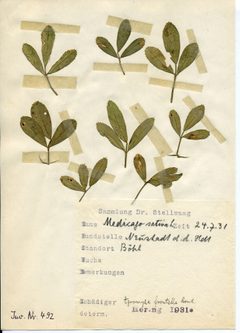
Larvae feed on mesophyll tissue of alfalfa (Medicago sativa) leaflets, creating blotch mines. Development and have been demonstrated on the alternate Medicago lupulina (black medick).
Host Associations
- Medicago sativa - primary alfalfa/lucerne; main agricultural
- Medicago lupulina - alternate black medick; supports development and
- Dacnusa dryas - introduced European braconid ; attacks larvae and pupae
Life Cycle
to development occurs within alfalfa foliage and soil. Eggs are laid in leaflets. Larvae pass through three instars while feeding within blotch mines; larval instars engage in . Mature larvae exit mines and pupate in soil near the surface. In eastern Ontario, three per year with third-generation larvae entering in September. Development rates from egg to first instar and for later instars and pupae are temperature-dependent, decreasing with rising temperature from 13 to 23°C in non-diapausing generations.
Behavior
Males exhibit bimodal daily activity peaks in early morning and late afternoon/early evening, coinciding with mating activity. Male abundance is negatively correlated with air temperature, solar insolation, and wind speed, and positively correlated with relative humidity. Females show less variable daily abundance patterns and feed and oviposit throughout the day; these activities are positively correlated with temperature and insolation and negatively correlated with relative humidity. Virgin females exhibit higher frequency of calling ( release) and greater pheromone titre than mated females; calling behavior decreases with female age and after mating. have limited burrowing capacity, resulting in close to the soil surface.
Ecological Role
Agricultural pest of alfalfa causing foliar damage through larval leafmining. Target of ; in Quebec declined to subeconomic levels following establishment of the introduced Dacnusa dryas. Serves as for larval-pupal parasitoids.
Human Relevance
Significant economic pest of alfalfa in North America, reducing forage quality and yield. Subject to programs including sequential decision plans based on counts in leaflets. Harvesting practices affect by eliminating partially developed larvae and increasing pupal mortality through soil temperature and humidity changes. Sampling protocols recommend four systematically selected leaves per stem or middle-leaflet-only counts with correction factors.
Similar Taxa
- Agromyza spp.congeneric may create similar linear or blotch mines; A. frontella distinguished by association with alfalfa, blotch mine shape, and geographic distribution in managed alfalfa systems
- Liriomyza spp.other agromyzid leafminers with different mine (typically more linear serpentine mines) and plant associations
Sources and further reading
- BugGuide
- Wikipedia
- GBIF taxonomy match
- iNaturalist taxon
- NCBI Taxonomy
- Catalogue of Life
- Encyrtid Holdings | Entomology Research Museum
- A SEQUENTIAL DECISION PLAN FOR MANAGEMENT OF THE ALFALFA BLOTCH LEAFMINER, AGROMYZA FRONTELLA (DIPTERA: AGROMYZIDAE)
- Note sur l’aire de distribution et l’importance du Dacnusa dryas, un parasite introduit au Québec pour lutter contre l’agromyze de la lyzerne (Agromyza frontella)
- Effect of age and mating status on the mating behaviour and pheromone titre in alfalfa blotch leafminer females Agromyza frontella (Diptera: Agromyzidae)
- Observations on the mating behavior of the alfalfa blotch leafminer,Agromyza frontella (Rondani) (Diptera: Agromyzidae), and evidence of a female sex pheromone
- A SAMPLING SYSTEM FOR ESTIMATING EGG AND LARVAL POPULATIONS OF AGROMYZA FRONTELLA (DIPTERA: AGROMYZIDAE) IN ALFALFA
- EFFECTS OF REMOVING THE PLANT CANOPY ON PUPAL SURVIVAL AND ADULT EMERGENCE OF THE ALFALFA BLOTCH LEAFMINER, AGROMYZA FRONTELLA (DIPTERA: AGROMYZIDAE)
- SEASONAL DEVELOPMENT, BEHAVIOR, AND HOST SYNCHRONY OF DACNUSA DRYAS (NIXON) (HYMENOPTERA: BRACONIDAE) PARASITIZING THE ALFALFA BLOTCH LEAFMINER, AGROMYZA FRONTELLA (RONDANI) (DIPTERA: AGROMYZIDAE)
- Development and Reproductive Performance of Agromyza frontella (Rondani) (Diptera: Agromyzidae) on an Alternate Host, Medicago lupulina L.
- Distribution of an Exotic Pest, <i>Agromyza Frontella</i> (Diptera: Agromyzidae), in Manitoba, Canada.
- Daily patterns of abundance and temporal distributions of feeding, mating and oviposition of the dipteran leaf miner, Agromyza frontella