
Gargaphia
Stål, 1862
Species Guides
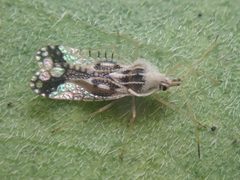
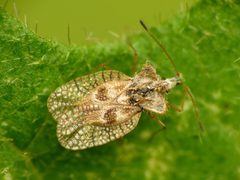
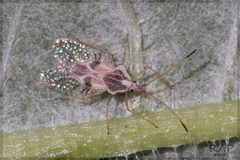
9Gargaphia is a of lace bugs ( Tingidae) containing more than 70 described . Members are small, phytophagous true bugs characterized by intricate reticulated forewings. Several species are economically significant as agricultural pests, particularly on solanaceous crops and passion fruit. The genus is notable for exhibiting maternal care , including guarding and defensive responses to .
Pronunciation
How to pronounce Gargaphia: /ɡɑrˈɡæfiə/
These audio files are automatically generated. While they are not always 100% accurate, they are a good starting point.
Identification
Distinguished from other tingid by specific patterns of areolation on the pronotum and . Some show distinctive crescent-shaped (lunulate) markings. Gargaphia lunulata, for example, is identifiable by the lunulate patterns referenced in its specific epithet. Separation from related genera such as Corythucha and Corythaica requires detailed examination of reticulation patterns and body proportions. and plant associations may provide field clues for certain species.
Images
Habitat
Found on the leaves of plants, typically on the abaxial (lower) surface. Colonies form on foliage of herbaceous plants and shrubs. seek shelter in leaf litter. Some occupy agricultural fields, greenhouses, and residential gardens; others occur in natural vegetation.
Distribution
Widely distributed in the Americas, with records from North America (United States, Canada), Central America, South America (Argentina, Brazil, Colombia, Paraguay), and the Caribbean. Individual have more restricted ranges; for example, G. tiliae occurs in eastern North America, while G. lunulata is broadly distributed in South America.
Seasonality
overwinter as in reproductive , becoming active in April or May in temperate regions. Activity continues through summer and early autumn. In October, adults fly short distances to sites in leaf litter.
Diet
Phytophagous; feeds on plant sap from leaves, causing characteristic white stippling damage. plant associations vary by , with many showing fidelity to particular plant or .
Host Associations
- Solanum - primary Multiple including S. elaeagnifolium, S. granuloso-leprosum; some Gargaphia species are feeders on Solanaceae
- Passiflora - primary G. lunulata is a significant pest of passion fruit (Passiflora edulis) in Brazil
- Ricinus communis - G. lunulata recorded on castor oil plant (Euphorbiaceae)
- Phaseolus - Multiple including P. vulgaris (common bean) and P. lunatus (lima bean)
- Abelmoschus esculentus - Okra; recorded for G. lunulata
- Canavalia ensiformis - Jack bean; recorded for G. lunulata
- Tilia - G. tiliae specific to basswood/linden
- Juglans - Associated with walnut
- Ruta graveolens - Rue; recorded for G. lunulata
- Crotalaria spectabilis - Showy rattlebox; recorded for G. lunulata
- Turnera ulmifolia - Yellow alder; recorded for G. lunulata
- Senna alata - Candle bush; recorded for G. lunulata
- Calopogonium mucunoides - Recorded for G. paula
Life Cycle
in temperate . Overwinters as in leaf litter in reproductive . laid on underside of leaves, often in masses. Nymphs develop through five instars. Development includes egg, five nymphal instars, and adult stages. , , and nymphal development have been quantified for some species.
Behavior
Exhibits colonial with and nymphs forming dense groups on plant leaves. Maternal care is well-documented: females guard masses and defend offspring against . Alarm responses involving chemical signaling have been observed. Egg dumping behavior occurs, where females lay eggs in the egg masses of other females; this behavior is influenced by relatedness between females. Mating occurs end-to-end at an angle of 35–40°.
Ecological Role
Herbivore that can significantly impact plant through feeding damage causing , wilting, and early leaf . Serves as prey for various and , though defensive and maternal care may reduce pressure. Some have been evaluated or employed as agents for weeds such as Solanum mauritianum and Solanum elaeagnifolium.
Human Relevance
Several are agricultural pests. Gargaphia solani is known as the eggplant lace bug. Gargaphia lunulata is an important pest of passion fruit in Brazil, causing significant damage to commercial . Gargaphia decoris and G. arizonica have been investigated and released as agents for Solanum weeds in South Africa, New Zealand, and other regions. specificity testing has been conducted to assess non-target risks for biocontrol applications.
Similar Taxa
- CorythuchaBoth are tingid with reticulated forewings; distinguished by specific patterns of areolation and pronotal structure. Corythucha such as C. juglandis show different associations and .
- CorythaicaNeotropical tingid with similar lace-like wing structure; Corythaica cyathicollis is a Solanum that co-occurs with some Gargaphia but differs in specific reticulation patterns and body form.
- StephanitisAnother lace bug with reticulated wings; distinguished by differences in pronotal hood structure and areolation patterns, as well as typically different plant associations.
More Details
Maternal care evolution
The Gargaphia has been extensively studied for its maternal care , including guarding and defensive responses. These behaviors show genetic variation and represent significant examples of in Hemiptera.
Biocontrol applications
Multiple Gargaphia have undergone rigorous specificity testing for programs. G. decoris was released in South Africa in 1999 for control of woolly nightshade (Solanum mauritianum) and has been evaluated for introduction to New Zealand. G. arizonica has been investigated for control of silverleaf nightshade (Solanum elaeagnifolium).
Taxonomic diversity
The contains substantial with over 70 described , many with restricted distributions and specialized associations. Accurate species identification requires examination of and detailed morphological analysis.
Sources and further reading
- BugGuide
- Wikipedia
- GBIF taxonomy match
- iNaturalist taxon
- NCBI Taxonomy
- Catalogue of Life
- Hemiptera | Beetles In The Bush | Page 9
- The effect of relatedness on Gargaphia egg dumping behaviour
- First record of Gargaphia paula Drake, 1939 (Hemiptera, Tingidae) from Colombia, with a new host plant and an updated checklist of Gargaphia species in the country
- Genetic Variation in the Maternal Defensive Behavior of the Lace Bug Gargaphia solani
- Life History Trade-Offs in Gargaphia Solani (Hemiptera: Tingidae): The Cost of Reproduction
- Natural history of Corythucha juglandis and Gargaphia tiliae (Hemiptera: Tingidae) in Ontario and Québec, Canada
- Registro de plantas hospedeiras de Gargaphia lunulata (Mayr) (Hemiptera: Tingidae) em área rural no estado do Tocantins
- Gargaphia paula(Heteroptera: Tingidae): First Host Plant Record, New Geographic Data and Distribution Summary
- Effects of temperature, photoperiod and humidity on the life history of Gargaphia decoris
- Registros de ocorrência e novos hospedeiros de Gargaphia lunulata (Mayr) (Hemiptera: Tingidae) nos estados do Acre e Paraná
- Maternal Behavior and Alarm Response inthe Eggplant Lace Bug, Gargaphia Solani Heidemann (Tingidae: Heteroptera)
- The current and future potential distribution of Gargaphia decoris: A biological control agent for Solanum mauritianum (Solanaceae)
- Maternal care in Gargaphia decoris (Heteroptera, Tingidae), with comments on this behavior within the genus and family
- Leptinotarsa texana Schaeffer and Gargaphia arizonica Drake & Carvalho as potential biocontrol agents for the noxious weed S olanum elaeagnifolium Cav
- The risk to <i>Solanum</i> spp in New Zealand from <i>Gargaphia decoris</i> (Hem Tingidae) a potential biocontrol agent against woolly nightshade <i>S mauritianum</i>
- Phaseolus lunatus L., the new host of Gargaphia torresi Lima, 1922 (Hemiptera: Tingidae) in Brazil