
Gargaphia solani
Heidemann, 1914
eggplant lace bug
Gargaphia solani is a subsocial lace bug in the Tingidae, described by Heidemann in 1914 after emerging as a pest of eggplant in Norfolk, Virginia. It is the first in its family in which maternal care was discovered. Females guard circular masses on leaf undersides and defend nymphs against , a essential for offspring survival given heavy pressure. Development from egg to takes approximately 20 days, with nymphs passing through five instars. The species is a significant agricultural pest of solanaceous crops and has been extensively studied for its reproductive trade-offs and the evolution of parental care.
Pronunciation
How to pronounce Gargaphia solani: //ɡɑrˈɡæfiə səˈleɪnaɪ//
These audio files are automatically generated. While they are not always 100% accurate, they are a good starting point.
Identification
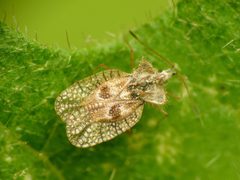
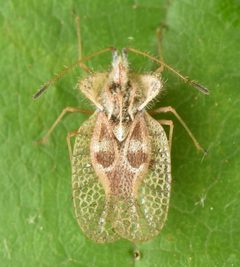
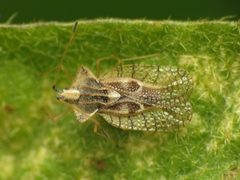
are small, flattened lace bugs with the characteristic reticulated, lace-like forewings of the Tingidae. Nymphs bear prominent spines, the function of which was historically uncertain but now understood to serve protective purposes. are deposited in distinctive circular masses on the abaxial leaf surface, attached at a slight angle and covered with —this egg mass structure is a key identifying feature. Fifth instar nymphs and adults were figured in early taxonomic literature (Fink 1915).
Images
Habitat
Associated with flowering plants in the Solanaceae, particularly agricultural settings where solanaceous crops are grown. overwinter in clumps of grass, under bark, or beneath leaves of mullein (Verbascum thapsus).
Distribution
Recorded from Mexico, the United States, and Canada. GBIF distribution records indicate presence across much of North America including Canadian provinces (Alberta, British Columbia, Labrador, Manitoba, New Brunswick, Newfoundland, Nova Scotia, Nunavut, Northwest Territories, Ontario, Prince Edward Island, Quebec, Saskatchewan, Yukon) and U.S. states (Alabama, Alaska, Arkansas, Arizona, California, Colorado, Delaware, Florida, Georgia, Idaho, Illinois, Indiana, Iowa, Kansas, Kentucky, Louisiana, Maine, Massachusetts, Michigan, Minnesota, Montana, Maryland, Mississippi, Missouri, North Carolina, North Dakota, Nebraska, Nevada, New Hampshire, New Jersey, New Mexico, New York, Ohio, Oklahoma, Oregon, Pennsylvania, Rhode Island, South Carolina, South Dakota, Tennessee, Texas).
Seasonality
Mating has been observed in November. Approximately seven to eight occur annually, with six generations typically on eggplant and the final generation on horse nettle (Solanum carolinense). have been found year-round in Missouri.
Diet
Feeds on phloem sap of plants in the Solanaceae. Recorded include Solanum melongena (eggplant), Solanum tuberosum (potato), Solanum lycopersicum (tomato), and other Solanum . Also found on Althara, Cassia, Gossypium, and Salvia species.
Host Associations
- Solanum melongena - primary eggplant, major agricultural pest
- Solanum tuberosum - potato
- Solanum lycopersicum - tomato
- Solanum carolinense - horse nettle, late-season
- Althara -
- Cassia -
- Gossypium -
- Salvia -
Life Cycle
Development from to takes approximately 20 days. The nymphal stage lasts about 10 days, with five instars. Females lay eggs in circular deposits on the abaxial (lower) side of leaves. Eggs are attached at a slight angle and covered with .
Behavior
Females exhibit subsocial maternal care, the first documented in the Tingidae. Mothers defend masses and early instar nymphs against and by moving toward threats and fanning their wings. Without this protection, offspring survival in the wild drops to approximately 3%. Females respond to alarm signals from nymphs. Nymphs display alarm response when disturbed, including aggregating and waving . Larvae emit an , geraniol, from glands that causes nearby nymphs to flee. Females engage in by laying eggs in the egg masses of conspecifics, exploiting other females' parental care. Maternal defensive intensifies with maternal age and as nymphs mature, consistent with evolutionary predictions regarding reproductive value and future reproductive potential.
Ecological Role
Agricultural pest of solanaceous crops, particularly when eggplant is planted at large . Subject to substantial and pressure, which has driven the evolution of elaborate defensive and maternal care. Prey to including ladybird beetles (Hippodamia convergens, Megilla maculata), heteropteran predators (Podisus maculiventris, Orius insidiosus), and small spider .
Human Relevance
Significant agricultural pest of eggplant, potato, and tomato. First recognized as a pest in 1913 in Norfolk, Virginia. Economic damage occurs primarily through feeding on solanaceous crops. Subject of extensive behavioral and evolutionary research due to its subsocial maternal care system.
Similar Taxa
- Corythaica cyathicollisAnother lace bug associated with Solanum ; distinguished by distribution (Neotropical vs. Nearctic), range, and lack of documented subsocial
- Gargaphia lunulataCongeneric feeding on different plants including Ricinus communis; distinguished by host associations and geographic distribution
Sources and further reading
- BugGuide
- Wikipedia
- GBIF taxonomy match
- iNaturalist taxon
- NCBI Taxonomy
- Catalogue of Life
- Katja Poveda: Zeroing in on Plant-Insect Interactions | Bug Squad
- Hemiptera | Beetles In The Bush | Page 9
- Small Farms: On the Front Lines of Emerging Agricultural Pests
- Argentina | Beetles In The Bush | Page 9
- Genetic Variation in the Maternal Defensive Behavior of the Lace Bug Gargaphia solani
- Life History Trade-Offs in Gargaphia Solani (Hemiptera: Tingidae): The Cost of Reproduction
- Maternal Behavior and Alarm Response inthe Eggplant Lace Bug, Gargaphia Solani Heidemann (Tingidae: Heteroptera)