
Ricinus
L., 1753
Castor Beans, Castor Oil Plant, Castor Bean, Higuerilla, Mamona
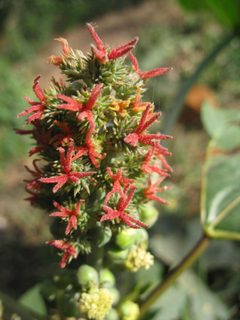
Ricinus is a of flowering plants in the spurge Euphorbiaceae, containing the single Ricinus communis. This fast-growing shrub or small tree is native to the southeastern Mediterranean Basin, East Africa, and India, but has become widespread throughout tropical and subtropical regions worldwide. The plant is economically significant as the source of castor oil, extracted from seeds that contain 40–60% oil rich in ricinoleic acid. All plant parts contain ricin, a highly potent water-soluble toxin that makes the seeds especially dangerous if ingested. The species exhibits remarkable morphological variability, with cultivars developed for both ornamental purposes and commercial oil production.
Pronunciation
How to pronounce Ricinus: //ˈrɪsɪnʊs//
These audio files are automatically generated. While they are not always 100% accurate, they are a good starting point.
Identification
Distinguished from other Euphorbiaceae by the combination of large palmately lobed leaves, terminal racemose inflorescences with separate male and female flowers, and spiny three-lobed capsules containing three large mottled seeds with caruncles. The 'false castor oil plant' Fatsia japonica (Araliaceae) is not closely related and differs in leaf structure and fruit type. Within Euphorbiaceae, Ricinus is placed in its own subtribe Ricininae based on unique morphological and chemical characteristics including the production of ricin and castor oil with high ricinoleic acid content.
Images
Habitat
Native to warm temperate and tropical regions; thrives in disturbed , wastelands, and open areas. In tropical climates, establishes readily and can become . Grown extensively as an ornamental in parks and public areas, and as a crop in agricultural systems. Requires well-drained soils and full sun; not cold hardy, suffering frost damage below freezing temperatures.
Distribution
to the southeastern Mediterranean Basin, East Africa, and India. Naturalized and widespread throughout tropical regions worldwide. Cultivated globally in suitable climates including southern Europe, the Americas, Africa, and Asia. In the United States, grows wild in parts of the Southwest and California, notably in Griffith Park, Los Angeles.
Seasonality
In temperate regions, active growth occurs during warm months; flowers and fruits produced summer through fall. In tropical climates, with year-round growth potential. In frost-prone areas, grown as or overwintered in protected conditions.
Host Associations
- Ariadne merione - plantCommon castor
- Samia cynthia ricini - plantEri silkmoth
- Achaea janata - plantCastor semi-looper
- Hypercompe hambletoni - plantLepidopteran larval food plant
- Discestra trifolii - plantNutmoth, larval food plant
- Evarcha culicivora - associationJumping spider consumes nectar and uses plant for courtship
- Ants (various species) - mutualismMyrmecochory via caruncle (elaiosome) on seeds
Life Cycle
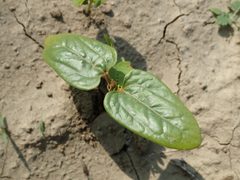
in tropical climates, behaving as in temperate regions with frost. Reproduces via mixed pollination system favoring selfing by geitonogamy while capable of outcrossing via wind (anemophily) or insect (entomophily) pollination. Natural pollination rates range from 5–46%. Seeds dispersed by ants attracted to lipid-rich caruncle; after removing caruncle, ants discard seeds in favorable germination sites. Seeds germinate readily in warm conditions; growth rapid, with plants reaching 2–3 m in one year under optimal conditions.
Ecological Role
Provides food and for specialized herbivores including several Lepidoptera . Seed mutualism with ants. Contains ricin, which provides natural protection against insect pests such as aphids and has been investigated as a potential . Allelopathic properties inhibit germination of competing plants such as lettuce and tomato. potential in disturbed tropical habitats where it can outcompete native vegetation.
Human Relevance
Economically important crop for castor oil production, with global production around two million tons annually; India produces over three-quarters of global yield. Oil used in lubricants, biodiesel, cosmetics, pharmaceuticals, and as chemical feedstock. Polyglycerol polyricinoleate derived from castor oil modifies cocoa butter flow in chocolate manufacture. Ornamental cultivars widely planted for foliage and architectural form. Historical medicinal use as laxative and topical treatment. Highly toxic: seeds contain ricin, one of the most potent plant toxins known; lethal dose in estimated at 4–8 seeds. Extremely allergenic (OPALS rating 10/10), with pollen, sap, and plant parts causing severe allergic reactions and asthma triggers. Misuse as instrument of coercion in historical political repression. Jewelry made from seeds poses poisoning risk if shells are damaged.
Similar Taxa
- Fatsia japonica 'false castor oil plant' refers to superficial resemblance in leaf shape, but belongs to Araliaceae, not Euphorbiaceae; differs in palmate leaves with fewer, broader lobes, and berry-like fruits rather than spiny capsules
- Jatropha curcasAnother euphorb with toxic seeds and oil production potential; differs in smaller, less deeply lobed leaves, different inflorescence structure, and non-spiny capsules
More Details
Cultivar Diversity
Numerous cultivars developed for distinct purposes: ornamental types selected for foliage color ('Carmencita' series, 'Gibsonii', 'New Zealand Purple', 'Impala', 'Red Spire', 'Zanzibarensis') and oil production types selected for yield, reduced ricin content ('Brigham'), or mechanized harvest compatibility ('BRS Energia', 'Hale')
Toxicity and Safety
Commercial cold-pressed castor oil is non-toxic as ricin is water-soluble and does not partition into the oil. Intact seeds may pass through digestive tract without releasing toxin; poisoning requires seed breakage or chewing. Ricin investigated for potential therapeutic and insecticidal applications.
Etymology
Linnaeus named Ricinus from Latin word for , referring to seed appearance with bump at tip and markings resembling certain ticks. 'castor oil' derives from use as replacement for castoreum (beaver gland product), not from the plant itself. Alternative name 'Palma Christi' (palm of Christ) refers to reputed healing properties.
Sources and further reading
- BugGuide
- Wikipedia
- iNaturalist taxon
- NCBI Taxonomy
- Catalogue of Life
- What Eats Ticks? Study Puts an Old Technique to New Use
- Hemiptera | Beetles In The Bush | Page 9
- The Sweetest Snack: Research Details Mosquitoes' Nectar Preferences
- Un relato sonoro con higuerillas (Ricinus communis) A Sound Story with Castor Beans (Ricinus communis) Uma narrativa sonora com mamonas (Ricinus communis)
- Ticks ixodes ricinus (Linnaeus, 1758) Of the lower Dniester River
- Lipolytic activity of ricin from Ricinus sanguineus and Ricinus communis on neutral lipids
- Botany, Geographical Distribution, Cultivation Techniques, and Crop Productivity of Ricinus communis L.
- Review on Reproductive Biology of Caster bean (Ricinus communis L.)
- Diversity Assessment by Molecular Barcoding and Seed Morphology in Ricinus communis L.
- Effect of short and randomly oriented Ricinus Communis L (Castor oil) plant on Mechanical Behaviour of Ricinus Communis L/ Epoxy LY556 Composites
- Ricinus communis L. (MAMONA): Sementes Tóxicas Com Potencial Alelopático