
Lycorma
Stål, 1863
lanternfly, lantern bug
Species Guides
1- Lycorma delicatula(Spotted Lanternfly)
Lycorma is a of planthoppers in the Fulgoridae, native to Asia. The genus was established by Carl Stål in 1863, with Lycorma imperialis designated as the type . The genus contains four recognized species, of which L. delicatula (the spotted lanternfly) has become a globally significant pest. Members of this genus are characterized by their brightly colored hind wings and are commonly referred to as "lanternflies" or "lantern " in reference to this display.


Pronunciation
How to pronounce Lycorma: //lɪˈkɔːr.mə//
These audio files are automatically generated. While they are not always 100% accurate, they are a good starting point.
Identification
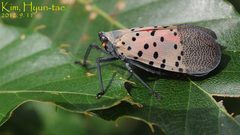
Lycorma can be distinguished from other Fulgoridae by their combination of cryptic forewings and vividly colored hind wings with red, black, and white patterns. Within the , species are differentiated by specific wing patterns and coloration: L. delicatula has grey forewings with black spots and red hind wing patches; L. imperialis has different coloration patterns; L. meliae and L. punicea have distinct morphological features. The genus is distinguished from the related genus Aphaena by taxonomic characters established by Stål in 1863.
Images
Appearance
Members of the Lycorma are medium to large planthoppers with distinctive coloration. possess forewings that are typically dull-colored (tan, brown, or grey with dark spots in L. delicatula) that conceal brightly colored hind wings. The hind wings are vivid, often displaying red, black, and white patterns that are exposed during or when the insect is disturbed. The body is somewhat flattened dorsoventrally. Nymphs undergo several instars with changing coloration: early instars are black with white spots, while later instars develop red patches in addition to black and white markings.
Habitat
in this inhabit forested and agricultural landscapes in their native Asian range. L. delicatula is strongly associated with tree of heaven (Ailanthus altissima) but utilizes a broad range of woody plants. In invaded ranges, establish in urban, suburban, and agricultural settings including vineyards, orchards, and forests. Nymphs are found on a wide variety of herbaceous and woody plants, while aggregate on specific host trees.
Distribution
Native to South and Southeast Asia. L. delicatula is native to northern China (Shanxi, Shandong, Hebei provinces) with expanded range to Anhui, Beijing, Guangdong, Henan, Jiangsu, Sichuan, Yunnan, Zhejiang; presence in Taiwan, Vietnam, and India requires confirmation. L. imperialis occurs in China, Bangladesh, and India (Assam, Sikkim). L. punicea is known from Bangladesh and India (Assam, Darjeeling). L. meliae is to Taiwan. : L. delicatula established in South Korea (2006), Japan (2009), and the United States (Pennsylvania 2014, now in 17+ eastern states).
Seasonality
In temperate regions, are active from late summer through autumn (July to November in North America). masses overwinter, with nymphs hatching in spring (April-May in North America). Nymphs develop through four instars before molting to adults. Adult activity ceases with hard frosts (temperatures below -2°C/28°F are lethal to adults); eggs survive colder winter temperatures.
Diet
Phloem sap feeder. All feed on vascular plants by inserting stylets into phloem tissue and extracting sap. L. delicatula is highly , feeding on more than 100 plant including woody and herbaceous species. Preferred include tree of heaven (Ailanthus altissima), grape (Vitis spp.), apple (Malus spp.), walnut (Juglans spp.), maple (Acer spp.), and willow (Salix spp.).
Host Associations
- Ailanthus altissima - primary Tree of heaven is the preferred ; survival and are significantly higher with access to this plant
- Vitis spp. - economic Grapevines are severely damaged by feeding; massive can cause vineyard demise
- Malus spp. - economic Apple trees are commonly utilized
- Juglans spp. - Walnut trees frequently support
- Acer spp. - Maple trees commonly mobbed by
- Salix babylonica - Willow utilized especially when Ailanthus absent
Life Cycle
Hemimetabolous development with , nymph, and stages. Eggs are laid in masses covered with white or grey waxy secretion that weathers to tawny brown or grey by late winter. Nymphs pass through four instars: first instar black with white spots; later instars develop red coloration. Development from egg to adult requires approximately 2-3 months under favorable conditions. Adults are present for several months before winter mortality. In L. delicatula, females with access to Ailanthus altissima deposited nearly 7-fold more egg masses than those without access.
Behavior
Nymphs are relatively sedentary, dispersing short distances (studies show travel of 56 feet, maximum 213 feet) to locate plants. exhibit two distinct behavioral phenotypes: unmated females are strong fliers capable of spontaneous of 30-150 feet to locate suitable hosts; mated females are flight-limited. Both sexes are attracted to sites on preferred hosts. Adults frequently land on human-made structures and vehicles. The is a notorious hitchhiker, with masses deposited on non-host objects including stone, cinder blocks, lawn furniture, and vehicles, facilitating long-distance human-assisted .
Ecological Role
As phloem feeders, members of this process large quantities of plant sap and excrete excess as honeydew. Honeydew production supports growth, which can impair plant . Honeydew also attracts other insects including stinging , yellowjackets, and honey bees. In invaded ranges, L. delicatula functions as a significant pest of agricultural and forest . Natural enemies in native ranges include praying mantises (Tenodera sinensis, T. angustipennis, Hierodula petellifera, Mantis religiosa, Statilia maculata) and (Anastatus orientalis, Ooencyrtus kuvanae).
Human Relevance
L. delicatula is a major agricultural pest causing estimated losses exceeding $50 million in Pennsylvania alone. Damage occurs through direct feeding, honeydew production that fouls fruit and foliage and promotes , and attraction of stinging insects. The threatens grape, apple, cherry, peach, and hop industries. measures are in place in multiple U.S. states to limit spread. Public awareness campaigns encourage reporting and destruction of specimens. The species has been detected on weather radar due to mass autumn . Some have declined in Pennsylvania due to natural enemy pressure, pathogenic fungi (Batkoa major, bassiana), and management efforts.
Similar Taxa
- AphaenaHistorically confused with Lycorma; some Lycorma were originally described under Aphaena. Distinguished by taxonomic characters established by Stål in 1863.
- FulgoraAnother fulgorid with "lanternfly"; distinguished by different and wing patterns.
More Details
Etymology
The name derives from the Lycormas river in Aetolia, Greece (modern Evinos river). In Greek mythology, Evenus drowned himself in this river after his daughter Marpessa was abducted by Idas.
Radar detection
Mass of L. delicatula have been detected on weather radar in the Mid-Atlantic United States, generating public attention to the of autumn .
Population genetics
Genetic analysis indicates that the Korean originated primarily from the Shanghai region of China, with at least three separate introduction events.
Sources and further reading
- BugGuide
- Wikipedia
- iNaturalist taxon
- NCBI Taxonomy
- Catalogue of Life
- Death of a lanternfly, Part 1: What a frosty night means to spotted lanternfly, Lycorma deliculata — Bug of the Week
- Mostly sunny with a chance of lanternflies: Radar sightings of spotted lanternflies, Lycorma delicatula — Bug of the Week
- Coming soon to your neighborhood? Spotted lanternfly, Lycorma delicatula — Bug of the Week
- Fright and fun courtesy of flying spotted lanternflies, Lycorma delicatula — Bug of the Week
- Why am I seeing more spotted lanternflies? Lycorma delicatula — Bug of the Week
- Honeydew for honey bees? Spotted lanternflies, Lycorma delicatula — Bug of the Week
- Lycorma delicatula (White)
- Spotted lanternfly, Lycorma delicatula (White)
- Lycorma delicatula . [Distribution map].
- Factors Guiding the Orientation of Nymphal Spotted Lanternfly, Lycorma delicatula
- Host alternation and dispersal ofLycorma delicatulain South Korea
- Biology and natural enemies of the spotted lanternfly,Lycorma delicatula,in North America
- Performance and Host Association of Spotted Lanternfly (Lycorma Delicatula) among Common Woody Ornamentals
- Multifaceted Investigation into the Absence and Potential Invasion of Spotted Lanternfly (Lycorma delicatula) in Taiwan
- Predation efficiency of praying mantises as important natural enemies of spotted lanternfly, Lycorma delicatula (Hemiptera: Fulgoridae)
- Spatial dynamics of spotted lanternfly, Lycorma delicatula, invasion of the Northeastern United States
- Suitability of twenty North America tree species as secondary hosts of the invasive spotted lanternfly,Lycorma delicatula(White) (Hemiptera: Fulgoridae)
- Parasitism Rate of Egg Parasitoid Anastatus orientalis (Hymenoptera: Eupelmidae) on Lycorma delicatula (Hemiptera: Fulgoridae) in China
- Predicting potential current distribution of Lycorma delicatula (Hemiptera: Fulgoridae) using MaxEnt model in South Korea
- Modeling the life cycle of the spotted lanternfly (Lycorma delicatula) with management implications
- Tracing the Origin of Korean Invasive Populations of the Spotted Lanternfly, Lycorma Delicatula (Hemiptera: Fulgoridae)