
Ooencyrtus kuvanae
(Howard, 1910)
gypsy moth egg parasitoid, spongy moth egg parasitoid
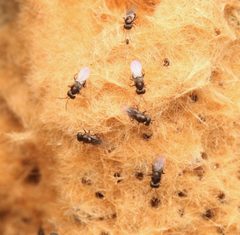
Ooencyrtus kuvanae is a solitary in the Encyrtidae, originally introduced to North America in 1908 for of Lymantria . It has since become established as a natural enemy of the spongy moth (Lymantria dispar) and has been documented parasitizing the spotted lanternfly (Lycorma delicatula) in North America. The exhibits quasi-gregarious development, with females typically laying one offspring per egg and adjusting sex ratios based on resource availability and local mate competition. Development from egg to takes 18–24 days, with males emerging approximately one day earlier than females.
Pronunciation
How to pronounce Ooencyrtus kuvanae: //oʊˈɛn.sɪr.təs kuˈvɑː.neɪ//
These audio files are automatically generated. While they are not always 100% accurate, they are a good starting point.
Identification
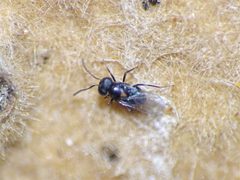
Distinguishable from other Ooencyrtus by its association with Lymantria dispar masses and documented of Lycorma delicatula eggs. Morphological identification requires examination of microscopic features typical of Encyrtidae: reduced wing venation with shortened , distinct mesoscutal structure, and characteristic antennal segmentation. Accurate species-level identification typically requires slide-mounted specimens and comparison with type material or expert determination.
Images
Habitat
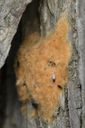
Associated with forest and urban environments where masses occur on trees and woody vegetation. In laboratory conditions, successfully reared at 24–25°C with 60–70% relative humidity and 14L:10D . Overwinters as near ground level, with seasonal vertical distribution shifting from higher positions in summer to lower positions in fall.
Distribution
Native to Asia; introduced to North America in 1908. Established in United States (Virginia, Pennsylvania, and other eastern states), Canada (Ontario, Quebec), and subsequently introduced to Russia (European part, imported from North Korea in 1988). Distribution closely tracks that of its primary , Lymantria dispar.
Seasonality
activity peaks during summer months, with reliable sampling estimates obtained between 1300–1600 hours EST on sunny days. Activity reduced on overcast days. Multiple may occur within a single mass before hosts are exhausted. adults present near ground level in late fall.
Diet
feed on honey and water in laboratory settings; wild feeding habits unknown. Larvae develop as obligate endoparasitoids within , consuming egg contents.
Host Associations
- Lymantria dispar - primary spongy moth/gypsy moth, significant forest pest in North America
- Lycorma delicatula - spotted lanternfly, pest in North America
- Philosamia ricini - substitute eri silkmoth, used for laboratory rearing and mass production
Life Cycle
to takes 18–24 days under laboratory conditions (25°C, 65% RH). Males develop faster, emerging approximately one day before females. Females insert single eggs into accessible eggs within egg masses. Quasi-gregarious development results in synchronous mass of sexually mature adults from host egg masses. Multiple may complete development within a single egg mass before host resources are exhausted. Mean oviposition period lasts approximately 22.8 days, with post-oviposition period of 13.6 days.
Behavior
Exhibits flexible oviposition based on time within patch and resource availability. Females spend more time and produce more offspring on single masses when given extended periods (4–16 days) versus frequent replacement scenarios. When presented with multiple egg masses simultaneously, females concentrate offspring production on a minority of egg masses rather than dividing effort equally. Sex allocation responds to local mate competition: produces more female-biased offspring when alone, more male-biased offspring when other foundresses present. Males engage in precopulatory and postcopulatory rituals; first-male observed with 88% paternity for males completing both rituals. Postcopulatory rituals function as mate guarding. No kin recognition or response to sibling presence documented.
Ecological Role
Natural enemy and agent of Lymantria dispar, a significant defoliating forest pest in North America. Contributes to of spongy moth through . Potential role in management of spotted lanternfly. Part of strategies combining chemical/biological treatments with releases.
Human Relevance
Used in programs against spongy moth since 1908. Mass reared for inundative release using substitute Philosamia ricini. Experimental releases in Russia (2019) demonstrated effectiveness in reducing host at moderate densities (82.9–90.3% at 107–268 thousand /ha), with reduced effectiveness at very high host densities (>3800 thousand eggs/ha). Optimal release timing occurs at beginning of pest focus formation; ineffective at controlling active populations with >1.5 egg masses per tree.
Similar Taxa
- Ooencyrtus pityocampaecongeneric with similar and mass rearing potential; both evaluated for cold storage effects on rearing parameters
- Anastatus japonicussympatric of Lymantria dispar in Russia; both imported from North Korea in 1988 for gypsy moth control
- Ooencyrtus nezaraecongeneric with similar , recently discovered in North America parasitizing kudzu bug
Sources and further reading
- BugGuide
- Wikipedia
- GBIF taxonomy match
- iNaturalist taxon
- NCBI Taxonomy
- Encyrtid Holdings | Entomology Research Museum
- ooencyrtus_limeirae_myartseva_holotype_female_ucrc_ent_222398_lateral.jpg | Entomology Research Museum
- Primary Type List | Entomology Research Museum
- Publications | Entomology Research Museum
- kudzu bug and Ooencyrtus nezarae - Entomology Today
- kudzu bug eggs parasitized by Ooencyrtus nezarae and Paratelenomus saccharalis - Entomology Today
- Application of Ooencyrtus kuvanae Howard Against Gypsy Moth
- Local mate competition in the solitary parasitoid wasp Ooencyrtus kuvanae
- Oviposition behavior of the quasi-gregarious parasitoid, Ooencyrtus kuvanae (Hymenoptera: Encyrtidae)
- A new substitute host and its effects on some biological properties ofOoencyrtus kuvanae
- Incidence of superparasitism in the egg parasitoid,Ooencyrtus kuvanaeHoward (Hymenoptera: Encyrtidae)
- Endogenous and exogenous factors affecting parasitism of gypsy moth egg masses by Ooencyrtus kuvanae
- Effects of differentPhilosamia ricini(Lepidoptera: Saturniidae) cold storage periods onOoencyrtus pityocampaeandOoencyrtus kuvanae(Hymenoptera: Encyrtidae) rearing
- Mechanisms, functions, and fitness consequences of pre- and post-copulatory rituals of the parasitoid wasp Ooencyrtus kuvanae
- DEVELOPMENT AND EVALUATION OF A SAMPLING SCHEME FOR THE GYPSY MOTH EGG PARASITOID OOENCYRTUS KUVANAE (HYMENOPTERA: ENCYRTIDAE)
- Host Plant Species and Parasitism of Gypsy Moth (Lepidoptera: Lymantriidae) Egg Masses by Ooencyrtus kuvanae (Hymenoptera: Encyrtidae)
- Does the Stereochemistry of Methylated Cuticular Hydrocarbons Contribute to Mate Recognition in the Egg Parasitoid Wasp Ooencyrtus kuvanae?
- First-male sperm precedence and precopulatory and postcopulatory rituals in the parasitoid waspOoencyrtus kuvanae(Hymenoptera: Encyrtidae)
- Effects of Host Diet on the Orientation, Development, and Subsequent Generations of the Gypsy Moth (Lepidoptera: Lymantriidae) Egg Parasitoid Ooencyrtus kuvanae (Hymenoptera: Encyrtidae)
- SPATIAL DISTRIBUTION OF ADULTS OFOOENCYRTUS KUVANAE(HYMENOPTERA: ENCYRTIDAE), AN EGG PARASITE OFLYMANTRIA DISPAR(LEPIDOPTERA: LYMANTRIIDAE)
- Effects of Light on Location of Host Egg Masses by Ooencyrtus kuvanae (Hymenoptera: Encyrtidae), an Egg Parasite of Gypsy Moth (Lepidoptera: Lymantriidae)