
Statilia maculata
Thunberg, 1784
Asian jumping mantis, 小蟷螂, ko-kamakiri, 좀사마귀, joem-sa-ma-gui
Statilia maculata is a medium-sized praying mantis native to East Asia, commonly known as the Asian jumping mantis. range from 40–50 mm (males) to 45–58 mm (females). The inhabits low-lying vegetation including weeds and shrubs, distinguishing it from -dwelling relatives. First described by Carl Peter Thunberg in 1784 from specimens thought to be from eastern India, it is now recognized across a broad Asian range. The species exhibits notable in cercal structure, with females possessing more articles and longer than males.
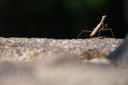
![Statilia maculata by Opencage]]. Used under a CC BY-SA 2.5 license.](https://bugswithmike.nyc3.cdn.digitaloceanspaces.com/responsive/wikipedia/arthropoda/hexapoda/insecta/mantodea/mantidae/mantinae/statilia/maculata/Statilia_maculata-240.jpg)

Pronunciation
How to pronounce Statilia maculata: //stæˈtɪliə ˌmækjʊˈleɪtə//
These audio files are automatically generated. While they are not always 100% accurate, they are a good starting point.
Identification
Medium-sized mantis with males 40–50 mm and females 45–58 mm in length. evident in cercal structure: females have more cercal articles (typically 16, range 12–18) and longer (4.87 ± 0.69 mm) compared to males (typically 14 articles, range 12–16; 3.89 ± 0.58 mm). Cercal surface bears short, shark tooth-like setae with scaly bases. Four types of cercal present: sensilla filiformia arranged in circular patterns near article margins, sensilla chaetica (with subtypes ScI and ScII) distributed across entire cerci, sensilla campaniformia, and cuticular pores.
Images
Habitat
Low-lying weeds and shrubs in tropical, subtropical, and temperate regions. Occupies a distinct vertical stratum in vegetation, contrasting with -dwelling mantids such as Hierodula patellifera.
Distribution
Native to East Asia. Documented from China (including Guangdong Province), Japan (Honshu, Shikoku, Kyushu), Korea, Taiwan, Russia, and Sri Lanka. S. m. maculata occurs across China, Japan, Taiwan, India, Java, Borneo, Nepal, Myanmar, New Guinea, Sri Lanka, Thailand, and Korea; S. m. continentalis recorded from Uttar Pradesh, India.
Diet
Predatory. Laboratory observations indicate feeding on Drosophila melanogaster; natural diet presumed to consist of small arthropods.
Life Cycle
Development includes stage within , nymphal instars, and . First instar nymphs exhibit no defensive response to . Second and third instar nymphs employ deimatic display as primary defense. Adults use as primary defensive strategy.
Behavior
Exhibits stage-specific defensive strategies against such as the Japanese skink (Takydromus tachydromoides). Second and third instar nymphs use deimatic display (startle response) when threatened; rely on . Unlike some sympatric mantids, does not switch between cryptic and subcryptic defenses based on predator distance. Cercal function in reproductive : females use for oviposition site assessment and molding; males use cerci to detect tactile and vibrational cues during courtship and mounting.
Ecological Role
Predatory insect with potential value in . Occupies distinct in low vegetation stratum, reducing competition with -dwelling predatory mantids.
Human Relevance
Consumed as food in Japan's Nagano prefecture, where wings, limbs, and guts are removed prior to cooking with sweetened soy sauce. used medicinally in Japan and China. size (C-value) of 3.05 has been documented for genetic studies.
Similar Taxa
- Hierodula patelliferaSympatric Asian of similar size, but distinguished by -dwelling versus low-lying vegetation preference of S. maculata; cercal ultrastructure differs in article number and distribution patterns.
- Tenodera aridifoliaLarger sympatric that exhibits distance-dependent defensive strategy switching, which S. maculata lacks; also shows aggressive defensive reactions in later instars absent in S. maculata.
Sources and further reading
- BugGuide
- Wikipedia
- GBIF taxonomy match
- iNaturalist taxon
- NCBI Taxonomy
- Catalogue of Life
- Be careful around baldfaced hornets, Dolichovespula maculata — Bug of the Week
- An inside look at baldfaced hornets, Dolichovespula maculata — Bug of the Week
- High fiber diets for baldfaced hornets? Nah, construction materials for enlarging nests: Baldfaced hornets, Dolichovespula maculata — Bug of the Week
- What do insects do in winter, Part 2? Tolerating the big chill: Banded woolly bears, Pyrrharctia isabella, field crickets, Gryllus spp., baldfaced hornets, Dolichovespula maculata, and others — Bug of the Week
- Bug Eric: Window-winged Moths
- Spiney, scaley distractions | Beetles In The Bush
- The Cercal Sensilla of the Praying Mantis Hierodula patellifera and Statilia maculata: A New Partition Based on the Cerci Ultrastructure
- Stage-Specific Defensive Strategies of Three Mantid Species, Tenodera aridifolia, Hierodura patellifera, and Statilia maculata, Against a Natural Enemy, Takydromus tachydromoides