
Acutalini
Fowler, 1895
Genus Guides
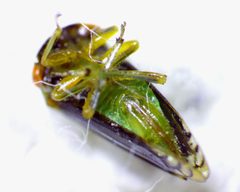
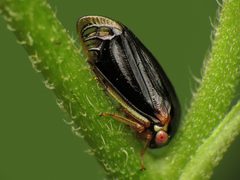
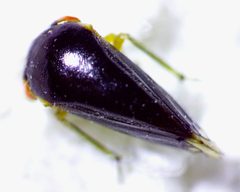
1Acutalini is a tribe of treehoppers in the Membracidae, containing approximately 26 described distributed from Canada to Brazil and Peru. Members are characterized by distinctive forewing venation including separate R, M, and Cu near the wing base, presence of R2+3 as a distinct branch, and R4+5 confluent with M distad of the M fork. Nymphs are cryptic, solitary, and not -attended, with unique morphological features including paired scoli on thoracic and abdominal segments. are primarily Neotropical, with many species associated with forest .
Pronunciation
How to pronounce Acutalini: //ˌækjuːtəˈlaɪnaɪ//
These audio files are automatically generated. While they are not always 100% accurate, they are a good starting point.
Identification
distinguished from other Smiliinae by forewing venation: separate R, M, and Cu near wing base; R2+3 present as distinct branch; R4+5 confluent with M distad of M fork; crossveins s and m-cu present. Some possess two discoidal in forewing. Nymphs identified by paired scoli on meso- and metathoracic nota and abdominal segments III–IX; some lack and pronotal scoli. Unique within Smiliinae: lateral rows of enlarged chalazae on and large ventrolateral scoli in some species.
Images
Habitat
Forest including terre firme forest and white water inundation forest. plants include Asteraceae (Ambrosia, Callistephus, Baccharis), Boraginaceae (Cordia), Fabaceae (Leucaena), Solanaceae (Lycopersicon), Acanthaceae (Anisacanthus), and Viscaceae (mistletoe). Some from highland elevations.
Distribution
New World: North America (Canada, United States), Central America (Guatemala, Mexico, Nicaragua), South America (Ecuador, Peru, Brazil, French Guiana, Colombia, Venezuela), and Caribbean (West Indies).
Diet
Phloem-feeding on plant sap. Preferred feeding sites are meristems and young leaves, which have higher nitrogen concentration.
Host Associations
- Ambrosia artemisiifolia - Asteraceae
- Callistephus chinensis - Asteraceae
- Baccharis - Asteraceae
- Cordia macrostachya - Boraginaceae
- Cordia - Boraginaceae
- Leucaena leucocephala - Fabaceae
- Lycopersicon esculentum - Solanaceae
- Anisacanthus thurberi - Acanthaceae
- Viscaceae - mistletoe
Life Cycle
deposited in clusters of 12–15, inserted into epidermal tissues of plant stems with approximately one-third of egg exposed, usually in leaf axis area. Nymphs solitary and not gregarious. Fifth instar nymphs of Micrutalini (closely related tribe) measure 3.0–3.5 mm; Acutalis fifth instars range 4.3–8.5 mm.
Behavior
Nymphs exceedingly cryptic in coloration and . Solitary, not -attended. Unable to jump, unlike most Auchenorrhyncha nymphs. Last visible abdominal segment (IX) ventrally, forming tube containing anal segments that can be everted at will. attracted to light traps.
Ecological Role
Potential for pseudo-curly top virus in tomato (reported for Micrutalis malleifera).
Similar Taxa
- MicrutaliniClosely related tribe within Smiliinae with which Acutalini shares cryptic nymphal and solitary, non--attended ; distinguished by wing venation and nymphal size (Micrutalini fifth instars notably smaller at 3.0–3.5 mm)
- Other Smiliinae tribesAcutalini nymphs uniquely possess lateral rows of enlarged chalazae on and large ventrolateral scoli in some ; distinguished by specific R2+3 and R4+5 wing venation pattern
Sources and further reading
- BugGuide
- iNaturalist taxon
- Catalogue of Life
- A new species of Cornutalis Sakakibara (Membracidae: Smiliinae: Acutalini) from Colombia
- Three new monobasic genera and three new species of the New World treehopper tribe Acutalini (Hemiptera, Membracidae, Smiliinae) with a key to all genera.
- The immatures of the New World treehopper tribes Acutalini Fowler and Micrutalini Haupt (Hemiptera, Membracidae, Smiliinae).