
Prosapia
Fennah, 1949
froghoppers, spittlebugs
Species Guides
5- Prosapia bicincta(Two-lined Spittlebug)
- Prosapia ignifera
- Prosapia ignipecta(Red-legged Spittlebug)
- Prosapia isobar
- Prosapia simulans
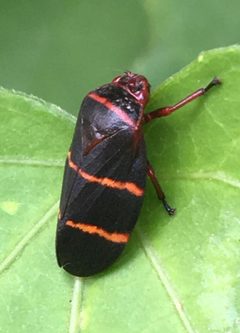
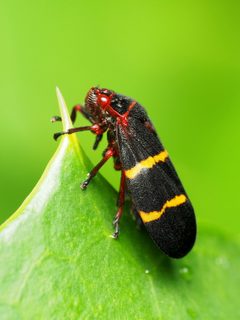
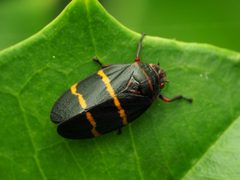
Prosapia is a of froghoppers ( Ischnorhinidae) comprising approximately six described distributed across North and Central America, including the Caribbean. These insects are commonly known as spittlebugs due to the protective foamy masses produced by nymphs. Several species are significant agricultural pests of forage grasses, turfgrasses, and sugarcane, causing economic damage through xylem feeding that induces water stress, tissue death, and reduced forage quality. The genus includes the two-lined spittlebug (P. bicincta), which established in Hawaiʻi in 2016 and has since damaged thousands of hectares of cattle pastures.
Pronunciation
How to pronounce Prosapia: /proˈsa.pi.a/
These audio files are automatically generated. While they are not always 100% accurate, they are a good starting point.
Images
Habitat
Members of this inhabit grass-dominated environments including pastures, rangelands, turfgrass systems, and sugarcane fields. In Hawaiʻi, P. bicincta occurs primarily in kikuyu grass (Cenchrus clandestinus) pastures at elevations between 519–1,679 meters, with highest abundance at mid-elevations (1,000–1,300 m). Activity coincides with wet season conditions.
Distribution
Native to North and Central America, including the Caribbean. P. bicincta is native to the southeastern United States and has been introduced to Hawaiʻi Island (detected 2016), where it has spread across an estimated 72,000–143,000 hectares in the Kona region. P. simulans has been detected in the Cauca Valley of Colombia (first recorded 1999).
Seasonality
In Hawaiʻi, P. bicincta exhibits peak abundance during the wet season, with most activity occurring from April to October and little to no activity between November and March. This pattern correlates with rainfall-driven plant productivity.
Diet
Xylem feeders on grasses (Poaceae). P. bicincta feeds on xylem sap of over 40 different plants. Nymph feeding causes water stress; feeding interferes with and causes plant tissue death. Documented hosts include kikuyu grass (Cenchrus clandestinus), Bermuda grass (Cynodon dactylon), Brachiaria , and various turfgrasses.
Host Associations
- Cenchrus clandestinus - primary kikuyu grass; forage grass in Hawaiʻi pastures, highly susceptible
- Cynodon dactylon - Bermuda grass; coastal and pasture varieties
- Brachiaria spp. - significant forage grass in Central and South America
- Urochloa spp. - multiple cultivars (Cayana, Cayman, Marandú, Mulato II, Sabiá) show resistance to P. bicincta
- Paspalum notatum - Bahia T9 cultivar shows resistance
- Cenchrus setaceus - fountain grass shows resistance
Life Cycle
Hemimetabolous development. P. simulans: pass through four morphologically distinguishable developmental stages (18 ± 1.3 days); nymphs pass through five instars (45.6 ± 5.4 days); longevity averages 16.5 days; total approximately 72 days. Egg occurs in field (69.8% in January–May ), extending up to 128 days. P. bicincta nymphs reside in protective spittle masses and complete five instars before emerging as adults.
Behavior
Nymphs continuously excrete frothy bubbles of feeding wastes from the , forming a protective spittle mass that conceals them from and desiccation. possess powerful hind legs enabling jumping distances up to 115 times their body length, earning the "froghopper." Females exhibit oviposition site preferences; in P. simulans, 82.7% of are deposited in stems versus soil.
Ecological Role
Agricultural pest causing significant economic and ecological damage to grassland . Heavy alter plant composition by killing forage grasses, facilitating weed invasion, reducing groundcover, and creating bare ground. In Hawaiʻi, P. bicincta has transformed pasture landscapes from productive grasslands to degraded systems dominated by forbs and shrubs.
Human Relevance
Major economic pest of cattle ranching, turfgrass industry, and sugarcane production. In Hawaiʻi, threatens a $48 million beef cattle industry covering nearly 20% of land area. Damage reduces forage availability, nutritional value, palatability, and digestibility. Management relies on grazing strategies, grass cultivars, burning, raking, mowing, and tilling; chemical control is generally not cost-effective at pasture . P. bicincta represents an existential threat to Hawaiʻi's culturally significant paniolo (cowboy) ranching tradition.
Similar Taxa
- Cercopidae (other spittlebug genera)Shared characteristics including spittle-producing nymphs and froghopper jumping ; Prosapia distinguished by Ischnorhinidae family placement and specific wing patterning in adults
- Aphrophora and PhilaenusOther spittlebug with similar nymphal spittle masses; Prosapia typically show more pronounced wing striping and are associated with tropical/subtropical pasture systems
More Details
Wolbachia endosymbiont
P. ignipectus harbors a group-B strain (wPig) that diverged from group-A Wolbachia 6–46 million years ago. frequencies are high but variable among sites and years. The wPig contains three divergent loci. P. bicincta in Hawaiʻi and Florida are uninfected, suggesting wPig was acquired after divergence of these sister . No apparent effect on reproductive isolation has been detected.
Invasion biology
P. bicincta is the first member of Cercopidae to invade Hawaiʻi, likely introduced via imported plant materials. Since 2016 detection, it has spread across >72,000 hectares and infests mid-elevation kikuyu grass pastures with densities up to 126 nymphs/m². This invasion demonstrates the vulnerability of isolated island to established continental agricultural pests.
Sources and further reading
- BugGuide
- Wikipedia
- GBIF taxonomy match
- iNaturalist taxon
- NCBI Taxonomy
- Catalogue of Life
- twolined-spittlebug-prosapia-bicincta - Entomology Today
- Prosapia bicincta Archives - Entomology Today
- Pasture Pest in Paradise: Invasive Bug Threatens Hawaiʻi Cattle Ranching
- twolined spittlebug foam - Entomology Today
- Hawaiʻi cattle pasture - Entomology Today
- twolined spittlebug damage in Hawaiʻi pasture - Entomology Today
- Two-lined spittlebug, Prosapia bicincta (Say) (Insecta: Hemiptera: Cercopidae)
- otb: an automated HiC/HiFi pipeline assembles the Prosapia bicincta Genome
- Biology and Control of the Spittlebug Prosapia bicincta in Coastal Bermuda Grass1
- Biology of the Two-Lined Spittlebug, Prosapia bicincta, on Florida Pastures (Homoptera: Cercopidae)
- Observations on the Biology and Cultural-Insecticidal Control of Prosapia bicincta, a Spittlebug, on Coastal Bermudagrass1
- Wolbachia in the spittlebug Prosapia ignipectus: Variable infection frequencies, but no apparent effect on host reproductive isolation
- Biology of the Spittlebug Prosapia Simulans (Homoptera: Cercopidae), New Pest of Cultivated Graminoids in Colombia
- Wolbachia in the spittlebug Prosapia ignipectus : Variable infection frequencies, but no apparent effect on host reproductive isolation
- Susceptibility of different forage grasses to feeding damage by Prosapia bicincta (Hemiptera: Cercopidae) adults in Hawaiʻi
- Prosapia bicincta (Hemiptera: Cercopidae) abundance, plant associations, and impacts on groundcover in Hawaiʻi Island rangelands