
Prosapia bicincta
(Say, 1831)
Two-lined Spittlebug, Twolined Spittlebug
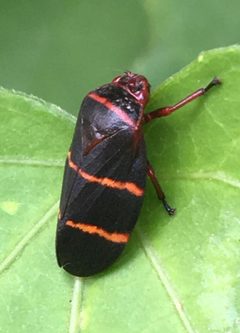
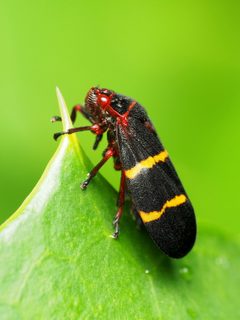
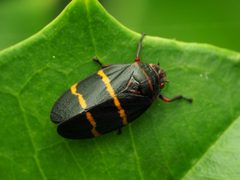
Prosapia bicincta, commonly known as the two-lined spittlebug, is a froghopper in the Ischnorhinidae (formerly Cercopidae). Native to the eastern United States, it was first detected in Hawaiʻi in 2016 and has since become a destructive pest of pasture grasses, infesting over 70,000 hectares on Hawaiʻi Island. The is named for the two prominent red or orange stripes crossing the black wings of and for the foamy spittle masses produced by nymphs. It causes significant economic damage to forage grasses, turfgrasses, and sugarcane through feeding that induces water stress, reduces , and causes plant tissue death.
Pronunciation
How to pronounce Prosapia bicincta: //prəˈseɪ.pi.ə baɪˈsɪŋk.tə//
These audio files are automatically generated. While they are not always 100% accurate, they are a good starting point.
Identification
are distinguished from similar spittlebugs by the two bold red or orange stripes crossing the black wings. The similar Prosapia simulans occurs in Central America and is not present in the United States. In Hawaiʻi, P. bicincta is the first and only member of Cercopidae to invade the islands. Nymphs are identified by their presence within foamy spittle masses on grasses, though species-level identification of nymphs requires rearing to adulthood.
Images
Appearance
are black with two prominent red or orange stripes crossing each wing, reaching 8–10 mm in length. The wings may show bluish reflections. Nymphs are concealed within distinctive foamy spittle masses. Adults possess enlarged hind legs adapted for jumping, enabling leaps up to 115 times their body length.
Habitat
In its native range, found in warm-season turfgrasses, pastures, and urban ornamental settings. In Hawaiʻi, occurs primarily in kikuyu grass (Cenchrus clandestinus) pastures from 519 to 1,679 meters elevation, with peak abundance at mid-elevations (1,000–1,300 m). Associated with moist conditions during the rainy season.
Distribution
Native to eastern North America, widespread from southern New England to Nebraska and Kansas, south to Florida and Louisiana. Introduced to Hawaiʻi Island in 2016, where it has spread throughout the Kona region and infests over 72,000 hectares. GBIF records indicate presence in Alabama, Arkansas, California, Connecticut, and District of Columbia.
Seasonality
In Hawaiʻi, activity peaks during the wet season from April to October, with little to no activity from November to March. In the native southeastern United States, are active during warm months; specific varies with latitude and local climate conditions.
Diet
Nymphs feed on xylem sap of various grasses including centipedegrass, bermudagrass, corn, and kikuyu grass. feed on leaves of native and introduced holly (Ilex spp.) and eastern redbud (Cercis canadensis) in the native range; in Hawaiʻi, adults feed primarily on pasture grasses. Feeding on xylem sap causes water stress; adult feeding damages photosynthetic tissue.
Host Associations
- Cenchrus clandestinus - primary Kikuyu grass; most prevalent forage grass in Hawaiʻi, highly susceptible
- Cynodon dactylon - Coastal bermudagrass; significant pest in southeastern U.S.
- Eremochloa ophiuroides - Centipedegrass
- Zea mays - Corn
- Ilex spp. - Native and introduced holly
- Cercis canadensis - Eastern redbud
- Urochloa spp. - cultivars identified: Cayana, Cayman, Marandú, Mulato II, Sabiá
- Paspalum notatum - Bahia grass cv. Tifton-9;
- Cenchrus setaceus - Fountain grass;
Life Cycle
Hemimetabolous development with five nymphal instars. Nymphs reside within protective spittle masses formed by continuously excreting frothy bubbles of feeding wastes. After completing five instars, nymphs emerge as . time and number of generations per year varies with climate; in warm regions multiple generations may occur.
Behavior
Nymphs remain within spittle masses, feeding on plant xylem sap. are highly mobile, using powerful hind legs to jump up to 115 times their body length when disturbed. Adults disperse from pastures to find mates and oviposition sites. Males may fly in searching patterns. In Hawaiʻi, seasonal activity closely tracks rainfall patterns.
Ecological Role
In native range, a minor component of grassland insect with limited ecological impact. As an in Hawaiʻi, causes severe grass dieback in pastures, facilitating weed invasion and altering plant community composition. Reduces forage availability and quality, impacting services provided by managed pastures including cattle production and watershed protection.
Human Relevance
Major economic pest of forage grasses, turfgrasses, and sugarcane. In the southeastern United States, causes damage to lawns and pastures. In Hawaiʻi, threatens the $48 million cattle industry and pasture-based ranching culture with historical and cultural significance. Damage includes reduced forage productivity, nutritional value, palatability, and digestibility. Management tactics include grazing management, use of grass cultivars, burning, raking, mowing, and tilling; chemical control is generally not cost-effective at pasture .
Similar Taxa
- Prosapia simulansSimilar appearance with two wing stripes, but restricted to Central America where it is an agricultural pest; not present in the United States or Hawaiʻi
- Prosapia ignipectusSister in northeastern North America with variable color forms ('black' and 'lined'); distinguished by wing pattern details and geographic separation
- Other Cercopidae spittlebugsLack the distinctive two red or orange stripes on black wings; nymphs produce similar spittle masses requiring for identification
More Details
Invasion History
First detected in Hawaiʻi in 2016, likely introduced via imported plant materials. By 2022, infested over 72,000 hectares on Hawaiʻi Island with damage exceeding 143,000 hectares by some estimates. The first member of Cercopidae to invade Hawaiʻi.
Wolbachia Status
in Hawaiʻi and Florida are uninfected by endosymbionts, unlike the sister P. ignipectus which carries wPig .
Genomic Resources
A high-quality assembly has been generated using HiFi/HiC methodology, supporting future research on resistance mechanisms and management strategies.
Sources and further reading
- BugGuide
- Wikipedia
- GBIF taxonomy match
- iNaturalist taxon
- NCBI Taxonomy
- Catalogue of Life
- twolined-spittlebug-prosapia-bicincta - Entomology Today
- Pasture Pest in Paradise: Invasive Bug Threatens Hawaiʻi Cattle Ranching
- twolined spittlebug foam - Entomology Today
- Hawaiʻi cattle pasture - Entomology Today
- twolined spittlebug damage in Hawaiʻi pasture - Entomology Today
- Bug Eric: Double-banded Scoliid wasp
- Two-lined spittlebug, Prosapia bicincta (Say) (Insecta: Hemiptera: Cercopidae)
- otb: an automated HiC/HiFi pipeline assembles the Prosapia bicincta Genome
- Biology and Control of the Spittlebug Prosapia bicincta in Coastal Bermuda Grass1
- Biology of the Two-Lined Spittlebug, Prosapia bicincta, on Florida Pastures (Homoptera: Cercopidae)
- Observations on the Biology and Cultural-Insecticidal Control of Prosapia bicincta, a Spittlebug, on Coastal Bermudagrass1
- Susceptibility of different forage grasses to feeding damage by Prosapia bicincta (Hemiptera: Cercopidae) adults in Hawaiʻi
- Prosapia bicincta (Hemiptera: Cercopidae) abundance, plant associations, and impacts on groundcover in Hawaiʻi Island rangelands
- Wolbachia in the spittlebug Prosapia ignipectus: Variable infection frequencies, but no apparent effect on host reproductive isolation