
Didea
Macquart, 1834
lucent flies
Species Guides
2- Didea alneti
- Didea fuscipes(Undivided Lucent)
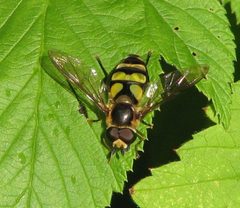
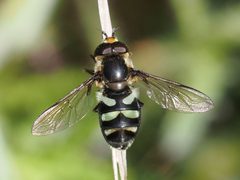
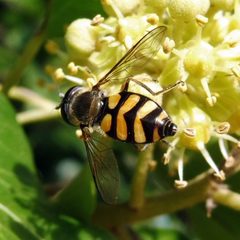
Didea is a Holarctic of hoverflies (Syrphidae) commonly known as lucent flies. are large-bodied, measuring 10–15 mm, with distinctive black and yellow coloration. The genus is notable for its late-season activity and predatory larvae that feed on arboreal aphids.
Pronunciation
How to pronounce Didea: //dɪˈdiːə//
These audio files are automatically generated. While they are not always 100% accurate, they are a good starting point.
Identification
Distinguished from other hoverfly by the combination of: large, broad, flat, and strongly emarginated with narrowly divided pale bands; black that is shining or subshining; anepisternum bare; upper and lower katepisternal hair patches broadly separated; meron bare; metepisternum and metasternum with some hairs; several hairs at the posteromedial angle of the hind . The moderately dipped R 4+5 and sparse lower calypter hairs provide additional diagnostic characters.
Images
Appearance
Large, robust hoverflies 10–15 mm in length. is broad, flat, and strongly emarginated with narrowly divided yellow, yellow-green, or pale green bands. is black, either shining or subshining. Notopleural callus and postsutural scutal margin may be obscurely yellowish in some specimens. is black with densely pale- areas on the upper half. scutellar fringe is short and sparse. R 4+5 is moderately dipped into r4+5. Lower calypter has very few fine, pale, erect, scattered hairs on the upper surface.
Habitat
Associated with arboreal environments, reflecting larval dependence on colonies in trees.
Distribution
Holarctic distribution, occurring in the Nearctic and Palearctic regions. Documented from North America (including Vermont), Denmark, Norway, and Sweden.
Seasonality
periods occur late in the year; are active primarily in late summer and autumn.
Ecological Role
Larvae are of arboreal aphids, contributing to natural of in tree .
Similar Taxa
- SyrphusSimilar black and yellow banded coloration, but Didea is distinguished by larger size, broader and more strongly emarginated , and specific thoracic hair patterns including bare meron and separated katepisternal hair patches.
- EpistropheShares yellow-banded abdominal pattern and Syrphini tribe membership, but Didea differs in abdominal shape (broad, flat, emarginated versus more rounded) and in details of thoracic pilosity and wing venation.
More Details
Species diversity
Eight are currently recognized: D. alneti (Fallén, 1817), D. fasciata Macquart, 1834, D. fuscipes Loew, 1863, D. intermedia Loew, 1854, D. poorva Ghorpadé, 1994, D. subalneti Claussen & Weipert, 2003, D. vockerothi Ghorpadé, 1994, and D. zhongtiaoshanensis Huo & Wang, 2014.