
Didea alneti
(Fallén, 1817)
Pronunciation
How to pronounce Didea alneti: /ˈdɪdiːə ælˈniːtaɪ/
These audio files are automatically generated. While they are not always 100% accurate, they are a good starting point.
Identification
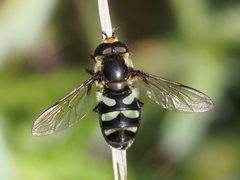
Distinguished from Didea fasciata by the male vertex, which is shorter and less narrow. Male tergite 4 shows wedge-shaped bars with front edge clearly separated from or only just touching the tergite margin on the line. The dark knob also aids identification.
Images
Appearance
Wing length 9.75–11.5 mm. mostly yellow. with at least the knob black or dark brown. Male vertex relatively short and less narrow than in Didea fasciata. Tergite 5 black, rarely with spots. Male tergite 4 with front edge of wedge-shaped bars clearly separated from the front margin of the tergite or just touching the front of the tergite on the line.
Habitat
Forest environments, particularly conifer forest and taiga, as well as Quercus woodland. Arboreal, descending to flowers.
Distribution
Palearctic: Europe east across Russia to the Pacific coast, Mongolia, Japan, and Korea. Nearctic: Alaska south to Colorado.
Seasonality
period mid-May to early September.
Diet
visit flowers of white umbellifers, yellow composites, Cirsium, Plantago, Potentilla, Rosa, Rubus idaeus, Salix, Sambucus ebulus, Valeriana officinalis, and Viburnum opulus. Larvae feed on aphids associated with Larix, Prunus, Salix, and Quercus.
Host Associations
- Larix - larval treelarvae feed on aphids associated with this tree
- Prunus - larval treelarvae feed on aphids associated with this tree
- Salix - nectar source and larval tree visit flowers; larvae feed on aphids associated with this tree
- Quercus - nectar source and larval tree visit flowers; larvae feed on aphids associated with this tree
- Cirsium - nectar source visit flowers
- Plantago - nectar source visit flowers
- Potentilla - nectar source visit flowers
- Rosa - nectar source visit flowers
- Rubus idaeus - nectar source visit flowers
- Sambucus ebulus - nectar source visit flowers
- Valeriana officinalis - nectar source visit flowers
- Viburnum opulus - nectar source visit flowers
Life Cycle
Larva arboreal, feeding on aphids. Male genitalia and larva figured by Dusek and Laska (1967).
Behavior
Arboreal, descending from trees to visit flowers. period spans mid-May to early September.
Ecological Role
Predatory larvae control on trees. contribute to pollination through flower visitation.
Human Relevance
agent through larval ; contributes to pollination.
Similar Taxa
- Didea fasciataDidea alneti differs in male vertex (shorter, less narrow) and male tergite 4 pattern (wedge-shaped bars with front edge separated from or just touching tergite margin)
More Details
Lectotype designation
Lectotype designated by Vockeroth (1983) in nomenclatural revision of Nearctic Syrphinae.
Morphological documentation
Male genitalia and larva illustrated by Dusek and Laska (1967).