
Microdon
Meigen, 1803
Ant Flies
Species Guides
14- Microdon abditus(Broad-footed Ant Fly)
- Microdon aurulentus(Golden-haired Ant Fly)
- Microdon cothurnatus(orange-legged ant fly)
- Microdon craigheadii(Large Metallic Ant Fly)
- Microdon fulgens(Rainbow Ant Fly)
- Microdon globosus(Globular Ant Fly)
- Microdon lanceolatus(Spear-horned Ant Fly)
- Microdon manitobensis(Greater Ant Fly)
- Microdon megalogaster(Black-bodied Ant Fly)
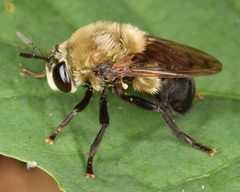
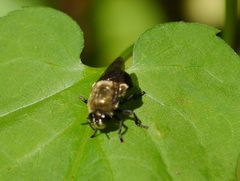
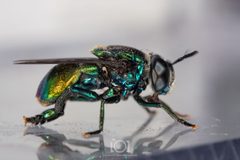
is a of hover flies (Syrphidae) in the Microdontinae, containing approximately 249 worldwide with greatest diversity in the tropics. The genus is notable for its myrmecophilous lifestyle: remain near colonies rather than visiting flowers, and larvae develop inside ant nests. Adults are morphologically atypical for hover flies—sedentary, robust, very hairy, and often -like in appearance. Larvae are dome-shaped, slug-like, and slow-moving, with on a peg-like . The genus has historically served as a catch-all for unrelated species, and ongoing taxonomic revision is expected to reassign many species to other genera.
Pronunciation
How to pronounce Microdon: //ˈmaɪ.krə.dɒn//
These audio files are automatically generated. While they are not always 100% accurate, they are a good starting point.
Identification
distinguished from other hover flies by: long (third segment nearly as long as or longer than first); scutellum with calcars; wing R4+5 with appendix; sedentary near nests rather than hovering at flowers. Some (e.g., M. myrmicae) have short wings and extra partial cross-vein. Larvae unmistakable—dome-shaped, slug-like, found only in ant nests. Separation from other Microdontinae requires examination of subtle morphological characters; the genus is currently under revision with many species expected to be reassigned.
Images
Habitat
Distribution
Worldwide distribution with 249 described ; greatest diversity in tropics. 30 species recorded from North America (many expected to be reassigned to other ). Present across Europe from France to Russia (excluding Mediterranean and far northern regions), western Britain, Thames Basin, New Forest. African species including Madagascar. Oriental and Australian/Oceanian regions. Neotropical fauna present.
Diet
Larvae feed on (, larvae, pupae) within nests; some may scavenge. of at least some species (e.g., M. myrmicae) are not known to feed.
Host Associations
- Myrmica - primary for multiple including M. myrmicae
- Myrmica scabrinodis - specific confirmed at study site for M. myrmicae
Life Cycle
laid in or near nests. First instar larva mobile, flatter, delicate, susceptible to and desiccation. Second and third instar larvae hemispherical, covered by tough , inhabiting ant nests. occurs within ant nest. live up to three weeks. specificity varies: some restricted to single ant species, others to related ant species or .
Behavior
sedentary and non-hovering, remaining near colonies rather than visiting flowers. Adults spend much time sitting on low vegetation. Larvae slow-moving, deep within ant nests. Larvae gain protection from ants through chemical mimicry and structural defenses including multi-layered , retractable , dome-shaped , and adhesive surface.
Ecological Role
Myrmecophile inhabiting nests; larval or scavenger of ant . Potential impact on ant colony . do not contribute to pollination.
Human Relevance
Of interest to entomologists studying myrmecophily and chemical mimicry. Some subject of genomic research (M. myrmicae sequenced). No known agricultural or economic importance; not used in due to specialized requirements.
Similar Taxa
- Other Microdontinae generaSimilar myrmecophilous lifestyle and larval ; distinguished by antennal structure, wing venation, and subtle morphological characters. Many currently in expected to be reassigned to other upon revision.
- Other Syrphidae differ in (sedentary, non-hovering, -associated vs. flower-visiting) and (long , robust hairy body). Larvae of other syrphids are typically maggot-shaped, not dome-shaped slug-like forms found in ant nests.
More Details
Taxonomic instability
has been used as a catch-all for various unrelated not placed in other genera. Many of the 30 North American species and others worldwide are expected to be transferred to other genera as revisionary work progresses. The genus is divided into six subgenera (Microdon sensu stricto, Chymophila, Dimeraspis, Megodon, Myiacerapis, Syrphipogon) plus five species groups and unplaced species in Microdon sensu lato.
Historical confusion
Larval originally led scientists to describe larvae as mollusks and scale insects due to their dome-shaped, slug-like appearance. This reflects the extreme morphological divergence associated with their specialized myrmecophilous lifestyle.
Genomic resources
myrmicae (Bog Fly) sequenced: 1,366.18 Mb assembly across 8 chromosomal pseudomolecules, 13,398 protein-coding genes annotated. This was split from M. mutabilis in 2002; larvae and are morphologically identical between the two, differing only in puparial characteristics.
Sources and further reading
- BugGuide
- Wikipedia
- iNaturalist taxon
- NCBI Taxonomy
- Catalogue of Life
- Syrphid Flies Are Pollinators, Too | Bug Squad
- Hover Flies Identified: Researchers Tackle 20,000 Syrphid Specimens in Illinois Collection
- hover flies - Entomology Today
- The genome sequence of the Bog Ant Fly, Microdon myrmicae Schönrogge et al., 2002.