
Microdon fulgens
Wiedemann, 1830
Rainbow Ant Fly
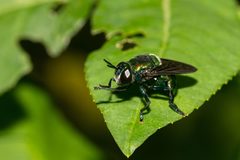
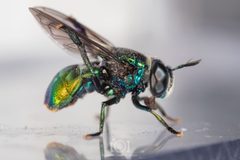
Microdon fulgens is a of syrphid fly (Syrphidae) in the Microdontinae. Members of the Microdon are commonly known as ant flies due to their unusual : larvae develop as within colonies. The specific epithet "fulgens" (Latin for shining or gleaming) likely refers to the 's appearance. As with other Microdon species, adults are , while larvae have a highly specialized ecological relationship with ants.
Pronunciation
How to pronounce Microdon fulgens: /ˈmaɪ.krə.dɒn ˈfʊl.dʒɛnz/
These audio files are automatically generated. While they are not always 100% accurate, they are a good starting point.
Identification
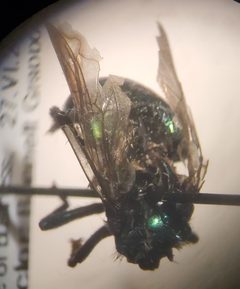
Microdon fulgens can be distinguished from other Microdon by its shining or metallic coloration, as suggested by its specific epithet. Within the Microdon, species identification typically requires examination of wing venation, facial characters, and abdominal patterning. The Microdontinae is characterized by with a distinctively broad, flattened and larvae that are hemispherical and legless, unlike the typical maggot form of other syrphid larvae.
Images
Distribution
The has been documented in North America based on specimen records. The 2023 Illinois Natural History Survey study of Syrphidae specifically examined Microdon aurulentus, a , suggesting that Microdon species including M. fulgens occur in the midwestern United States. iNaturalist records indicate observations primarily from the eastern and central United States.
Host Associations
- Formicidae - Larvae develop within colonies as ; specific ant for M. fulgens are not documented in available sources.
Life Cycle
Microdon have a highly specialized . Females deposit near nest entrances. Larvae are carried into nests by ants, where they feed on ant and possibly other nest materials. The larvae are hemispherical, legless, and superficially resemble slug larvae or even ant larvae themselves. occurs within the ant nest. This myrmecophilous (ant-associated) lifestyle is characteristic of the entire Microdontinae.
Behavior
are and visit flowers for nectar and pollen. Females exhibit specialized oviposition , depositing near nest entrances to facilitate larval entry into colonies. Unlike many syrphid flies, Microdon adults are not known to be strong fliers and may remain near their sites.
Ecological Role
function as in natural and agricultural . The larval stage represents a unique ecological interaction as an in colonies, where larvae may influence ant colony dynamics through or competition. This specialized relationship makes Microdon indicators of healthy ant and complex terrestrial ecosystems.
Human Relevance
Like other syrphid flies, contribute to pollination services. The has been studied for its unusual , contributing to understanding of myrmecophily and - relationships. No specific economic importance or pest status has been documented for M. fulgens.
Similar Taxa
- Microdon aurulentusSimilar size, distribution, and -associated ; distinguished by differences in abdominal coloration and patterning, with M. aurulentus typically showing more golden or coppery tones versus the shining appearance implied by M. fulgens.
- Microdon cothurnatusOverlapping range in eastern North America; M. cothurnatus has distinctive leg modifications in males and different facial markings.
- Microdon tristisSimilar - but typically darker in coloration with less metallic sheen; M. fulgens distinguished by brighter, more shining appearance.
More Details
Taxonomic note
Microdon fulgens was described by Wiedemann in 1830. The is currently placed in the subgenus Chymophila within Microdon. Some sources list Microdon fulgens as a synonym, though GBIF and other major databases currently treat it as an accepted species. The Microdontinae is considered one of the most morphologically and biologically distinct groups within Syrphidae due to its extreme larval specialization.
Conservation status
The 2023 Illinois Natural History Survey study highlighted that many syrphid , including some Microdon species, show evidence of range contractions or are species of potential conservation concern. However, specific conservation status for M. fulgens has not been formally assessed.