
Microdon tristis
Loew, 1864
Long-horned Ant Fly
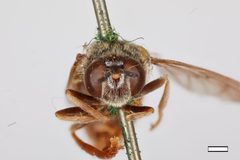
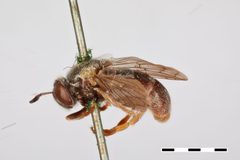
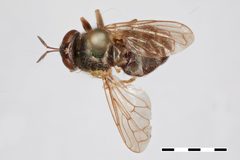
Microdon tristis is a syrphid fly in the Microdontinae, commonly known as the Long-horned Fly. The exhibits pronounced in wing venation and facial structure. are characterized by distinctive bronze-black coloration with greenish and purplish metallic reflections, and are associated with ant colonies as larvae.
Pronunciation
How to pronounce Microdon tristis: /ˈmiː.kroʊˌdɔn ˈtrɪs.tɪs/
These audio files are automatically generated. While they are not always 100% accurate, they are a good starting point.
Identification
Distinguished from other Microdon by the combination of: unusually flat and broadened below with narrow gray pollinose depressions; long ocellar triangle extending nearly to transverse depression; male with wing stump at or beyond middle of first (female before middle); with segment 3 almost 1.75× length of segment 2; segment 4 longer than first three combined. The greenish thoracic stripes and distinctive abdominal punctation pattern aid separation from . in wing venation (vein stump position) is diagnostic when specimens of both sexes are available.
Images
Distribution
Distribution records not available in consulted sources. described from North America based on taxonomic literature context.
Host Associations
- Formicidae - larval associateLarvae develop within colonies, though specific ant not documented for M. tristis. This association is characteristic of the Microdontinae.
Life Cycle
Complete with , larva, pupa, and stages. Larvae are in nests. Specific developmental details not documented.
Ecological Role
As larval in colonies, likely function as scavengers or within nest microhabitats. presumably though specific floral associations not documented.
Human Relevance
No documented economic or medical significance. Of interest to entomologists studying myrmecophilous fly associations.
Similar Taxa
- Other Microdon speciesShare general Microdontinae including reduced mouthparts and -associated larvae. Distinguished by specific wing venation patterns, abdominal segment proportions, and facial structure details described above.
- Other SyrphidaeMicrodontinae are distinguished from other hoverfly by their aberrant larval ( nest inquilinism) and morphological reductions including short and reduced mouthparts.
More Details
Taxonomic status
Catalogue of Life lists this as a synonym, though GBIF and NCBI treat it as accepted. Taxonomic resolution may require further verification.
Nomenclature
Authorship: Loew, 1864. Placed in Microdon, Microdontinae, tribe Microdontini.