
Microdontinae
Ant Flies and Allies
Genus Guides
4- Laetodon
- Microdon(Ant Flies)
- Mixogaster
- Rhopalosyrphus
A of hoverflies (Syrphidae) comprising approximately 400 , distinguished by their obligate myrmecophilous lifestyle. Larvae develop within nests as or scavengers of ant , exhibiting reduced body segmentation compared to other syrphid larvae. of many species remain near ant colonies rather than visiting flowers; some species lack functional mouthparts entirely. Several lack the spurious characteristic of other Syrphidae.
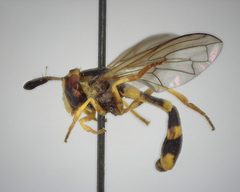
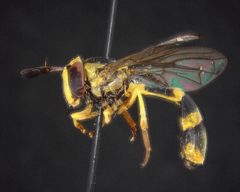
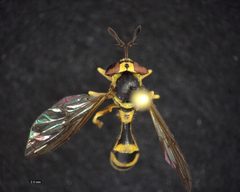
Pronunciation
How to pronounce Microdontinae: /ˌmaɪkroʊˈdɒntɪniː/
These audio files are automatically generated. While they are not always 100% accurate, they are a good starting point.
Identification
Larvae lack the pronounced body segmentation visible in other syrphid larvae. of several (Masarygus, Paragodon, Schizoceratomyia, Surimyia) lack the spurious —a diagnostic feature otherwise present throughout Syrphidae. Many exhibit Hymenoptera mimicry, particularly of (Meliponini) in the Neotropics.
Images
Habitat
nests (Formicidae); primarily subterranean or within ant-built structures. of some remain in close proximity to larval colonies rather than dispersing to typical adult syrphid .
Distribution
Worldwide distribution with records from: Nearctic, Neotropical (including disjunct northwestern and southeastern Brazilian in some ), Oriental (Peninsular Malaysia, China, Nepal, India), Palaearctic (first record from Iran representing southwestern Asian range extension), and other regions.
Diet
Larvae: or scavengers of within nests. : many do not feed; some lack functional mouthparts. Species of Stipomorpha have been observed visiting flowers.
Host Associations
- Formicidae - larval Obligate myrmecophily; larvae develop within nests. Documented associations with at least 69 ant across 24 and five (Ponerinae, Dolichoderinae, Formicinae, Myrmicinae, Pseudomyrmecinae). No known associations with dorylomorph ants (army ants and relatives).
- Mixogaster - basal with associationOne of the most basal Microdontinae , indicating associations evolved early in history.
Life Cycle
Complete with larval development confined to nests. Larvae are either scavengers or of ant . occurs within nests.
Behavior
Strong fidelity to colonies; of many remain near larval host nests rather than exhibiting typical hoverfly flower-visiting . Some Neotropical species are mimics of (Meliponini), potentially reducing risk near ant colonies.
Ecological Role
of within colonies; impacts on host ants unknown. Potential role in ant colony nutrient cycling as scavengers.
Similar Taxa
- other SyrphidaeMicrodontinae differ in larval ( nests vs. diverse aquatic or terrestrial habitats), reduced larval body segmentation, and frequent lack of flower-visiting . Several lack the spurious present in all other syrphids.
- other myrmecophilous DipteraMicrodontinae are distinguished by specific morphological reductions (larval segmentation, spurious absence) and documented phylogenetic distribution of associations throughout the .
Sources and further reading
- BugGuide
- Wikipedia
- iNaturalist taxon
- NCBI Taxonomy
- Catalogue of Life
- Taxonomic exploration of Neotropical Microdontinae (Diptera: Syrphidae) mimicking stingless bees
- Ubristes rex sp. n., a new microdontine hoverfly from northern Brazil (Diptera: Syrphidae: Microdontinae)
- Revision of the Neotropical species of the hoverfly genus Serichlamys Curran, 1925 (Diptera, Syrphidae, Microdontinae)
- Review and Phylogenetic Evaluation of Associations between Microdontinae (Diptera: Syrphidae) and Ants (Hymenoptera: Formicidae)
- Review of the Indian species of Metadon Reemer, 2013 (Diptera: Syrphidae: Microdontinae), with description of two new species
- A third species of the rarely collected Oriental hoverfly genus Furcantenna Cheng, 2008 (Diptera, Syrphidae, Microdontinae)
- The first southwest Asian record of the subfamily Microdontinae, and the description of a new species of Metadon Reemer from Iran (Diptera: Syrphidae)
- An unusual, but not unexpected, evolutionary step taken by syrphid flies: the first record of true primary parasitoidism of ants by Microdontinae
- Revision of the Oriental species of the hoverfly genus Paramixogaster Brunetti, 1923 (Diptera, Syrphidae, Microdontinae).