
Chalcosyrphus inarmatus
(Hunter, 1897)
Yellow-haired Leafwalker
Chalcosyrphus inarmatus, commonly known as the yellow-haired leafwalker, is an uncommon of syrphid fly distributed across northern North America. The species belongs to a whose larvae are typically associated with decaying wood rather than the common to many hover flies. are flower visitors that obtain nectar and pollen from floral resources.
Pronunciation
How to pronounce Chalcosyrphus inarmatus: //kælkoʊˈsɜrfəs ɪnˌɑrˈmeɪtəs//
These audio files are automatically generated. While they are not always 100% accurate, they are a good starting point.
Identification
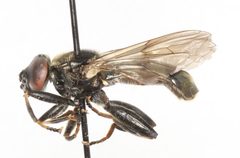
Distinguished from congeneric by its all-black coloration without metallic blue highlights (C. chalybeus) or red abdominal markings (C. piger). The enlarged, toothed metafemora are distinctive but may require close examination. Males can be recognized by . The species' association with dead wood and of repeatedly returning to tree trunks when disturbed may aid field identification.
Images
Habitat
Associated with forested environments, particularly areas with dead and decaying wood. have been observed on the trunks of recently wind-thrown trees. The ' 'leafwalker' and its behavioral tendency to land on and return to woody substrates suggests a close association with woodland .
Distribution
Northern North America, including Canada and the United States. Described from specimens collected across this broad northern range.
Diet
feed on pollen and nectar from flowers. Larvae are saprophagous, developing in decaying wood rather than preying upon aphids as in many other syrphid .
Host Associations
- Dead and decaying wood - larval development substrateLarvae are saprophagous in rotting wood
- Recently wind-thrown trees - foraging/oviposition site observed repeatedly returning to trunks of dead trees
Life Cycle
Complete . Larval stage develops in decaying wood as a saprophage. emerge and visit flowers for pollen and nectar. Specific details of and not documented.
Behavior
exhibit a distinctive of repeatedly returning to and landing on the trunks of dead trees when disturbed, suggesting a strong association with woody substrates. This behavior, combined with the robust body form, initially led to confusion with predatory robber flies (Asilidae: Laphriinae) that share similar ecological associations with dead wood. Adults are capable of hovering typical of syrphid flies. The function of the enlarged, spinose metafemora remains unclear; they may serve some predatory or grasping function, though adults are documented pollen feeders.
Ecological Role
contribute to pollination through flower visitation. Larvae function as decomposers in forest by processing decaying wood. The represents an ecological guild shift within Syrphidae, having abandoned the typical of the for a saprophagous lifestyle in woody substrates.
Human Relevance
Minor significance. The is uncommon and not economically important. May be encountered by entomologists and naturalists in forest , particularly near dead or downed timber. The distinctive appearance and can cause initial confusion with robber flies or other predatory insects.
Similar Taxa
- Chalcosyrphus chalybeusSimilar all-black coloration, but C. chalybeus exhibits distinctive steel blue metallic highlights absent in C. inarmatus
- Chalcosyrphus pigerSimilar robust build, but C. piger consistently shows red abdominal markings which C. inarmatus lacks
- Xylota spp.Related with similar wood-associated larvae; differ in gestalt and lack the distinctive enlarged metafemora of Chalcosyrphus
- Andrenosoma fulvicaudum and Laphria spp. (Asilidae)Robber flies with similar dead wood associations and robust black appearance; distinguished by predatory , different wing venation, and lack of syrphid-specific features
More Details
Taxonomic placement
Originally described by Hunter in 1897. The has been placed in the subgenus Xylotomima within Chalcosyrphus by some authorities.
Etymology
The specific epithet 'inarmatus' (Latin: unarmed) may refer to the lack of prominent armature or color patterns compared to related . The 'yellow-haired leafwalker' presumably refers to coloration and the species' habit of on leaves or woody vegetation.
Research needs
The function of the enlarged, ventrally spinose metafemora remains unexplained in the literature. Detailed studies, including larval development and , are lacking for this uncommon .