
Brachyopa
Meigen, 1822
Sapeaters
Species Guides
5- Brachyopa daeckei(black-tailed sapeater)
- Brachyopa flavescens(Yellow Sapeater)
- Brachyopa gigas(Giant Sapeater)
- Brachyopa notata(Black-banded Sapeater)
- Brachyopa vacua(Yellow-spotted Sapeater)
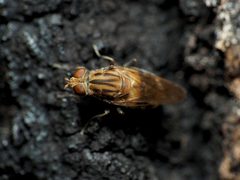
Brachyopa is a Holarctic of hoverflies (Syrphidae) characterized by atypical grey and brown coloration that distinguishes them from the typically bright-colored members of their . These flies are cryptic and easily overlooked among other dipteran families. Larvae develop under bark of dead wood in association with decaying sap, making the genus saproxylic. have been observed feeding on sap flows from wounded trees.


Pronunciation
How to pronounce Brachyopa: /brəˈkaɪəpə/
These audio files are automatically generated. While they are not always 100% accurate, they are a good starting point.
Identification
Distinguished from other hoverfly by dull grey-brown coloration rather than typical yellow-black patterning. -level identification often requires examination of male genitalia; for example, B. panzeri is distinguished from B. dorsata by male genital tract structure and diffuse wing browning. Larval identification requires examination of chaetotaxy patterns.
Images
Habitat
Saproxylic : larvae develop under bark of dead branches and trees in decaying sap. found at sap flows on recently cut or wounded tree trunks, particularly in wooded areas and urban parks with mature trees. Specific microhabitats are critical for persistence.
Distribution
Holarctic distribution. Documented across Europe including Greece (Northern Aegean Islands), Switzerland (Geneva), Ukraine, and multiple countries including Germany, Austria, Belgium, Denmark, France, Hungary, Luxembourg, Netherlands, Poland, Czech Republic, Romania, Russia, Slovakia, Sweden. GBIF records from Denmark, Norway, and Sweden. Eastern Mediterranean (Greece, Israel, Turkey) form a distinct biogeographic unit for some groups.
Seasonality
activity observed in May (B. panzeri in Geneva, 11.V.2009). Specific periods vary by and region.
Diet
feed on sap oozing from wounded or recently cut trees. Larval diet in decaying sap and associated microorganisms under bark; specific feeding mechanisms not fully described.
Host Associations
- Acer campestris - sap sourceObserved on field maple stump oozing sap in urban Geneva
- Tetrastichus brachyopae - endoparasitoidEulophid reared from B. panzeri in Ukraine
Life Cycle
Complete with , larval, pupal, and stages. Larvae develop under bark in decaying wood. Pupal stage duration has been determined for B. panzeri. COI barcodes have been used to link larval and adult stages in some .
Behavior
aggregate at sap flows on wounded trees. Cryptic and coloration make them easily overlooked. Some exceptionally rare and seldom encountered even in targeted surveys.
Ecological Role
Saproxylic decomposers contributing to nutrient cycling in dead wood . may function as when visiting flowers, though this is less documented than sap-feeding. Serve as for , specifically Tetrastichus brachyopae.
Human Relevance
Indicators of old-growth forest and saproxylic biodiversity. Conservation concern due to dependence on specific microhabitats (decaying sap under bark) that are threatened by forest management practices. Urban highlight value of city parks with mature trees for insect conservation.
Similar Taxa
- Other SyrphidaeBrachyopa are easily confused with non-syrphid flies due to their dull grey-brown coloration, unlike the typical bright yellow-black hoverfly pattern. Careful examination of wing venation and body structure required for -level identification.
- Brachyopa dorsataB. panzeri is morphologically similar and requires examination of male genital tract structure and wing edge browning patterns for reliable separation.
More Details
Taxonomic challenges
The is taxonomically difficult due to morphological similarity among . Male genitalia provide the most reliable diagnostic characters. Historical confusion exists in larval descriptions, requiring redescription based on reared specimens.
Conservation status
are exceptionally rare in collections and field observations, suggesting either genuine rarity or cryptic habits. Dependence on specific saproxylic microhabitats makes them vulnerable to loss from forestry practices and urban tree management.
Sources and further reading
- BugGuide
- Wikipedia
- GBIF taxonomy match
- iNaturalist taxon
- NCBI Taxonomy
- Catalogue of Life
- Brachyopa minima (Diptera: Syrphidae), a new species from Greece with notes on the biodiversity and conservation of the genus Brachyopa Meigen in the Northern Aegean Islands
- Unexpected Finding of Brachyopa panzeri Goffe, 1945 (Diptera, Syrphidae) within the Urban Environment of Geneva
- Description of the Puparium and Redescription of the Third-Instar Larva of Brachyopa panzeri (Diptera, Syrphidae) with New Data on its Biology