
Brachyopa daeckei
Johnson, 1917
black-tailed sapeater
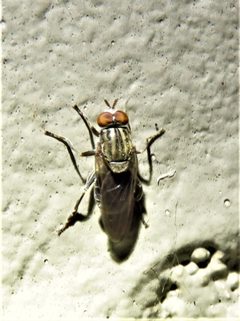
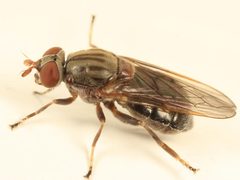
Brachyopa daeckei is a rare syrphid fly known from northeastern North America. measure 6–7 mm and exhibit distinctive coloration including a black with grayish pollen, ferruginous red , and a reddish-brown to black with white pile. The is poorly known, with only two observations recorded and larvae undescribed.
Pronunciation
How to pronounce Brachyopa daeckei: /brəˈkaɪəpə ˈdeɪki/
These audio files are automatically generated. While they are not always 100% accurate, they are a good starting point.
Identification
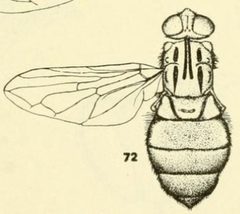
Distinguished from by the combination of: ferruginous red humeri; scutellum with diffuse reddish-brown basal half and conspicuous preapical depression; uniformly reddish brown to black with obscurely reddish apex on fifth segment; all front and last two segments of mid and hind tarsi black; and distinct lateral facial stripes reaching to antennal base. The male and specific wing venation (R4+5 section shorter than r-m) provide additional diagnostic characters. The black-tailed condition (tarsi) contrasts with the specific epithet reference to 'black-tailed sapeater'.
Images
Distribution
Northeastern North America. Specific localities not detailed in available sources.
Diet
feed on nectar and pollen from flowers. Larval diet unknown.
Life Cycle
Larvae undescribed for this . Other Brachyopa species have rat-tailed type larvae.
Behavior
hover in , a characteristic of Syrphidae. Adults observed on and around flowers.
Ecological Role
likely contribute to pollination through flower visitation. Ecological role of larvae unknown due to undescribed stages.
Similar Taxa
- Other Brachyopa speciesB. daeckei is distinguished by the specific combination of coloration on scutellum, , and , along with male and wing venation proportions.
More Details
Taxonomic status
Listed as synonym in Catalogue of Life but accepted in GBIF and NCBI. Johnson, 1917 is the original describer.
Knowledge gaps
Larvae remain undescribed. Only two observations recorded in iNaturalist as of source date. preferences, , and complete distribution poorly documented.