
Physoconops fronto
(Williston, 1885)
thick-headed fly
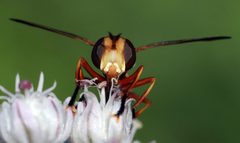
Physoconops fronto is a of thick-headed fly in the Conopidae. Like other conopids, it exhibits -mimicry in appearance and is known to parasitize bees and wasps. The species was described by Williston in 1885. Members of the Physoconops closely resemble potter wasps (Vespidae: Eumeninae) in their elongated and wing pigmentation patterns.


Pronunciation
How to pronounce Physoconops fronto: /faɪsoʊˈkoʊnɒps ˈfrɒntoʊ/
These audio files are automatically generated. While they are not always 100% accurate, they are a good starting point.
Identification
Physoconops fronto can be distinguished from similar by its large relative to body size, characteristic of the Conopidae. The Physoconops is recognized by -mimicking features including an elongated, and dark pigmentation along the wing margin that simulates the folded wing appearance of resting potter wasps. The name 'fronto' refers to the (front of the head), which is notably prominent. Specific identification to species level requires examination of chaetotaxy (bristle arrangement) on the head and , and comparison with .
Images
Host Associations
- bees - Female conopid flies attack bees in to deposit between abdominal segments
- wasps - Some Physoconops are known to parasitize solitary
Behavior
Female Physoconops fronto, like other conopids, are known to attack bees or in mid-air, forcibly depositing an between the host's abdominal segments. The larva develops as an internal , eventually killing the host after approximately 10-12 days. The larva then pupates within the hollowed of the host, with the fly emerging the following season.
Ecological Role
As a of bees and , P. fronto contributes to of its . The wasp-mimicry of may provide protection from while the flies forage for nectar at flowers.
Similar Taxa
- Physocephala tibialisAnother conopid with similar -mimicry and ; differs in specific bristle patterns and abdominal shape
- potter wasps (Eumeninae)Convergent appearance due to mimicry; true have two pairs of wings (forewings and hindwings) and a constricted waist, while conopids have only one pair of wings plus and lack a true wasp waist
Sources and further reading
- BugGuide
- Wikipedia
- GBIF taxonomy match
- iNaturalist taxon
- NCBI Taxonomy
- How a Student's 'A' Term Paper Went on to Win a Campuswide Competition | Bug Squad
- Super Crop Challenge #4 | Beetles In The Bush
- Forgotten Foto Friday: Centruroides vittatus | Beetles In The Bush
- Super Crop Challenge #9 | Beetles In The Bush
- Bug Eric: April 2011