
Physocephala marginata
(Say, 1823)
thick-headed fly
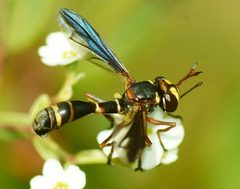
Physocephala marginata is a of thick-headed fly in the Conopidae. It is an internal of the solitary Anthophora abrupta. The larva develops inside the living , with occurring only after the bee's death. Like other conopid flies, are mimics that frequent flowers for nectar.
Pronunciation
How to pronounce Physocephala marginata: //ˌfaɪsoʊˈsɛfəla ˌmɑːrdʒɪˈneɪtə//
These audio files are automatically generated. While they are not always 100% accurate, they are a good starting point.
Identification
Members of Physocephala resemble potter wasps (Vespidae: Eumeninae) with an elongated, constricted creating a ' waist' appearance. The is disproportionately large relative to the body, giving the its 'thick-headed flies.' The front margin of the wing is heavily pigmented, mimicking the longitudinal fold in a potter wasp's wings at rest. Specific diagnostic features for P. marginata require close examination and are not detailed in available sources.
Images
Distribution
Records indicate presence in Vermont, USA, and other parts of the United States. The Anthophora abrupta occurs in eastern North America, suggesting a corresponding range for this .
Diet
feed on nectar from flowers. Larvae are internal that consume the tissues of the Anthophora abrupta.
Host Associations
- Anthophora abrupta - Internal ; larva develops inside living and pupates after host death
Life Cycle
The female fly intercepts the in and forcibly deposits an between the bee's abdominal segments. The larva hatches and feeds internally as a , eventually killing the host. occurs within the dead host's , with the fly emerging the following season.
Behavior
are known to lurk among flowers, where they seek bees in addition to feeding on nectar. Females engage in aerial pursuit of host bees, sometimes forcing them to the ground to oviposit.
Ecological Role
Acts as a regulating of its Anthophora abrupta. As a flower visitor, may contribute to pollination while foraging for nectar.
Similar Taxa
- Physocephala tibialisAnother Physocephala that parasitizes bumble bees; similar -mimic appearance and
- Physoconops speciesRelated conopid with similar potter wasp mimicry and parasitic lifestyle
More Details
Wasp mimicry
The Conopidae exhibits pronounced mimicry of Hymenoptera, particularly potter wasps. This mimicry likely provides protection from while the flies are active at flowers.