
Physocephala burgessi
(Williston, 1882)
thick-headed fly
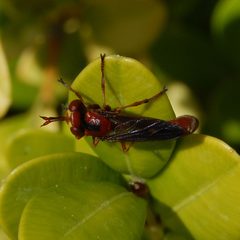
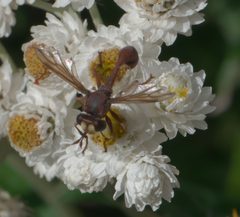
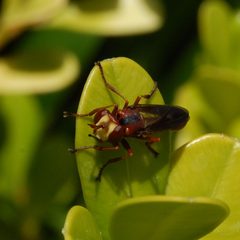
Physocephala burgessi is a of thick-headed fly in the Conopidae. Like other members of its , it is a of bees and . The species exhibits wasp mimicry in appearance and , including an elongated resembling a wasp waist and dark pigmentation along the front wing margin that mimics the folded wing appearance of potter wasps at rest.
Pronunciation
How to pronounce Physocephala burgessi: //ˌfaɪsoʊˈsɛfələ ˈbɜːrdʒəsi//
These audio files are automatically generated. While they are not always 100% accurate, they are a good starting point.
Identification
Resembles potter wasps (Vespidae: Eumeninae) in general form. Distinguished from other Conopidae by features of the Physocephala: large relative to body size, beak-like mouthparts adapted for nectar feeding, elongated creating a '-waisted' silhouette, and dark pigmentation along the wing margin. Specific identification to P. burgessi requires examination of morphological details not described in available sources.
Images
Habitat
Observed in association with flowering plants, particularly in prairie and grassland where bees and are active.
Distribution
North America. Specific range details not documented in available sources; inferred to occur in regions where suitable hymenopteran and prairie overlap.
Diet
feed on nectar from flowers. Larvae are internal , feeding on the tissues of hymenopterans.
Life Cycle
Females intercept bees or in , forcibly depositing an between the 's abdominal segments. The larva hatches and develops internally, killing the host in approximately 10–12 days. occurs within the hollow of the dead host. timing varies by climate; temperate likely produce one annually, with southern populations potentially multivoltine.
Behavior
Females actively pursue in mid-air, sometimes forcing them to the ground during the attack. frequent flowers for nectar, where they also seek host encounters. Exhibits aggressive pursuit toward hymenopteran prey.
Ecological Role
of bees and , contributing to of hymenopteran and . May influence and wasp dynamics in prairie .
Human Relevance
No direct human relevance documented. Indirectly relevant as a natural enemy of ; may reduce local . Not a pest of humans or domestic animals.
Similar Taxa
- Physocephala tibialisSimilar size (12–15 mm), -mimicking appearance, and ; distinguished by specific morphological characters and associations
- Zodion speciesAlso Conopidae with similar , but smaller (5–7 mm), less pronounced mimicry, and attack solitary wasps rather than bees
- Physoconops speciesRelated conopid with similar potter wasp mimicry and