
Psychoda sigma
Kincaid, 1899
moth fly
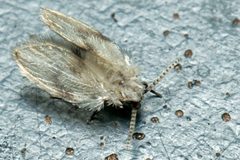
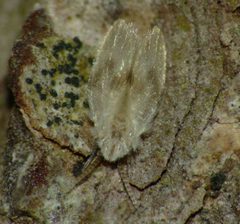
Psychoda sigma is a small moth fly in the Psychodidae, commonly known simply as 'moth fly.' First described by Kincaid in 1899, this belongs to the subgenus Tinearia within the Psychoda. Moth flies are characterized by their dense body pilosity and small size, typically measuring only a few millimeters in length. The species has been documented in North America and parts of Europe, including Belgium and Denmark.
Pronunciation
How to pronounce Psychoda sigma: //saɪˈkoʊdə ˈsɪɡmə//
These audio files are automatically generated. While they are not always 100% accurate, they are a good starting point.
Identification
Distinguished from other Psychoda by subtle morphological characters, primarily in genitalic structures. The subgenus Tinearia placement separates it from other Psychoda subgenera. Distinguished from other moth fly by the combination of: dense body pilosity, broad wings held roof-like at rest, and long . Accurate species identification requires examination of male genitalia under magnification. Separated from the common P. alternata by specific genitalic differences.
Images
Appearance
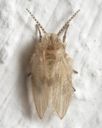
Tiny fly with dense pilosity covering the body, giving a fuzzy or -like appearance. Body length approximately 1-2 mm. Wings are broad relative to body size and held roof-like over the when at rest. are long and (bead-like). Coloration typically dull grayish-brown. The dense hairiness is a distinctive feature visible even at low magnification.
Habitat
Associated with moist, organic-rich environments. Has been observed in wooded areas with mesic upland forest conditions. attracted to artificial light sources at night. Larval presumed to include decaying organic matter and moist substrates, though specific requirements for this are not well documented.
Distribution
Recorded from North America (type locality) and Europe. Documented occurrences include Belgium (Brussels-Capital Region, Flemish Region, Walloon Region) and Denmark. Distribution likely broader but underrecorded due to small size and identification difficulty.
Seasonality
have been observed in late April in Missouri, USA, suggesting spring activity. Light trap captures indicate activity. Full seasonal pattern not well documented.
Behavior
, attracted to mercury vapor lamps. are weak fliers with a characteristic fluttering pattern. When disturbed, individuals may seek shelter on nearby surfaces. The dense pilosity may serve to repel water in humid microhabitats.
Ecological Role
Larvae likely contribute to decomposition of organic matter in moist . serve as prey for small and may participate in nutrient transfer between aquatic or semi-aquatic systems and terrestrial .
Human Relevance
Occasionally encountered at outdoor lighting fixtures. Not known to be a significant pest or . Small size and harmless nature make it of interest primarily to entomologists and naturalists.
Similar Taxa
- Psychoda alternataMost common North American Psychoda ; distinguished by male genitalic structure and subtle differences in wing venation
- Other Psychodidae genera (e.g., Clogmia, Telmatoscopus)Share -like appearance but differ in wing shape, structure, and body proportions; Psychoda has broader wings and more uniform dense pilosity
- Chironomidae (non-biting midges)Similar small size and attraction to lights, but lack dense body pilosity and have more slender, delicate bodies with longer legs relative to body size
More Details
Taxonomic placement
Placed in subgenus Tinearia within Psychoda; three of this subgenus are recorded from North America
Photographic documentation
High-quality macro photography at 5X magnification has been used to document this , revealing diagnostic pilosity patterns
Identification challenges
-level identification in Psychoda requires microscopic examination of male terminalia; females and stages are difficult or impossible to identify to species