
Psychodidae
Moth flies, Drain flies, Sink flies, Filter flies, Sewer gnats, Sand flies
Subfamily Guides
4- Bruchomyiinae
- Phlebotominae(sand flies)
- Psychodinae(Moth Flies)
- Trichomyiinae
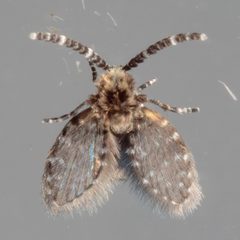
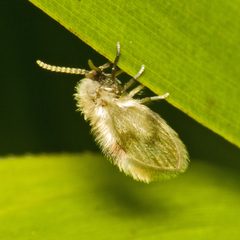
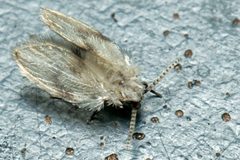
is a large of true flies comprising over 2,600 described worldwide, with highest diversity in humid tropical regions. Members exhibit distinctive short, hairy bodies and wings that create a -like appearance. The family encompasses two ecologically divergent groups: non-biting moth flies that inhabit moist, decaying organic matter and plumbing systems, and blood-feeding sand flies ( Phlebotominae) that serve as .
Pronunciation
How to pronounce Psychodidae: /saɪˈkɒdɪdiː/
These audio files are automatically generated. While they are not always 100% accurate, they are a good starting point.
Identification
are distinguished by densely pilose bodies and wings, small size (typically 2–5 mm), and wings held roof-like over the body at rest. Wings display reduced venation with parallel longitudinal and few crossveins—the most elementary wing structure among Diptera. Larvae are elongated, cylindrical, and segmented with annulated bodies; they lack and possess a terminal for breathing. The Phlebotominae (sand flies) can be separated from Psychodinae by blood-feeding mouthparts and more slender body form.
Images
Habitat
Aquatic to semi-terrestrial environments including plumbing drains, sewage systems, bathroom sinks, septic tanks, filter beds at sewage treatment facilities, compost heaps, birdbaths, clogged rain gutters, and moist tropical forest floors with decomposing organic matter.
Distribution
Worldwide distribution with greatest in humid tropical regions. Documented from North America, South America, Europe, Africa, Asia, Madagascar and neighboring islands (Seychelles, Comores), and the Middle East including Yemen.
Seasonality
typically and most active in evening hours; attracted to lights after dark. In Yemen, active season extends May through November with bimodal peaks. Indoor populations may persist year-round in suitable microhabitats.
Diet
Larvae feed on , bacteria, fungi, microbes, and decaying organic matter in gelatinous films and sludge. of most do not feed; members of Phlebotominae are , feeding on vertebrate blood.
Life Cycle
Complete with four instars. hatch in 32–48 hours. Larval stage lasts 9–15 days depending on , temperature, and environment; larvae breathe through a and must reach the water surface regularly. Pupal stage lasts 20–40 hours, spent submerged near the water surface. emerge and live approximately 20 days, breeding once within hours of . Females deposit 30–200 eggs in loose clusters just above water lines in moist substrates.
Behavior
are erratic, weak fliers often observed or running rapidly rather than flying. They orient around lights and may be attracted to light and odors. Some larvae use attachment disks to secure themselves to surfaces.
Ecological Role
Larvae function as decomposers in aquatic and semi-terrestrial , processing organic matter in sludge and biofilms. In sewage treatment systems, they are considered beneficial organisms that help prevent drain clogs by consuming hair and sludge waste. Phlebotominae serve as for Leishmania , transmitting cutaneous and visceral .
Human Relevance
Non-biting are nuisance pests in homes, particularly bathrooms and kitchens, where they indicate moist organic buildup in drains. They do not bite or transmit , though Clogmia albipunctata has been recorded as an opportunistic agent of myiasis. Inhalation of insect fragments may trigger asthma. Sand flies (Phlebotominae) are significant medical responsible for transmitting , with estimated 0.7–1.2 million cases of cutaneous leishmaniasis and 22,000 deaths from visceral leishmaniasis globally.
Similar Taxa
- ScatopsidaeBoth contain minute dark flies associated with decaying organic matter; Scatopsidae (minute black scavenger flies) lack the dense pilosity and roof-like wing posture of .
- ChironomidaeNon-biting midges share aquatic larval and small size; lack hairy bodies and have more elaborate wing venation with distinct wing posture.
- CeratopogonidaeBiting midges overlap in size and some ecological roles; have more prominent wing venation and lack the characteristic -like pilosity, while larvae possess absent in .
Misconceptions
The '' is applied inconsistently: in some countries it refers to Phlebotominae (), while elsewhere it denotes horse flies (Tabanidae) or no-see-ums (Ceratopogonidae). Moth flies are frequently mistaken for actual due to their hairy appearance, but they are true flies with single wing pairs. They do not cause clogged drains—rather, they exploit existing organic buildup—and they are not known to carry human despite their association with sewage systems.
Sources and further reading
- BugGuide
- Wikipedia
- GBIF taxonomy match
- iNaturalist taxon
- NCBI Taxonomy
- Catalogue of Life
- Bug Eric: Moth Flies
- New Sand Fly Species and Potential Vector of Leishmaniasis Discovered by Navy Entomologists
- Itty bitty tiny little flies | Beetles In The Bush
- Bug Eric: Compost Insects
- The Best of 2019 on Entomology Today
- flies | Beetles In The Bush | Page 6
- Systematic and palaeoecology of Psychodidae (Insecta: Diptera) from Miocene Mexican amber
- Phlebotomine Sandflies (Diptera: psychodidae) in Different Localities of Dhamar Governorate,Yemen. دراسة الذباب الرملي (Diptera: psychodidae) في مناطق مختلفة من محافظة ذمار، اليمن.
- Contribution à l’inventaire des Phlébotomes (Psychodidae – Phlebotominae) de Madagascar et des îles voisines
- Phlebotomine sand flies (Diptera: Psychodidae, Phlebotominae) fauna in Unaí, State of Minas Gerais, Brazil.