
Clogmia albipunctata
(Williston, 1893)
Bathroom Moth Fly, Drain Fly, Filter Fly, Bathroom Moth Midge, Sewer Gnat, Sink Fly
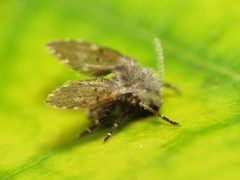
Clogmia albipunctata is a small, non- moth fly in the Psychodidae with worldwide distribution in tropical and temperate regions. measure 2.2–2.5 mm in body length with distinctive broad, hairy wings marked by black spots near the middle and white spots along the edges. The is strongly associated with human dwellings, particularly bathrooms and kitchens, where larvae develop in moist, decaying organic matter within drains. Adults are weak fliers that rarely move from walls and live approximately 12 days. Though historically reported as a myiasis agent, critical review of evidence finds no incontestable documentation of true ; reported cases typically involve facultative of pre-existing cavities with decaying material rather than tissue invasion.


Pronunciation
How to pronounce Clogmia albipunctata: /ˈklɒɡ.mi.ə ˌæl.baɪˌpʌŋkˈtɑː.tə/
These audio files are automatically generated. While they are not always 100% accurate, they are a good starting point.
Identification
are distinguished from other small flies by the combination of: broad, hairy wings held roof-like over the body giving a -like appearance; distinctive wing pattern of paired black spots centrally and white marginal spots; longer than the with white hairs; and legs with white rings at tibial and metatarsal tips. Similar moth flies in Psychodidae lack this specific spot pattern. Distinguishable from sand flies ( Phlebotominae) by non-biting mouthparts and wing venation. Larvae identified by presence of 26 chitinous plates, dense black setae, and conical caudal siphon.
Images
Habitat
Larval consists of aquatic or subaquatic environments with moist, decaying organic matter: sink drains, shower drains, floor drains, sewer drains, sewage treatment plants, septic tanks, sump pump pits, elevator pits, compost heaps, clogged rain gutters, birdbaths, plant pots, swamps, and forest decaying matter. occur in same vicinity, commonly found perched on walls near breeding sites. Strongly associated with anthropogenic structures; can breed continuously indoors during winter months while adults spread outdoors during temperate seasons.
Distribution
with worldwide distribution in tropical and temperate areas. Documented occurrences include: Asia (Japan, India, China, Palestine, Taiwan), Europe (Belgium, Croatia, Germany, Austria, Greece, Slovenia, Slovakia, Switzerland, UK, France), Africa (Egypt, Morocco), and North America (USA). Common in urban and suburban environments globally.
Seasonality
active year-round in indoor environments; continuous breeding possible indoors during winter months. Adults more active in evening hours and attracted to lights after dark. Outdoor more prevalent during temperate seasons.
Diet
Larvae are copro-saprophagous, feeding on , fungi, microbes, and decaying organic matter in gelatinous biofilms lining drains. sustain themselves by drinking water or consuming flower nectar.
Life Cycle
Holometabolous with four stages: , larva (four instars), pupa, and . Eggs hatch in 32–48 hours. Larval development spans approximately 9–15 days to 18 days across four instars. Pupal stage lasts 5 days to 20–40 hours depending on conditions. Adult lifespan approximately 12 days. Total egg-to-adult period averages 27±5 days. Female lays 200–300 eggs lifetime. Temperature and humidity accelerate development; laboratory rearing at 25°C produced adult in 11 days.
Behavior
are weak fliers with limited movement, spending most of their life stationary on walls. Both adults and larvae possess water-repellent hairs that protect against drowning and water-borne toxins. Adults are non-biting and non-. Attracted to light after dark. Larvae remain in moist organic substrate.
Ecological Role
Important decomposer of organic matter in aquatic and decaying environments, particularly in sewage treatment systems where larvae are considered beneficial organisms. Potential mechanical for bacteria: documented carriage of 45 bacterial including nosocomial , with location-specific microbial dominated by environmental bacteria (Pseudomonas, Ralstonia) but also including potential clinical (Mycobacterium, Acinetobacter baumannii, Providencia, Nocardia). Can plug pipes and cause food or water through bacterial . Airborne from dead may cause allergic respiratory reactions.
Human Relevance
Common household nuisance pest associated with drains; indicate presence of moist organic matter in plumbing. Not harmful to public health in the sense of biting or transmission, though mechanical bacterial transmission is possible. Control requires elimination of larval food source through thorough mechanical drain cleaning for at least three weeks; chemical treatments largely ineffective due to water-repellent hairs. Monitoring possible with jar traps, adhesive tape, or light traps. Historically reported but critically unverified as cause of true myiasis; single documented case of facultative infestation in dental residual root with decaying food material.
Similar Taxa
- Psychoda spp.Other moth flies in same ; lack distinctive black-and-white spotted wing pattern of C. albipunctata
- Phlebotominae (sand flies)Biting relatives in Psychodidae; possess piercing mouthparts, different wing venation, and are of
- Drosophila spp. (fruit flies)Different (Drosophilidae) with large red , smoother bodies, and attraction to fresh fruit rather than decaying matter in drains
Misconceptions
Widely reported in literature as causative agent of human myiasis (urogenital, intestinal, nasopharyngeal, oral), but critical review of 51 publications found no incontestable epidemiological, entomological, or clinical evidence confirming true myiasis. Most cases lacked documentation, proper larval isolation from lesions, or clinical . The ' non-, saprophagous makes tissue invasion unlikely; reported cases likely represent misinterpretation, , or delusional parasitosis. Single verified case involved facultative of pre-existing cavity (dental residual root) with decaying organic matter, not tissue feeding.
More Details
Scientific name etymology
epithet 'albipunctata' derives from Latin 'albus' (white) and 'punctatus' (dotted), referring to the white spots on wings and appendages.
Pest control challenges
Protected by extremely fine water-repellent hairs, and larvae are difficult to drown and unaffected by most water-borne toxins including bleach. Boiling water has little effect on adults; are highly to chemical and thermal assault and can withstand dehydration. High-pressure drain cleaning and mechanical removal of organic deposits are most effective controls.
Sources and further reading
- BugGuide
- Wikipedia
- iNaturalist taxon
- NCBI Taxonomy
- Catalogue of Life
- Bug Eric: Moth Flies
- Clogmia albipunctata (Nematocera; Psychodidae) as the Etiologic Agent of Myiasis: True or False?
- A Rare Case of Human Residual Root Myiasis Caused by Clogmia Albipunctata Larvae(Diptera: Psychodidae)
- Distinct microbial communities of drain flies (Clogmia albipunctata) across sites with differing human influence
- Breaking anterior-posterior symmetry in the moth fly Clogmia albipunctata.