
Psychoda
Latreille, 1797
moth fly, drain fly, filter fly
Species Guides
2- Psychoda alternata(trickling filter fly)
- Psychoda sigma(moth fly)
Psychoda is a large of moth flies ( Psychodidae) containing over 400 described . These tiny, -like flies are characterized by their dense body hair, broad wings held roof-like over the body, and long . They are commonly associated with moist, decaying organic matter and are frequently encountered in sewage systems, drains, and bathrooms where they can become nuisance pests. The genus has worldwide distribution with records from North America, Europe, the Middle East, and South America.
Pronunciation
How to pronounce Psychoda: //saɪˈkoʊdə//
These audio files are automatically generated. While they are not always 100% accurate, they are a good starting point.
Identification
Psychoda can be distinguished from other moth fly by the combination of: dense body pilosity, long with cylindrical or bead-like segments, and wing venation patterns. The subgenus Tinearia is recognized by specific antennal characteristics. -level identification requires microscopic examination of genitalia and other subtle morphological features. Psychoda alternata is the most common North American species. Similar genera in Psychodidae include Clogmia and Telmatoscopus, which may be distinguished by differences in wing venation, antennal structure, and body proportions.
Images
Appearance
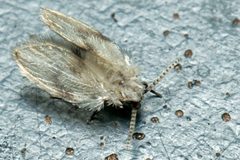
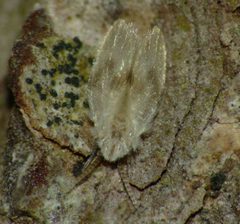
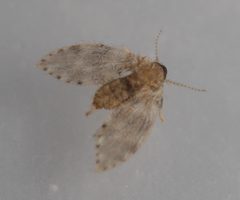
Tiny flies, typically 2-5 mm in length, with a distinctly -like appearance. Body densely covered in setae (hairs), giving a fuzzy or furry appearance. Wings broad, oval to rounded, held roof-like over the body when at rest. long, often longer than the body, with bead-like or cylindrical segments. Coloration generally drab: gray, brown, or tan. large relative to size. Legs relatively short and stout.
Habitat
Moist, decaying organic matter including sewage filter beds, drains, trickling filters, percolating filters, and biofilms. Larvae develop in sludge and microbial films in aquatic or semi-aquatic environments with low oxygen conditions. frequently found resting on walls near breeding sites, particularly in bathrooms, kitchens, and around floor drains.
Distribution
Worldwide distribution. Documented from North America (including Florida, Kansas, Missouri), Brazil, Norway, Croatia, Mallorca (Spain), Iraq, Belgium, Denmark, Sweden, Colombia, and Turkey.
Seasonality
active year-round in suitable indoor environments; outdoor show increased activity in spring and summer. In temperate regions, adults may be observed during warm winter days when temperatures allow.
Diet
Larvae feed on microbial films, organic detritus, and sludge in sewage systems and moist decaying matter. Some may exhibit predatory on small in these .
Host Associations
- Homo sapiens - accidental Psychoda albipennis has been documented causing rare urogenital myiasis in humans; larvae found in urinary tract
Life Cycle
laid in moist organic matter or biofilms. Larvae pass through four instars, developing in sludge, microbial films, or decaying organic substrate. occurs within the same , often in a silken cocoon. emerge as weak fliers with relatively short lifespan. Some may exhibit .
Behavior
Weak, fluttering pattern; often appear to hop rather than fly. Strongly phototactic, attracted to light. Adults rest on vertical surfaces near breeding sites. Larvae can tolerate low-oxygen and high-organic-load environments. Adults do not bite humans.
Ecological Role
Decomposers in sewage treatment systems and natural aquatic with organic enrichment. Integral components of biofilm . Some may contribute to control of snail or parasitic larvae in filter systems.
Human Relevance
Nuisance pests in bathrooms, kitchens, and buildings with floor drains or sewage system access. Indicators of plumbing issues or standing water. Rarely implicated in myiasis (Psychoda albipennis documented in single case of urinary myiasis in Turkey). Generally harmless but can be persistent indoor pests when breeding sites are established.
Similar Taxa
- ClogmiaAlso moth flies in Psychodidae; distinguished by differences in wing venation and antennal structure
- TelmatoscopusSimilar preferences and appearance; separated by genitalia and subtle wing characteristics
More Details
Taxonomic complexity
The contains over 400 described with ongoing taxonomic revision; exist (e.g., related groups requiring genetic or detailed morphological analysis for separation)
Sewage system ecology
Important components of biological wastewater treatment processes; larval feeding activity contributes to breakdown of organic matter in filter beds
Sources and further reading
- BugGuide
- Wikipedia
- GBIF taxonomy match
- iNaturalist taxon
- NCBI Taxonomy
- Catalogue of Life
- Itty bitty tiny little flies | Beetles In The Bush
- Bug Eric: New Year’s Insects and Spiders
- Bug Eric: 2026
- Drain Fly Psychoda spp. (Insecta: Diptera: Psychodidae)
- A rare urogenital myiasis caused by Psychoda albipennis: a case report