
Psychoda alternata
Say, 1824
trickling filter fly, drain fly, moth fly
Psychoda alternata is a small moth fly ( Psychodidae) native to North America that has become through human transport. are about 4 mm long with broad, hairy wings held rooflike over the body. The is strongly associated with wastewater treatment systems, where larvae feed on microbial biofilms in trickling filters and percolating beds. It has also been documented as an emerging nuisance pest in potted plants at commercial nurseries. Adults are short-lived, non-feeding, and primarily active in subdued light.
Pronunciation
How to pronounce Psychoda alternata: /ˈsaɪkoʊdə ælˈtɜrnətə/
These audio files are automatically generated. While they are not always 100% accurate, they are a good starting point.
Identification
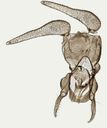
Distinguished from other small flies by -like appearance with densely hairy wings held in rooflike posture over body. Separated from other Psychoda by specific antennal and genital characters requiring microscopic examination; P. alternata is the most common North American species in the . Differs from non-biting midges (Chironomidae) by wing posture and hair ; from other moth flies by combination of size, wing venation, and association. In laboratory and field settings, molecular or detailed morphological analysis may be required for definitive species identification within the P. alternata .
Images
Appearance
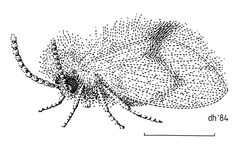
females approximately 4 mm in length; males slightly smaller. Wings broad and held at an angle away from body, densely clothed with tuft-like hairlike along , giving a mottled grey appearance. Wing muscles relatively weak; adults mostly run or hop rather than fly, occasionally making short . Body and wings covered with fine setae, contributing to -like appearance. Larvae slender, whitish, cream or pale brown, with well-developed capsule bearing strong , 11 body segments, and siphons on the hindermost two segments. Pupae yellowish brown to brown with pair of ear-like respiratory processes on end.
Habitat
Larval consists of moist, organically rich substrates: gelatinous microbial films in trickling filter sewage treatment systems, percolating filter beds, drain leaks, and sewage effluent seeps. Also documented in soil of potted plants at commercial nurseries, ditches, and sludges of decaying organic matter. remain near sites, rarely dispersing more than a few meters. Larvae typically occupy the upper 2.5 cm of substrate, occasionally deeper in drier material.
Distribution
Native to North America; now . Established in Europe (including Britain by 2000, Norway by 2011, Spain by 2016), western Asia (Iraq by 2013, Croatia by 2013), and South America (Brazil by 2006). Distribution closely tied to human wastewater infrastructure and horticultural trade.
Seasonality
Continuous breeding year-round in indoor heated filter systems; outdoor show seasonal peaks with overlapping . In temperate regions, larval stage overwinters in . patterns show alternating peaks corresponding to generation , with large and small outbursts alternating due to for food resources in warmer months.
Diet
Larvae feed on microbial film consisting of bacteria and fungi growing on organic substrates in filter systems and decaying matter. are non-feeding.
Life Cycle
laid singly or in gelatinous batches of 15-40 (up to 100 per female) in moist larval ; translucent, under 1 mm diameter. Incubation approximately 2 days at 21°C. Larval development 14-21 days at 22°C, typically 15 days at 21°C; larvae overwinter in in temperate regions. occurs in upper substrate layers or on surface; pupal stage lasts 1-2 days. lifespan 3-5 days without food or water, 10-14 days with water only, 30-60 days with food and water. Total time approximately 17-24 days under favorable conditions. Overlapping generations with continuous breeding possible in stable indoor environments.
Behavior
primarily run or hop due to weak wing muscles; limited to short distances. Strongly photophobic: active in subdued light, inactive in bright light. Adults seldom disperse far from site. Males emerge before females and survive only a few days; unmated females may live up to a week. In laboratory conditions, adults show highest activity in dim lighting conditions.
Ecological Role
Decomposer and in wastewater treatment systems, contributing to breakdown of organic matter in microbial biofilms. Serves as food source for other organisms in filter , including predatory insects and mites. Potential indicator organism for wastewater treatment process conditions. In nursery settings, large emergences may indicate excessive organic matter in potting media.
Human Relevance
Important organism in biological wastewater treatment, where larval feeding on microbial biofilms contributes to system function. Can become nuisance pest when emerge in large numbers from potted plants at commercial nurseries, potentially affecting neighboring residences. Occasionally encountered in domestic drains. Not a biting pest; adults do not feed. Used as laboratory model for studying dipteran and competition dynamics.
Similar Taxa
- Psychoda phalaenoidesSimilar -like appearance and preference; requires microscopic examination of genitalia and antennal structure for separation.
- Psychoda cinereaOverlaps in distribution and ; distinguished by subtle differences in wing venation and body scaling.
- Clogmia albipunctataAnother drain fly with similar and ; differs in wing pattern with distinct pale spots on dark background.
- Telmatoscopus adamsiSimilar size and in filter systems; separated by wing shape and antennal segmentation.
Misconceptions
Often mistaken for biting midges or mosquitoes due to small size and association with moist ; are non-biting and non-feeding. 'drain fly' sometimes applied to multiple unrelated moth fly , leading to confusion about specific identity and .
More Details
Laboratory Rearing
Successfully reared on digested sewage sludge with 65-80% survival to adulthood; development time 14-21 days at 22°C.
Population Dynamics
Exhibits characteristic alternating peaks in outdoor filters due to between overlapping , with rapid cycles in warm months depleting food resources for successive cohorts.
Nuisance Potential
First documented case of nursery nuisance occurred in Florida, 2014, with emerging from potted plants and affecting neighboring residences; indicates potential for economic impact in horticultural settings.
Sources and further reading
- BugGuide
- Wikipedia
- GBIF taxonomy match
- iNaturalist taxon
- NCBI Taxonomy
- Catalogue of Life
- Itty bitty tiny little flies | Beetles In The Bush
- Bug Eric: New Year’s Insects and Spiders
- Bug Eric: 2026
- NUISANCE PSYCHODA ALTERNATA (DIPTERA: PSYCHODIDAE) DEVELOPING IN POTTED PLANTS AT A COMMERCIAL NURSERY
- Rearing Psychoda alternata (Diptera: Psychodidae) in the Laboratory on Digested Sewage Sludge, with Some Observations on Its Biology1
- Aspects of the Biology of Psychoda alternata (Say.) and P. severini parthenogenetica Tonn. (Diptera) in a Percolating Filter
- Materials for a study in animal competition