
Clogmia
Enderlein, 1937
drain flies, moth flies, filter flies, bathroom flies
Species Guides
1- Clogmia albipunctata(Bathroom Moth Fly)
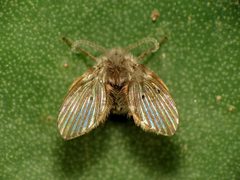
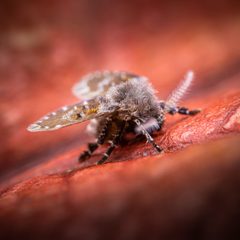
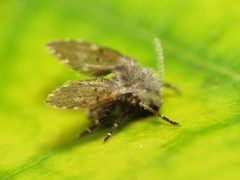
Clogmia is a of small, non-biting drain flies in the Psychodidae. are 3–5 mm long with fuzzy, -like appearance due to dense hairs on wings and body. The genus includes the C. albipunctata, commonly known as the filter fly or bathroom fly, which frequently inhabits human dwellings. These flies are primarily nuisance pests associated with moist, decaying organic matter. Larvae play a documented role in sewage treatment as decomposers.
Pronunciation
How to pronounce Clogmia: //ˈklɒɡ.mi.ə//
These audio files are automatically generated. While they are not always 100% accurate, they are a good starting point.
Identification
Distinguished from other Psychodidae by combination of wing venation, antennal structure, and genital ; specific identification requires examination of terminalia. Separated from sand flies (Phlebotominae) by non- mouthparts and lack of biting . Differs from other drain fly (Psychoda, Telmatoscopus) by details of wing pattern and antennal segmentation. C. albipunctata specifically identified by wing pattern with paired black spots and white markings, plus 13-segmented . Larvae distinguished by 26 chitinous plates and cone-shaped caudal siphon with or without fixing hooks.
Images
Appearance
are small dipterans, 3–5 mm in length, with broad, hairy wings held roof-like over the body. Dense covering of setae on wings and body creates a fuzzy, -like appearance. Wings typically bear pattern of gray-brown hairs with dark spots and white markings; in C. albipunctata, two black spots occur on each wing with additional white spots. are long and multi-segmented (13 nodes in C. albipunctata). Body coloration ranges from grayish to grayish-brown. Larvae are elongated, 7–8 mm at maturity, grayish dorsally and white ventrally, with dark brown and tail, 26 saddle-shaped chitinous plates, dense long black backward-pointing setae, and a prominent cone-shaped caudal respiratory siphon.
Habitat
Aquatic and subaquatic environments with decaying or moist organic matter. Natural include swamps, forest decaying matter, and wetland margins. exploit sewer drains, sewage treatment plants, septic tanks, filter beds, clogged rain gutters, compost heaps, birdbaths, plant pots, and bathroom/kitchen drains. Can complete entire within drain pipes regardless of general cleanliness. remain near breeding sites due to low flying ability.
Distribution
distribution with records across tropical, subtropical, and temperate regions. Documented in Asia (China, India, Japan, Taiwan, Palestine), Europe (UK, France, Belgium, Germany, Austria, Switzerland, Greece, Croatia, Slovenia, Slovakia), Africa (Egypt, Morocco, Cape Verde), and North and South America (USA, Colombia). GBIF records include Colombia (Chocó, Cundinamarca), Denmark, Norway, Sweden, and USA (Vermont).
Seasonality
active year-round in heated buildings; outdoor activity during temperate seasons with continuous indoor breeding during winter months. Evening activity peak; attracted to lights after dark.
Diet
Larvae are copro-saprophagous, feeding on , fungi, microbes, and decaying organic matter in gelatinous films lining drains and aquatic substrates. do not feed; mouthparts are non- and non-functional for biting.
Life Cycle
Holometabolous with four stages: , larva (four instars), pupa, and . Eggs are transparent, less than 1 mm, laid in loose clusters of 30–200 in sludge around sewage and drainage areas; hatch in 32–48 hours. Larval stage lasts approximately 9–18 days; pupal stage approximately 5 days. Total development from egg to adult: 20–40 hours for pupal alone, or approximately 27 ± 5 days complete cycle. Rising temperature and humidity accelerate development. Rearing at 25°C produced adult emergence in 11 days in one documented case.
Behavior
Non-biting and non-. Low ability; stay near breeding sites and are most active in evening hours. Attracted to lights after dark, facilitating entry into buildings through open doors and windows. Adults possess water-repellent hairs that protect from water-borne toxins. Larvae respire through caudal siphon, remaining in organic films. Mature larvae may leave feeding substrate to seek sites, occasionally appearing as "worms" in sinks or showers.
Ecological Role
Important decomposers of organic matter in aquatic and subaquatic environments. Larvae are considered beneficial organisms in municipal sewage treatment, contributing to breakdown of organic waste. Potential mechanical of bacteria; have been documented carrying 45 bacterial associated with nosocomial . Dead adults and shed may form respiratory allergens causing allergic rhinitis and asthma.
Human Relevance
Primarily nuisance pest due to presence in bathrooms, kitchens, and other indoor spaces. Beneficial role in sewage treatment infrastructure. Documented, though debated, association with human myiasis; one confirmed case of oral myiasis in residual tooth root. Mechanical potential for hospital-acquired bacterial . Source of indoor allergens from accumulated dead specimens and .
Similar Taxa
- PsychodaSimilar drain fly in Psychodidae; differs in wing pattern details and antennal segmentation
- TelmatoscopusAnother psychodine drain fly ; separation requires examination of genitalia and wing venation
- PhlebotomusSand flies in Phlebotominae; distinguished by blood-feeding , biting mouthparts, and medical importance as
Misconceptions
Despite "filter fly" and association with drains, Clogmia does not cause clogged drains and may actually help prevent blockages through larval feeding activity. Role as etiologic agent of human myiasis is disputed; many reported cases lack confirmed isolation of larvae from actual , with larvae more likely representing of urine or rather than true tissue .
More Details
Taxonomic note
Clogmia Enderlein, 1937 is an accepted in Psychodidae with five described including C. albipunctata (Williston, 1893), C. bidentata Ježek, 2004, C. caboverdeana (Ježek & Harten, 1996), C. fuscipennis (Tonnoir, 1920), and C. poncianicola (Satchell, 1953). Most biological information derives from C. albipunctata.
Medical controversy
A 2022 critical review in Diagnostics questioned C. albipunctata's role as a true myiasis agent, finding that 57% of 21 reported "urogenital myiasis" cases involved larvae in urine with normal clinical examinations and no imaging evidence of . The authors concluded that misinterpretation is common and accurate requires isolation of larvae from corresponding with proper clinical and entomological documentation.
Sources and further reading
- BugGuide
- Wikipedia
- GBIF taxonomy match
- iNaturalist taxon
- NCBI Taxonomy
- Catalogue of Life
- Bug Eric: Moth Flies
- Clogmia albipunctata (Nematocera; Psychodidae) as the Etiologic Agent of Myiasis: True or False?
- A Rare Case of Human Residual Root Myiasis Caused by Clogmia Albipunctata Larvae(Diptera: Psychodidae)
- Breaking anterior-posterior symmetry in the moth fly Clogmia albipunctata.