
Liriomyza commelinae
(Frost, 1931)
Liriomyza commelinae is a leaf-mining fly in the Agromyzidae, first described by Frost in 1931. The is associated with Commelina plants (dayflowers) and has been studied primarily for its role in supporting that also attack the economically important pest . Research indicates it experiences high mortality rates (over 96%) from parasitoids, predatory ants, and competition-related factors. Its distribution includes Florida, the broader Neotropical region, and parts of Brazil.
Pronunciation
How to pronounce Liriomyza commelinae: /ˌlɪriˈɒmɪzə ˌkɒməˈlɪni/
These audio files are automatically generated. While they are not always 100% accurate, they are a good starting point.
Images
Habitat
Agricultural and natural environments where Commelina (dayflowers) occur. The species has been studied in plant patches at spatial ranging from individual leaves and stems to meter-scale .
Distribution
Florida, USA; Neotropical region. Specific Brazilian state records include Pará (BR-PA), Rio de Janeiro (BR-RJ), and Santa Catarina (BR-SC).
Diet
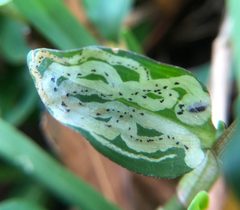
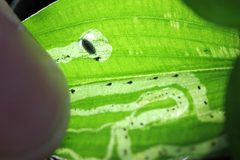
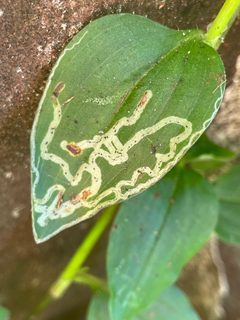
Larval feeding creates leaf mines between upper and lower leaf surfaces of plants. Specific feeding habits on Commelina inferred from species epithet and host plant association.
Host Associations
- Commelina species - primary plantDayflowers; specific not explicitly named in sources but implied by species epithet 'commelinae'
- Liriomyza huidobrensis - facilitates shared Serves as alternative for that can subsequently attack this economically important pest
Life Cycle
to larva development occurs within leaf mines. time and specific developmental stages not detailed in available sources.
Behavior
Larvae burrow through leaves creating tunnels or 'mines' between leaf surfaces, impairing plant . Serves as a host for , enabling natural enemy maintenance when target pest are scarce.
Ecological Role
Alternative supporting for of agricultural pests. High natural mortality (96.3%) from parasitoids, predatory ants (notably Crematogaster brevispinosa), and competition-related factors contributes to . Parasitoid mortality averages 41.2% and shows positive -dependence at meter- level.
Human Relevance
Studied as a potential component of strategies. reared on L. commelinae can successfully parasitize the , suggesting value for maintaining natural enemy in agricultural systems.
Similar Taxa
- Liriomyza huidobrensisClosely related leafminer ; L. commelinae serves as alternative for of L. huidobrensis, indicating ecological and taxonomic proximity
- Liriomyza sativaeRelated leafminer with which L. huidobrensis competes; similar and leaf-mining habit
Sources and further reading
- BugGuide
- Wikipedia
- GBIF taxonomy match
- iNaturalist taxon
- NCBI Taxonomy
- Catalogue of Life
- Liriomyza miserabilis Lonsdale dorsal | Entomology Research Museum
- Primary Type List | Entomology Research Museum
- Publications | Entomology Research Museum
- Liriomyza huidobrensis Archives - Entomology Today
- Predicting Shifts in the Range of Invasive Insect Species in the Face of Climate Change
- A Case for Preservation: Maintaining Insect Collections in Developing Countries
- Liriomyza commelinae(Diptera: Agromyzidae): an alternative host for parasitoids of the leafminer pestLiriomyza huidobrensis
- Variation of density‐dependence with spatial scale in the leaf‐mining fly Liriomyza commelinae (Diptera: Agromyzidae)