
Archytas metallicus
(Robineau-Desvoidy, 1830)
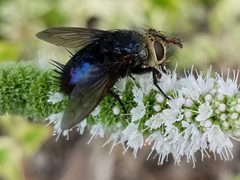
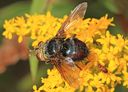
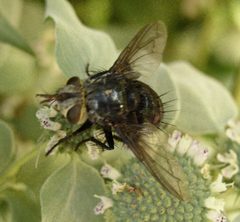
Archytas metallicus is a of tachinid fly ( Tachinidae) distributed across North America. As a member of the Tachininae , it belongs to a group of flies whose larvae develop inside other insects. The species has been documented visiting flowers of Ericameria nauseosa (rubber rabbitbrush), where it occurs alongside other and flower-visiting insects. It is one of numerous Archytas species in the Nearctic region, many of which remain poorly studied in terms of their specific relationships and ecological details.
Pronunciation
How to pronounce Archytas metallicus: /ˈɑːrkɪtæs məˈtælɪkəs/
These audio files are automatically generated. While they are not always 100% accurate, they are a good starting point.
Identification
Archytas metallicus can be distinguished from similar large tachinids by its combination of metallic coloration and dense bristling. It may be confused with Juriniopsis adusta, another large, black, bristly tachinid that co-occurs on the same flower ; reliable separation requires examination of specific bristle patterns, facial features, and male terminalia. Within the Archytas, identification to level typically requires detailed morphological study including chaetotaxy (bristle arrangement) and genitalia dissection. The genus Archytas as a whole is distinguished from related tachinine genera by features of the facial ridge and postabdomen structure.
Images
Habitat
Documented from montane and submontane in western North America, particularly in coniferous forest zones and adjacent open areas. Has been observed in burned and recovering woodland areas, as well as in canyon and plateau environments. Associated with flowering vegetation in late summer and early fall, particularly rubber rabbitbrush (Ericameria nauseosa) in subalpine and montane zones.
Distribution
North America. Documented from the southwestern United States including Arizona (Kaibab Plateau), Utah, Nevada, and New Mexico. The GBIF distribution records confirm presence across North America broadly, though specific collection records are concentrated in western montane regions.
Seasonality
activity recorded in late summer and early fall (September). The appears on flowers during this period, coinciding with bloom of late-season composites such as Ericameria nauseosa. This timing is later than many related tachinid species, which may show peak activity in mid-summer.
Behavior
have been observed visiting flowers, specifically the inflorescences of Ericameria nauseosa (rubber rabbitbrush), where they may feed on nectar or possibly pollen. The is active during daylight hours and has been documented in large numbers on flowering plants, suggesting concentrated foraging . activity has not been reported. Larval behavior is unknown but presumed to involve of other insects based on -level .
Ecological Role
function as flower visitors in late-season montane , potentially contributing to pollination of composite flowers. As a tachinid fly, the larval stage likely acts as a of other insects, though specific remain undocumented for this . The species is part of the diverse tachinid that utilizes late-blooming rabbitbrush in western North American montane .
Human Relevance
No direct economic or medical significance documented. The is of interest to entomologists studying tachinid diversity and flower-visiting fly in western North America. Its occurrence in post-fire may make it relevant for studies of recovery and insect reassembly.
Similar Taxa
- Juriniopsis adustaAnother large, black, bristly tachinid that co-occurs on Ericameria nauseosa flowers; distinguished by non-metallic coloration and different facial/oral features
- Adejeania vexatrixLarge orange bristle fly in same but readily distinguished by bright orange coloration versus metallic black of A. metallicus
- Other Archytas speciesNumerous congeneric in North America require detailed morphological examination for reliable separation, particularly of male genitalia and bristle patterns
More Details
Taxonomic history
Originally described by Robineau-Desvoidy in 1830. The Archytas is a large and taxonomically challenging group within Tachinidae, with many descriptions based on limited material and requiring modern revision.
Field observation notes
In September 2025, specimens tentatively identified as A. metallicus or Juriniopsis adusta were observed in enormous numbers on rubber rabbitbrush flowers on the Kaibab Plateau, Arizona, notably in the absence of the cerambycid beetles (Crossidius spp.) typically associated with this plant. This suggests the fly may be a consistent late-season visitor to this plant across its range.