
Juriniopsis adusta
(Wulp, 1888)
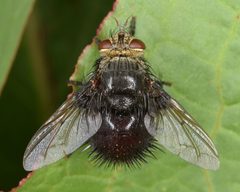
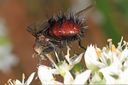
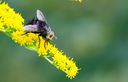
Juriniopsis adusta is a of tachinid bristle fly found across North America. It is a common and widespread member of the Tachinidae, frequently observed visiting flowers of Ericameria nauseosa (rubber rabbitbrush) in the western United States. The species is one of the most frequently encountered tachinids in this , often appearing in large numbers during late summer and early fall. Its broad distribution spans from southern Canada through the United States and into Mexico, Central America, and northern South America.
Pronunciation
How to pronounce Juriniopsis adusta: //d͡ʒʊˌɹɪniˈɒpsɪs əˈdʌstə//
These audio files are automatically generated. While they are not always 100% accurate, they are a good starting point.
Identification
Juriniopsis adusta is a large, black, bristly tachinid fly. It can be distinguished from similar large black tachinids such as Archytas metallicus by subtle morphological differences in bristle arrangement and body proportions; accurate identification typically requires examination of diagnostic characters. The is notably bristlier in appearance than many .
Images
Habitat
Open including grasslands, shrublands, and woodland edges where its plants and nectar sources occur. Frequently found in areas with abundant Ericameria nauseosa (rubber rabbitbrush) in the western United States.
Distribution
Eastern half of the United States (throughout), southern parts of eastern Canada (primarily around Toronto), Mexico, Central America, and northern South America (primarily Colombia and Ecuador).
Seasonality
Active primarily in late summer and early fall (August–September in the northern hemisphere), with peak activity coinciding with flowering of rabbitbrush and other late-season composites.
Diet
have been observed feeding on nectar from flowers of Ericameria nauseosa (rubber rabbitbrush). Larval diet unknown; as a tachinid, larvae are presumably of other insects, but specific have not been documented.
Behavior
are flower visitors, frequently observed in large on blooming rabbitbrush. Attracted to ultraviolet light.
Ecological Role
serve as of late-season composite flowers. Presumed larval , though specific relationships and ecological impacts are undocumented.
Similar Taxa
- Archytas metallicusSimilar large, black, bristly tachinid fly frequently found on the same flowers; distinguished by subtle morphological differences requiring close examination.
- Adejeania vexatrixAnother large, orange-brown bristle fly in the same found in similar western on rabbitbrush flowers; differs in coloration.