
Archytas marmoratus
(Townsend, 1915)
marbled bristle fly
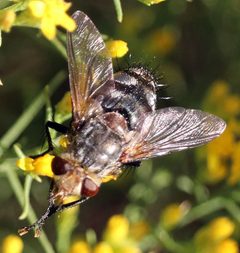
Archytas marmoratus is a tachinid bristle fly and member of the marmoratus group. It is a larval-pupal of noctuid caterpillars, particularly the corn earworm (Helicoverpa zea) and fall armyworm (Spodoptera frugiperda). In 1986, it was successfully employed in programs against the fall armyworm. The species has been used in inundative release programs, achieving rates exceeding 90% in isolated corn fields.


Pronunciation
How to pronounce Archytas marmoratus: /ˈɑːrkɪtæs ˌmɑːrməˈreɪtəs/
These audio files are automatically generated. While they are not always 100% accurate, they are a good starting point.
Images
Habitat
Agricultural and natural where caterpillars occur; frequent flowers and foliage.
Distribution
Widespread in the Americas: United States, Cuba, Haiti, Jamaica, Puerto Rico, Barbados, Grenada, Guadeloupe, Montserrat, Virgin Islands, Trinidad and Tobago, Rica, El Salvador, Guatemala, Honduras, Mexico, Nicaragua, Panama, Argentina, Bolivia, Brazil, Chile, Colombia, Ecuador, Guyana, Peru, Suriname, and Venezuela.
Diet
feed on nectar and honeydew; larvae develop as internal within caterpillars.
Host Associations
- Helicoverpa zea - primary (larval-pupal )corn earworm; major agricultural pest of corn, cotton, and other crops
- Spodoptera frugiperda - primary (larval-pupal )fall armyworm; major agricultural pest of corn and other grasses
- Spodoptera exigua - (larval-pupal )beet armyworm; quality affected by plant
Life Cycle
laid on or near caterpillar; larva enters host and develops internally; mature larva emerges from host during late instar or prepupal stage and burrows into soil to pupate; emerges from . No observed in the —development continues above threshold temperature regardless of host diapause state.
Behavior
Exhibits , with females depositing multiple on or near a single ; among larvae typically results in only one emerging per host. Adults are and visit flowers for nectar. Shows strong host-finding capability, with rates positively correlated with host up to 0.8 km from release sites.
Ecological Role
agent; of agricultural pest caterpillars. Contributes to natural suppression of noctuid in corn and other crop systems.
Human Relevance
Used in programs against corn earworm and fall armyworm. Inundative releases of approximately 1500 females per hectare per week have achieved rates of 42% in non-isolated fields and over 90% in isolated fields of -stage corn. Represents a potential component of strategies.
Similar Taxa
- Archytas metallicuscongeneric tachinid with similar size and general appearance; both found on flowers of Ericameria nauseosa and may co-occur in southwestern North America
- Juriniopsis adustasimilar large, black, bristly tachinine appearance; both observed on rabbitbrush flowers in western North America and require careful examination for separation
- Lespezia spp.congeneric or closely related tachinid of Spodoptera frugiperda; co-occur as parasitoids of fall armyworm in Puerto Rico and other regions
Sources and further reading
- BugGuide
- Wikipedia
- GBIF taxonomy match
- iNaturalist taxon
- NCBI Taxonomy
- Catalogue of Life
- Bug Eric: Beetles from Bones
- Bug Eric: What's in Dat Scat?
- Bug Eric: Review: Diving Beetles of the World
- Bug Eric: More Beetles from Bones
- Oecanthidae | Beetles In The Bush
- Bug Eric: April 2016
- The Biology of Archytas marmoratus (Townsend)1,2,3,4
- Archytas marmoratus (Diptera: Tachinidae) Survival in Diapausing and Nondiapausing Strains of Helicoverpa zea (Lepidoptera: Noctuidae)
- Superparasitism and Intraspecific Competition by the Solitary Larval-Pupal Parasitoid Archytas marmoratus (Diptera: Tachinidae)
- Survival of Archytas marmoratus (Diptera: Tachinidae) in Helicoverpa zea and Spodoptera frugiperda (Lepidoptera: Noctuidae) at Low Temperatures and Short Days
- Inundative Release of Archytas marmoratus (Diptera: Tachinidae) Against the Corn Earworm and Fall Armyworm (Lepidoptera: Noctuidae) in Whorl-Stage Corn
- Integration of Inherited Sterility and a Parasitoid, Archytas marmoratus (Diptera: Tachinidae), for Managing Helicoverpa zea (Lepidoptera: Noctuidae): Acceptability and Suitability of Hosts
- Influence of Helicoverpa zea (Lepidoptera: Noctuidae) Age During the Last Instar on Rates of Parasitization by the Larval-Pupal Parasitoid, Archytas marmoratus (Diptera: Tachinidae)
- Potential of the Combined Use of Inherited Sterility and a Parasitoid, Archytas marmoratus (Diptera: Tachinidae), for Managing Helicoverpa zea (Lepidoptera: Noctuidae)
- Seasonal Distribution, Response to Host Developmental Stage, and Screened-Cage Performance of Archytas marmoratus (Diptera: Tachinidae) and Ophion flavidus (Hymenoptera: Ichneumonidae) on Spodoptera frugiperda (Lepidoptera: Noctuidae)
- Effects of linear furanocoumarins on the herbivore Spodoptera exigua and the parasitoid Archytas marmoratus: host quality and parasitoid success
- Host Corn Earworm (Lepidoptera: Noctuidae) Reared on Meridic Diet Containing Silks from a Resistant Corn Genotype on Archytas marmoratus (Diptera: Tachinidae) and Ichneumon promissorius (Hymenoptera: Ichneumonidae)
- Primer registro de Archytas marmoratus y Voria ruralis (Diptera: Tachinidae) y sus niveles de parasitoidismo en dos lepidópteros plaga en Coahuila, México
- ARCHYTAS MARMORATUS (TOWNSEND) AND LESPESIA SPP. (DIPTERA: TACHINIDAE) PARASITOIDS OF SPODOPTERA FRUGIPERDA (J.E. SMITH) (LEPIDOPTERA: NOCTUIDAE) ON ZEA MAYS L. IN SOUTHERN PUERTO RICO