
Prosena siberita
(Fabricius, 1775)
Prosena siberita is a tachinid fly with a distinctive elongated that folds beneath the body. feed on nectar and pose no threat to humans or plants. The was introduced to the United States in 1925 as a agent targeting scarab beetle larvae, particularly the Japanese beetle. It has established across a broad geographic range spanning Eurasia, Australasia, and North America.
Pronunciation
How to pronounce Prosena siberita: /proˈsɛna sɪˈbɛrɪta/
These audio files are automatically generated. While they are not always 100% accurate, they are a good starting point.
Identification
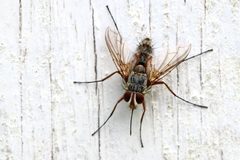
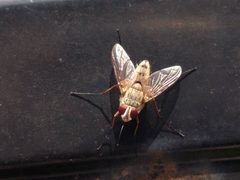
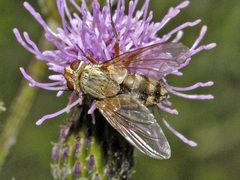
Distinguished from other tachinid flies by the exceptionally long, slender that folds under the body—longer than the height. Reduced palpi separate it from similar . in abdominal coloration (testaceous males versus fuscous, grey-dusted females) aids identification. Grey-dusted body with yellowish thoracic hairs and reddish provide additional diagnostic characters.
Images
Appearance
Body length 7.5–10.5 mm. Overall coloration grey-dusted, fuscous to testaceous. testaceous in males, fuscous and densely grey-dusted in females. with yellowish hairs. extremely long and slender, exceeding height when extended, folded hinged beneath body at rest. Palpi highly reduced. reddish-brown, bare. reddish. Wings hyaline with yellowish-brown coloration at base.
Habitat
frequent flowering plants in open . Larval habitat determined by scarab beetle distribution, primarily in soil where scarab larvae develop.
Distribution
Native range: most of Europe, Central Asia, Japan, Mongolia, China, Russia, Transcaucasia, India, Indonesia, Malaysia, Myanmar, Nepal, Philippines, Ryukyu Islands, Sri Lanka, Taiwan, Australia, New Caledonia. Introduced and established in the United States (first released in New Jersey in 1925).
Seasonality
—produces one per year.
Diet
feed on nectar from flowers of Clematis gouriana, Gnaphalium , Tecoma castanifolia, Seseli libanotis, Patrinia scabiosifolia, and other plants. Larvae are , developing inside scarab beetle larvae.
Host Associations
- Popillia japonica - Japanese beetle; primary target of U.S. introduction
- Adoretus - scarab
- Anomala - scarab
- Leucopholis - scarab
- Sericini - scarab tribe
- Melolonthini - scarab tribe
- Anomalini - scarab tribe
Life Cycle
. emerge and feed on nectar. Females parasitize scarab beetle larvae by depositing or larvae on or near . Tachinid larvae develop internally within host larvae, eventually killing them. occurs within host remains or in soil.
Behavior
are harmless nectar feeders. The long is kept folded beneath the body when not in use. No defensive reported; adults do not bite or sting.
Ecological Role
agent of scarab beetle pests. As a , regulates of soil-dwelling scarab larvae that damage plant roots. Contributes to pollination as nectar feeding transfers pollen between flowers.
Human Relevance
Intentionally introduced to the United States in 1925 for of the Japanese beetle (Popillia japonica), a major agricultural and horticultural pest. pose no threat to humans, crops, or livestock. Not known to cause myiasis or other medical issues.
Similar Taxa
- Other TachinidaeLack the extremely elongated, body-folded and highly reduced palpi characteristic of Prosena siberita
- Prosena other speciesWithin , P. siberita distinguished by specific combinations of coloration, body size, and distribution; precise differentiation requires examination
More Details
Biological Control History
The 1925 New Jersey introduction represents one of the earliest deliberate tachinid releases for pest management in North America. Establishment success has been documented, though efficacy in Japanese beetle suppression relative to other control measures is not well quantified in available sources.